
BoundWrite AI
FEATURED PRODUCT CASE STUDY
AI-assisted quote intake, enrichment, underwriting and bound policy management for insurance.
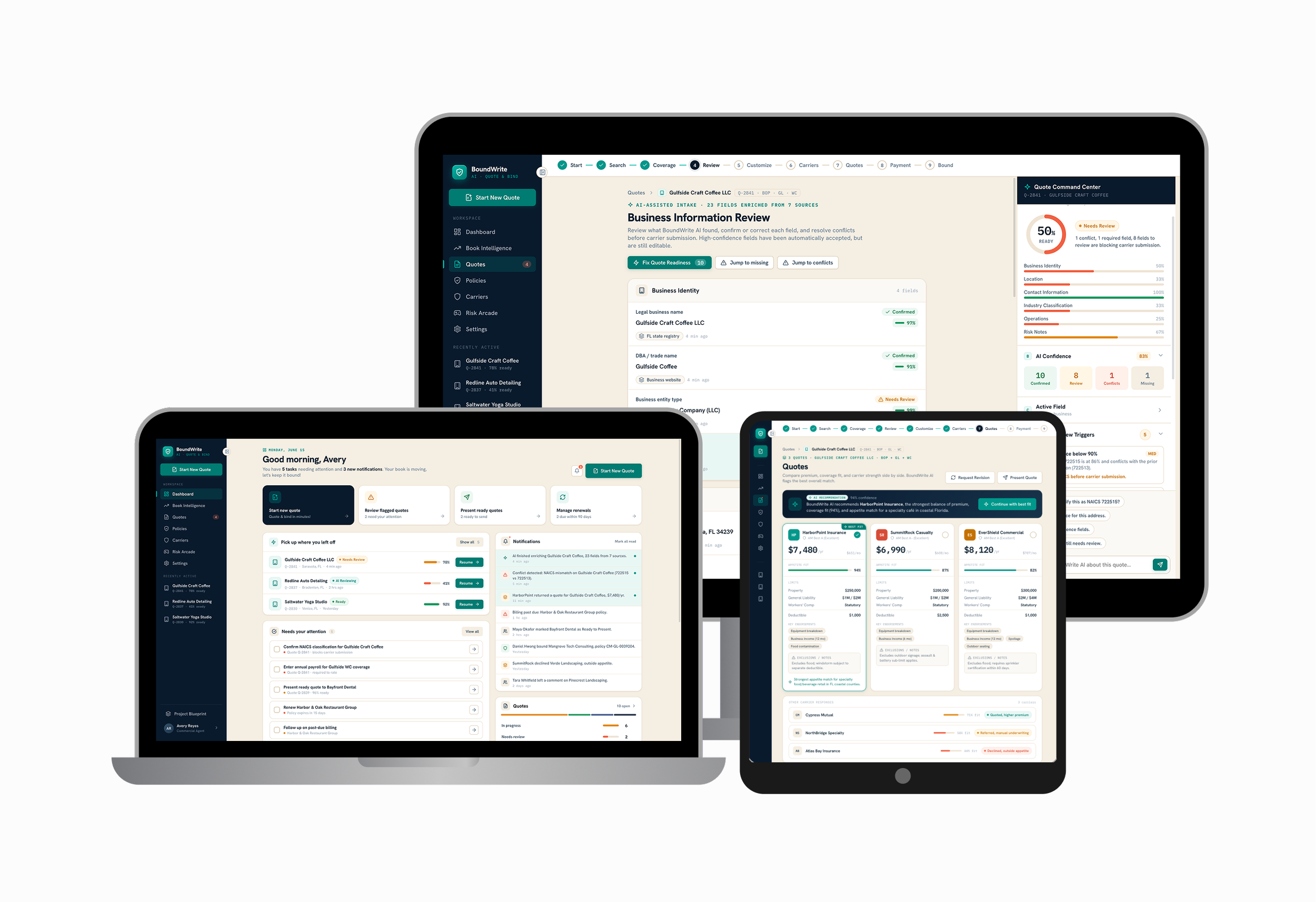
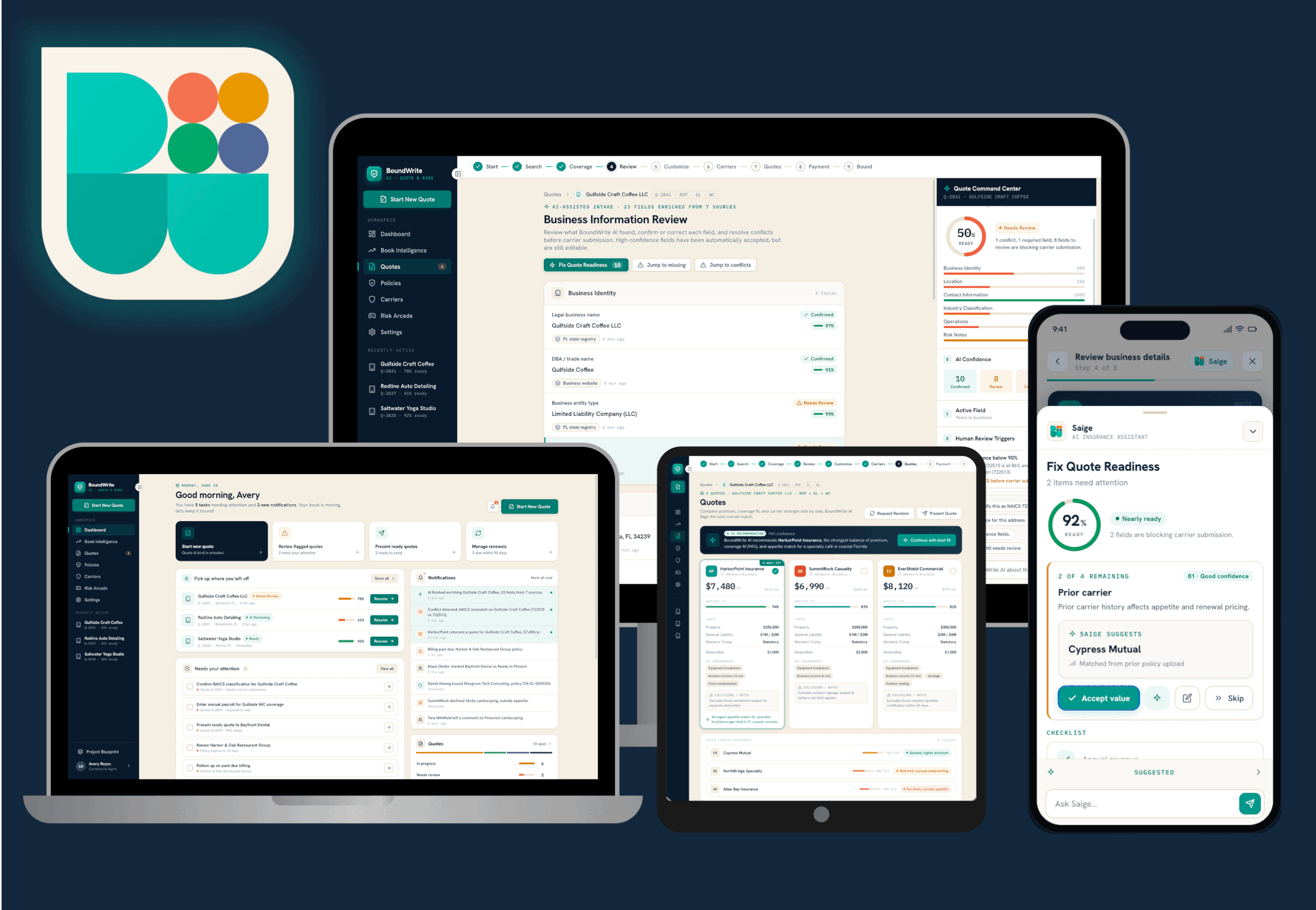
BoundWrite AI is an AI-assisted quote-readiness platform that helps commercial insurance teams move from minimal business information to structured, enriched, quote-ready submissions. The product combines AI classification, trusted data enrichment, document extraction, missing-information detection, carrier comparison, quote readiness signals, and human-in-the-loop review to support a faster, clearer path from submission to bind.
The system has grown into a broader AI workflow ecosystem, including Saige, a context-aware insurance assistant; BoundWrite Go, a mobile-first quote-and-bind experience for agents on the move; and BoundWrite Command Center, a Ctrl+K / Cmd+K action hub for faster navigation and workflow execution. BoundWrite is an intelligent workflow layer, not a chatbot, and it never binds coverage on its own. Instead, it helps users make faster, better-informed decisions while preserving transparency, accountability, and control.
Launch the interactive prototype to explore Saige AI, BoundWrite GO, AI-enhanced Quote & Bind Flow, Intelligence Dashboards, Risk Arcade, Carrier & AI Settings and the Project Blueprint including the Design System Library. View from a tablet or larger for the best experience.
About
The BoundWrite AI process began by turning years of commercial insurance quote-and-bind experience into a focused AI product design opportunity: helping agents, brokers, underwriters, and internal teams move from fragmented intake and manual review to a faster, clearer path from submission to bind. I mapped the workflow, identified high-friction moments, defined user roles and decision points, and separated what AI should automate from what should remain human-controlled. From there, I shaped the product strategy, information architecture, quote-readiness model, review states, and core flows across business intake, document extraction, coverage selection, carrier comparison, payment, and policy binding.
As the project evolved, I expanded BoundWrite into a more complete AI workflow ecosystem. Saige became the context-aware assistant layer for explainability, quote readiness support, source transparency, and guided recommendations. BoundWrite Go extended the platform into a mobile-first experience for agents who need to start quotes, upload documents, review AI-prefilled information, compare carriers, and move toward bind from the field. BoundWrite Command Center added a Ctrl+K / Cmd+K productivity layer for power users, helping teams navigate the platform, run actions, search workflows, and trigger context-aware AI support without breaking focus.
The project combined traditional UX best practices with AI-specific principles from Stanford’s UI/UX Design for AI Products program and USF’s AI Automation coursework. I applied concepts around human-AI interaction, trust calibration, explainability, mixed-initiative design, automation thresholds, confidence indicators, source transparency, and human-in-the-loop review. Figma supported UX flows, high-fidelity interface design, reusable components, and prototyping, while OpenAI, ChatGPT, Claude, n8n, and Make.com helped explore product logic, workflow automation, AI-assisted intake, review queues, notifications, and case study development.
The result is a flagship AI product design case study that demonstrates how I approach principal-level product design: translating messy, high-stakes operational workflows into clear, trustworthy, decision-ready SaaS experiences. BoundWrite AI reflects my belief that the best AI products are not black-box automations, but human-AI systems that improve speed and quality while preserving transparency, accountability, and user control.
Product Journey
1. AI-Powered Quote Intake & Business Enrichment
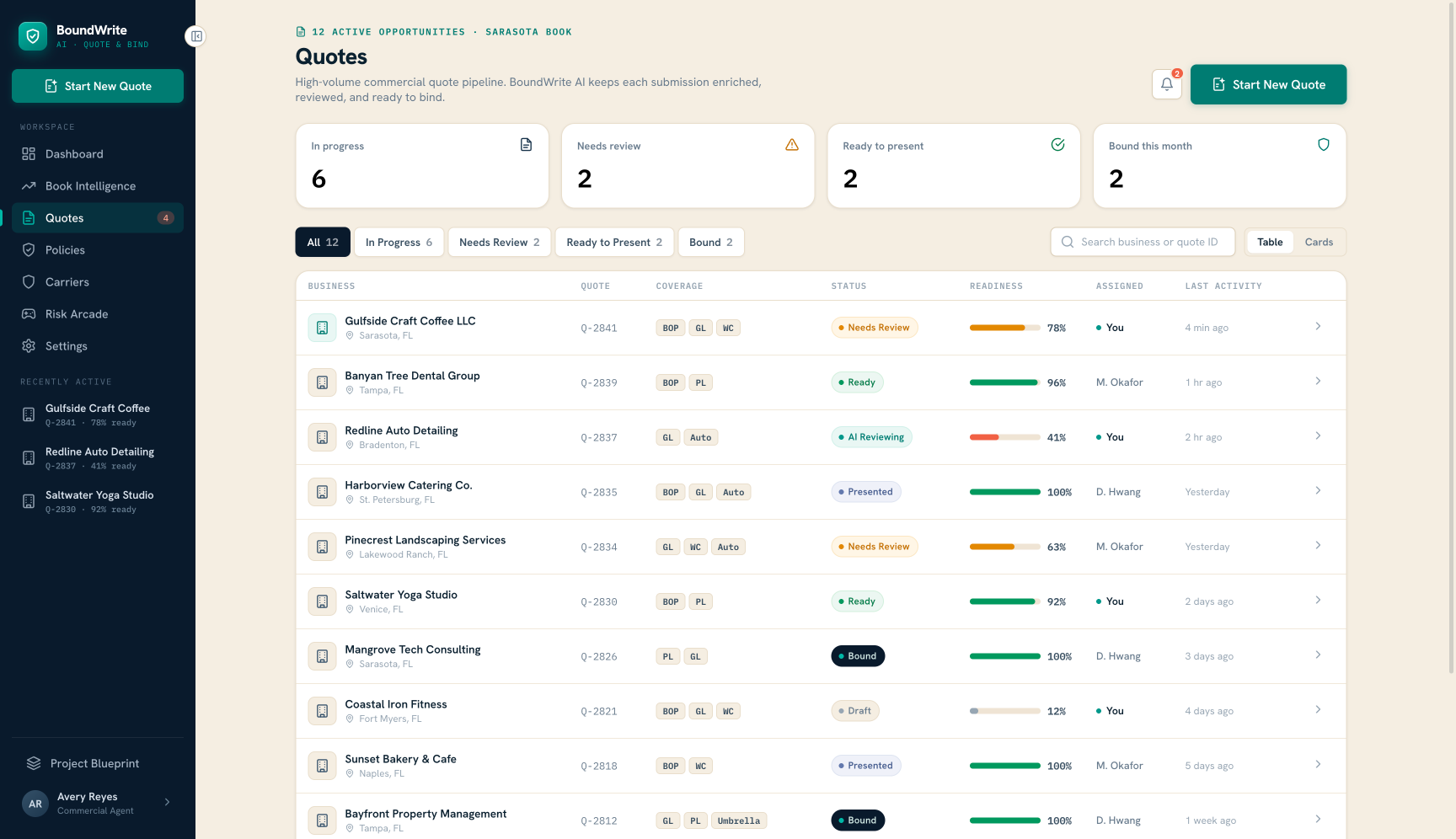
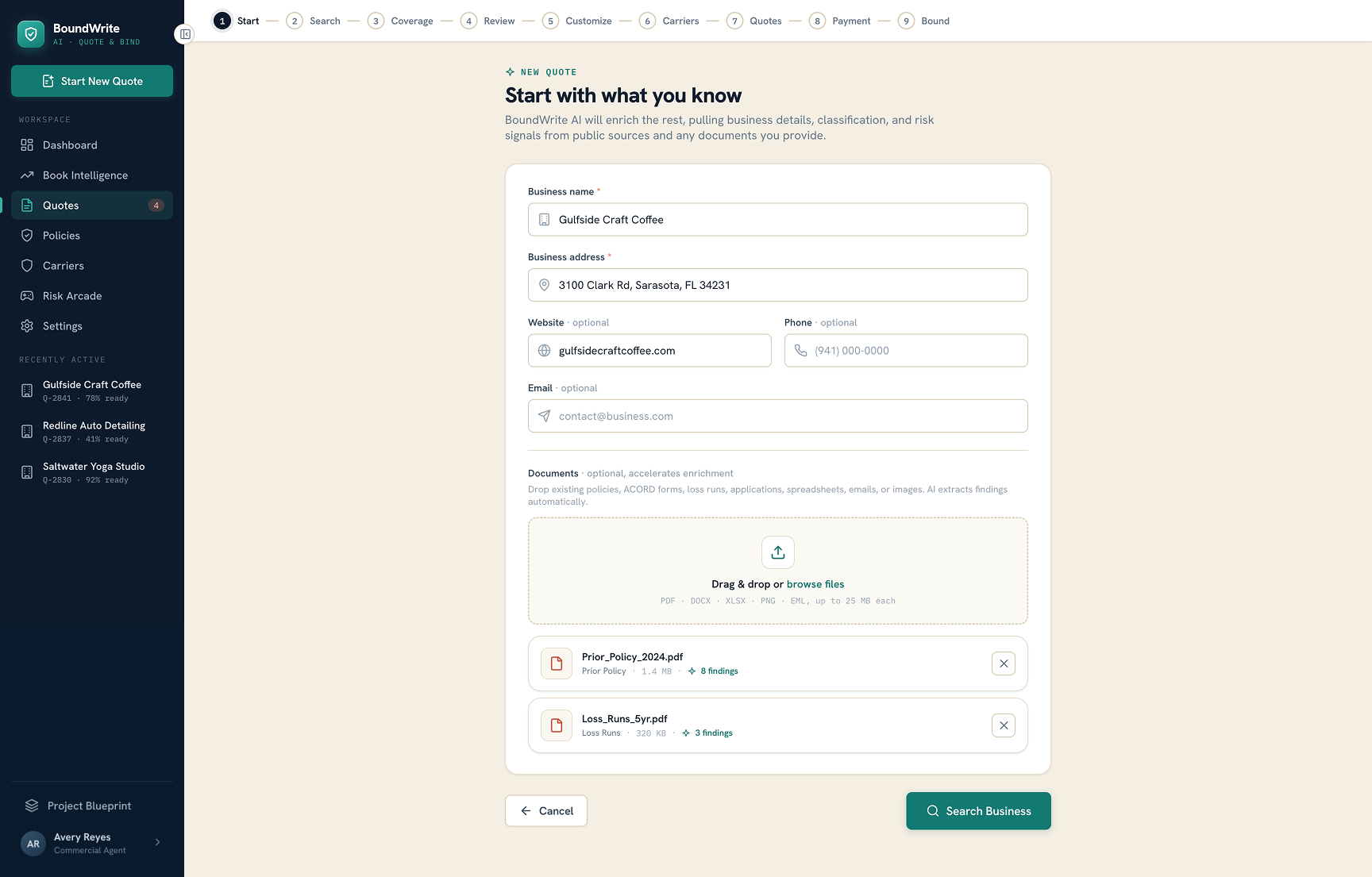
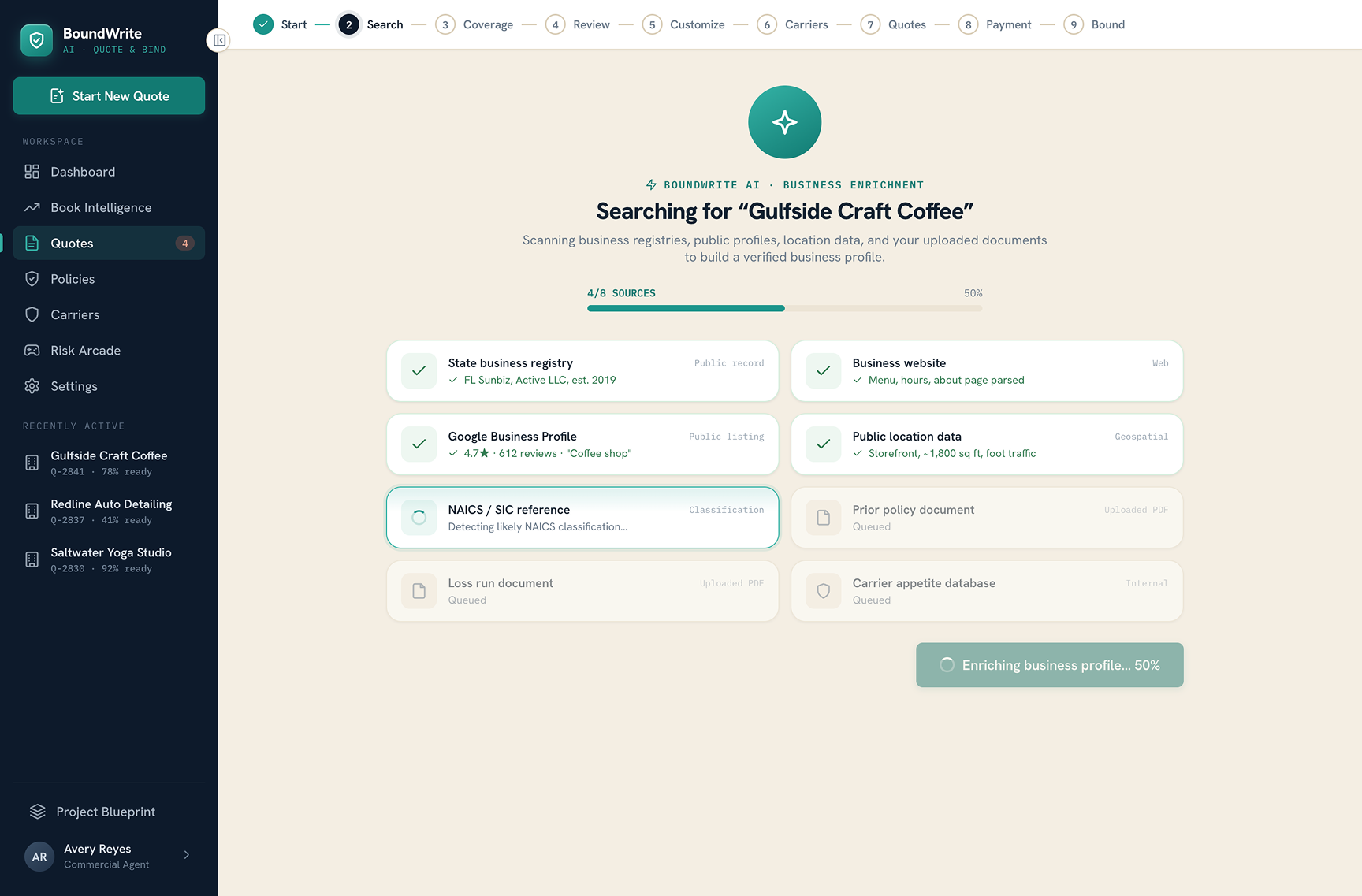
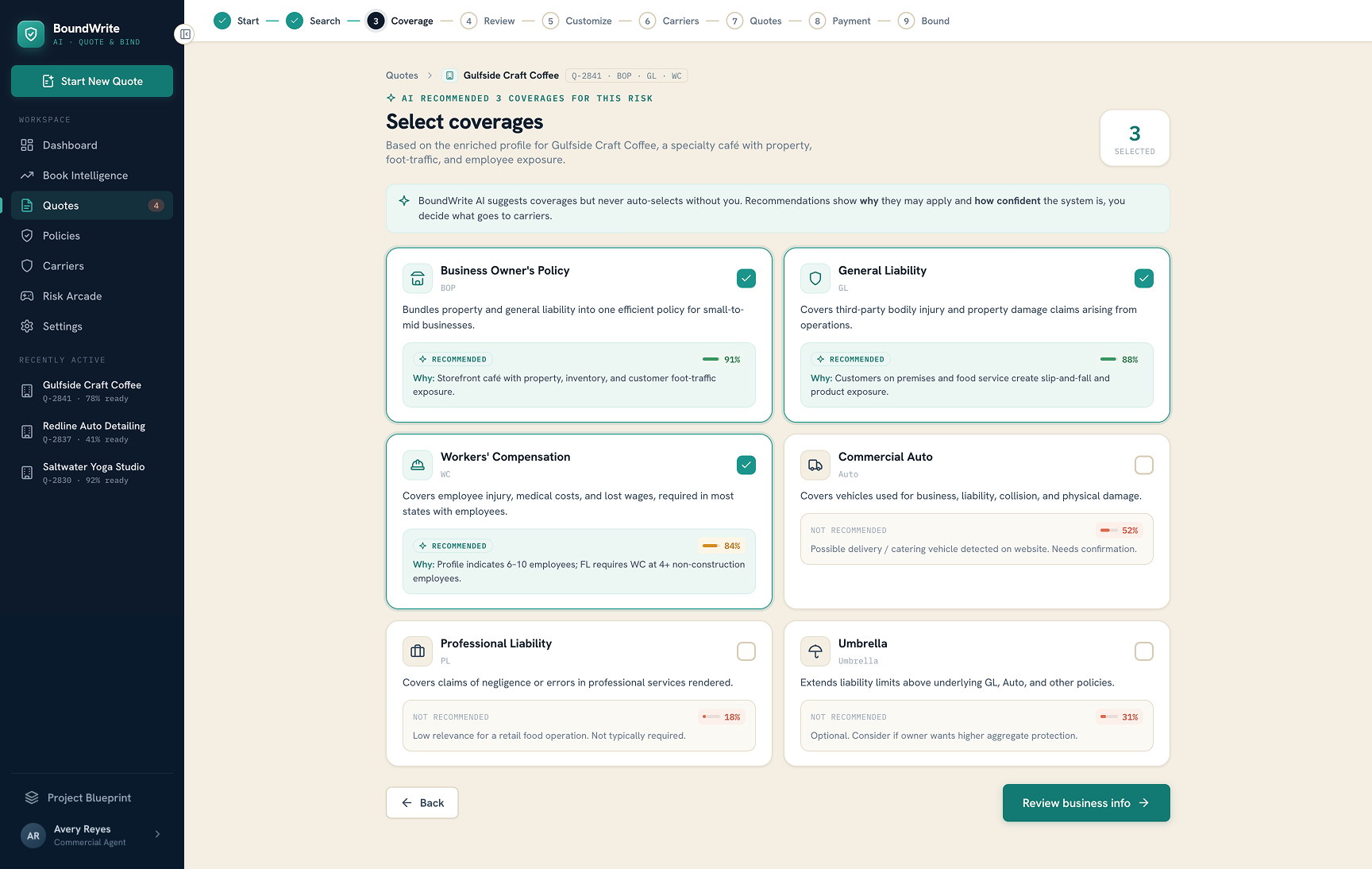
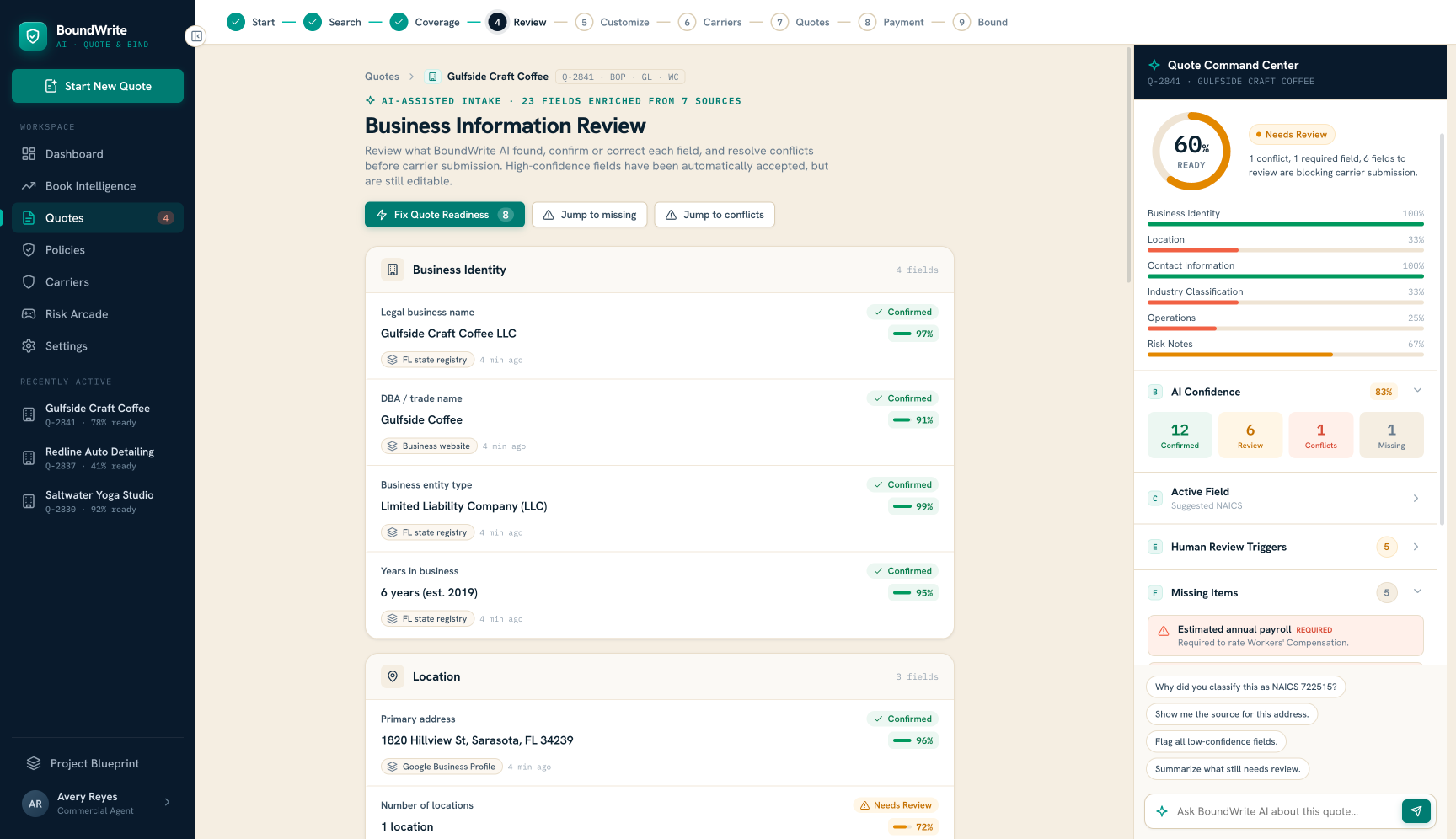
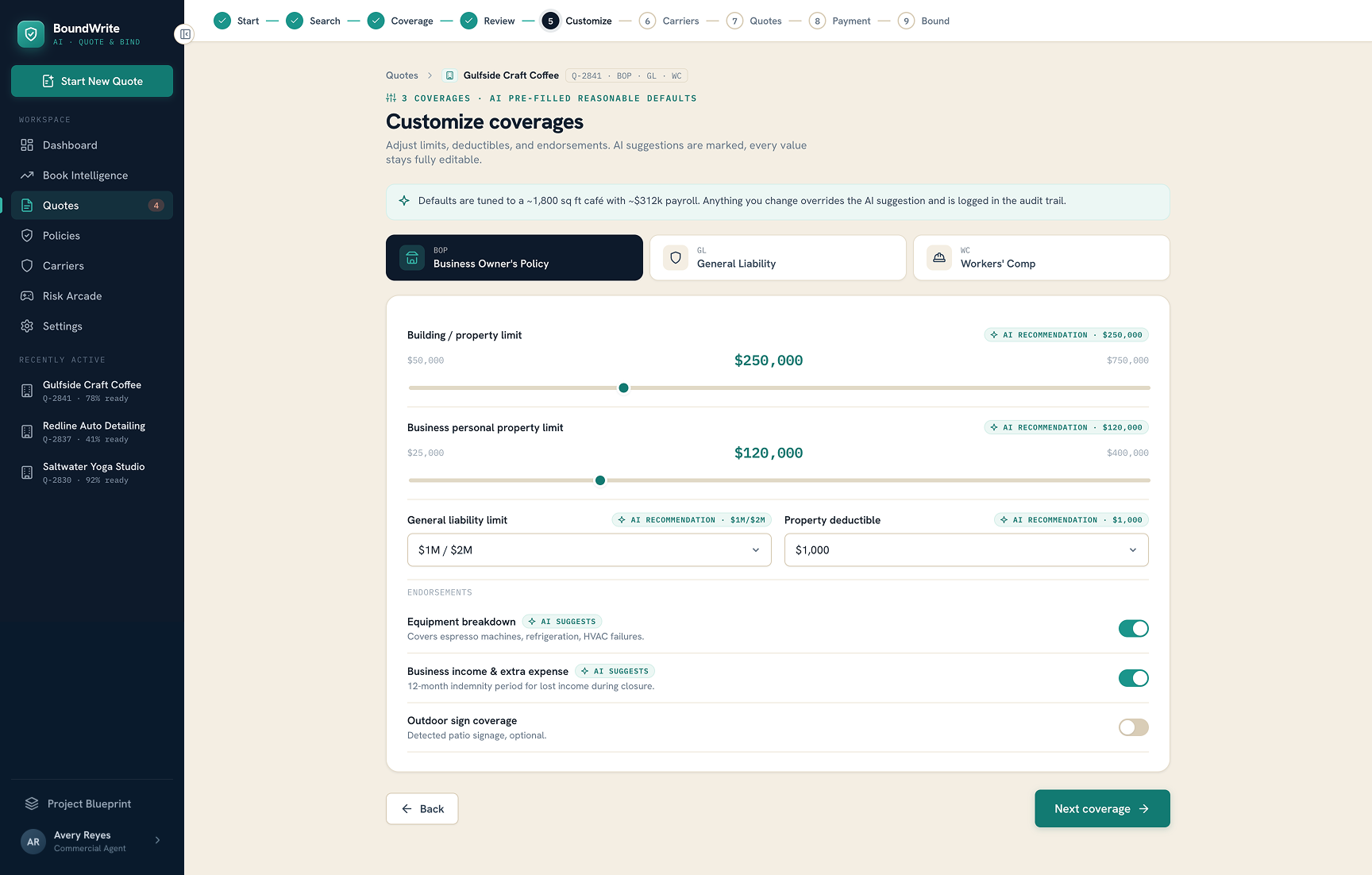
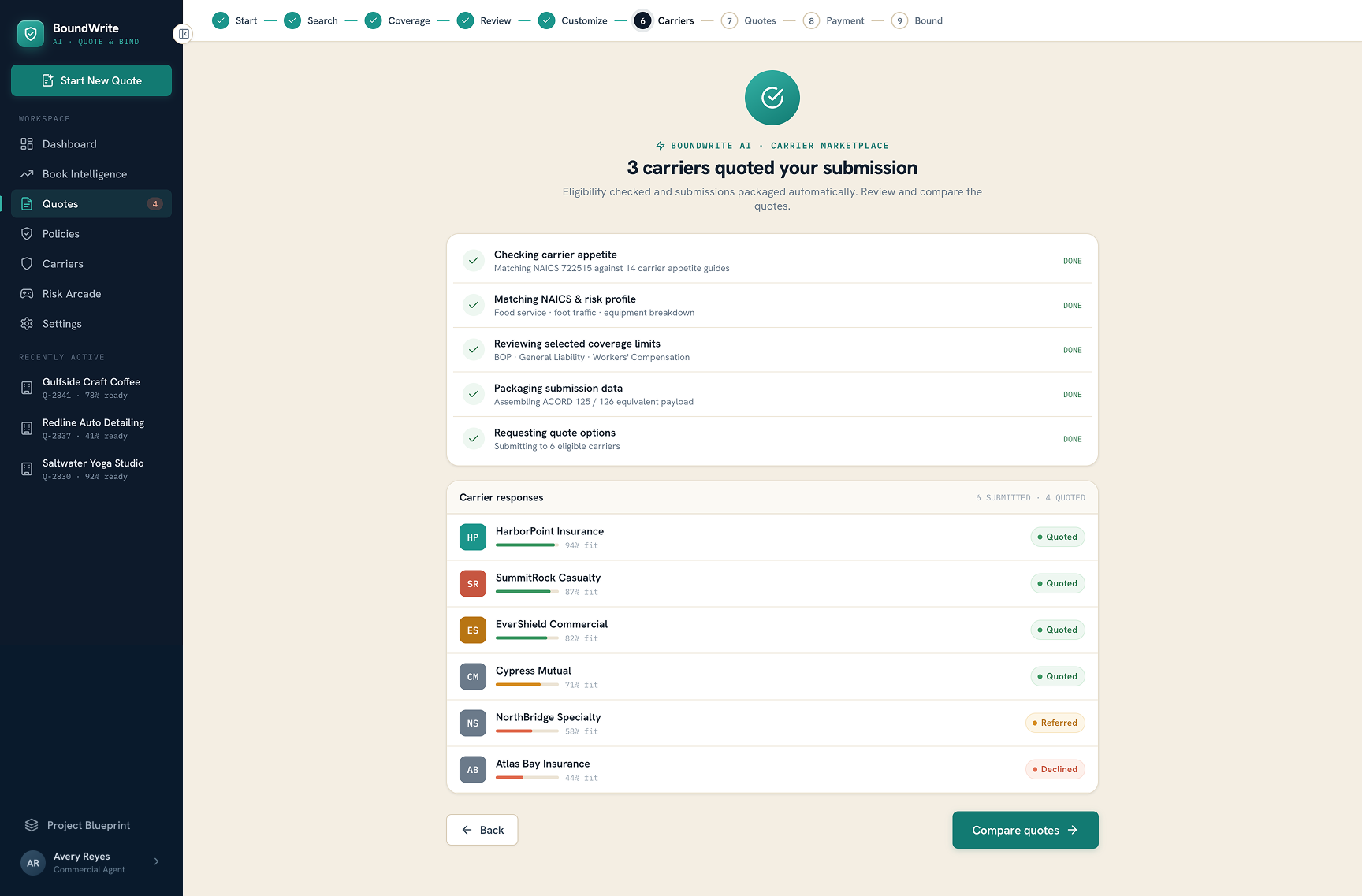
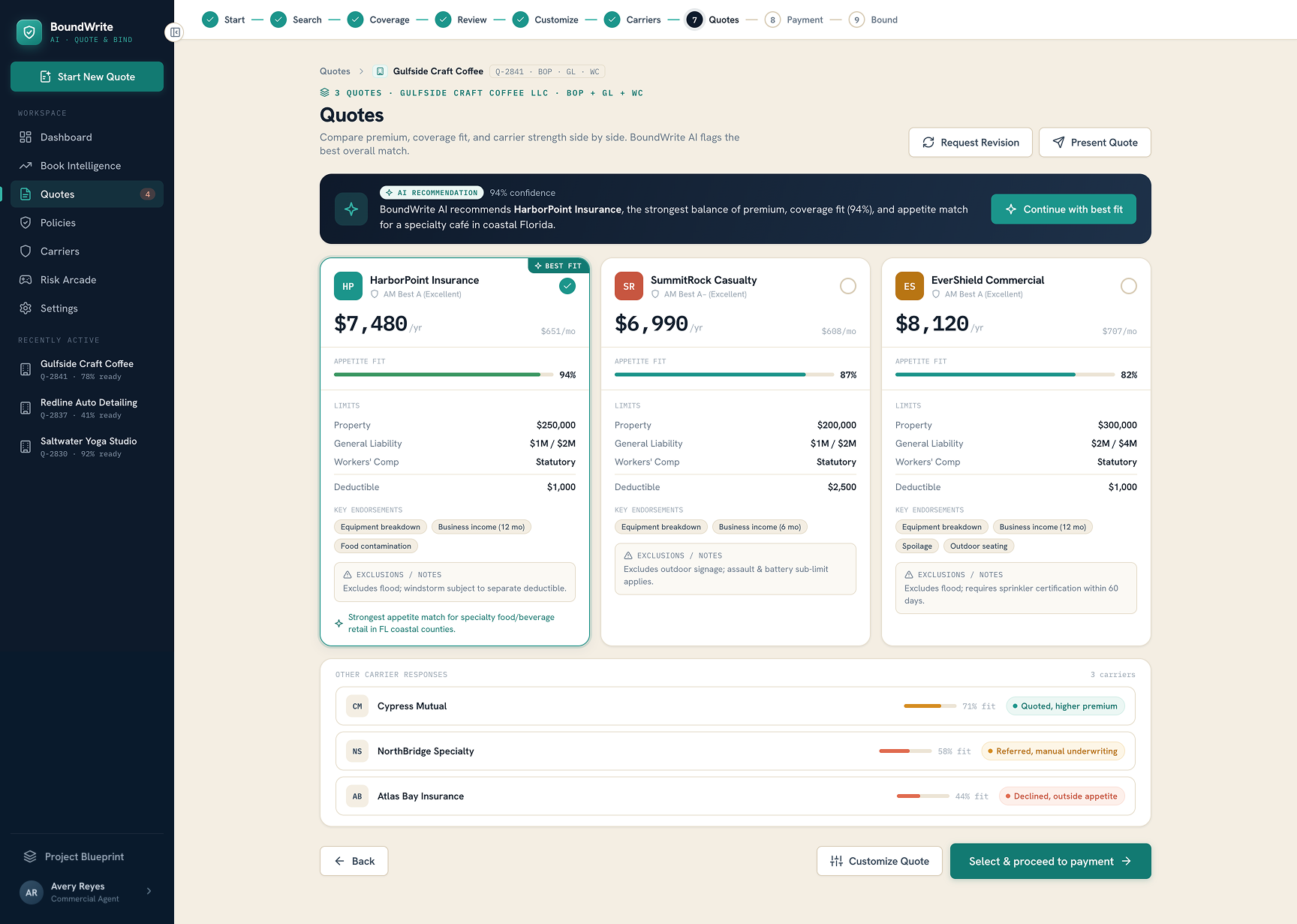
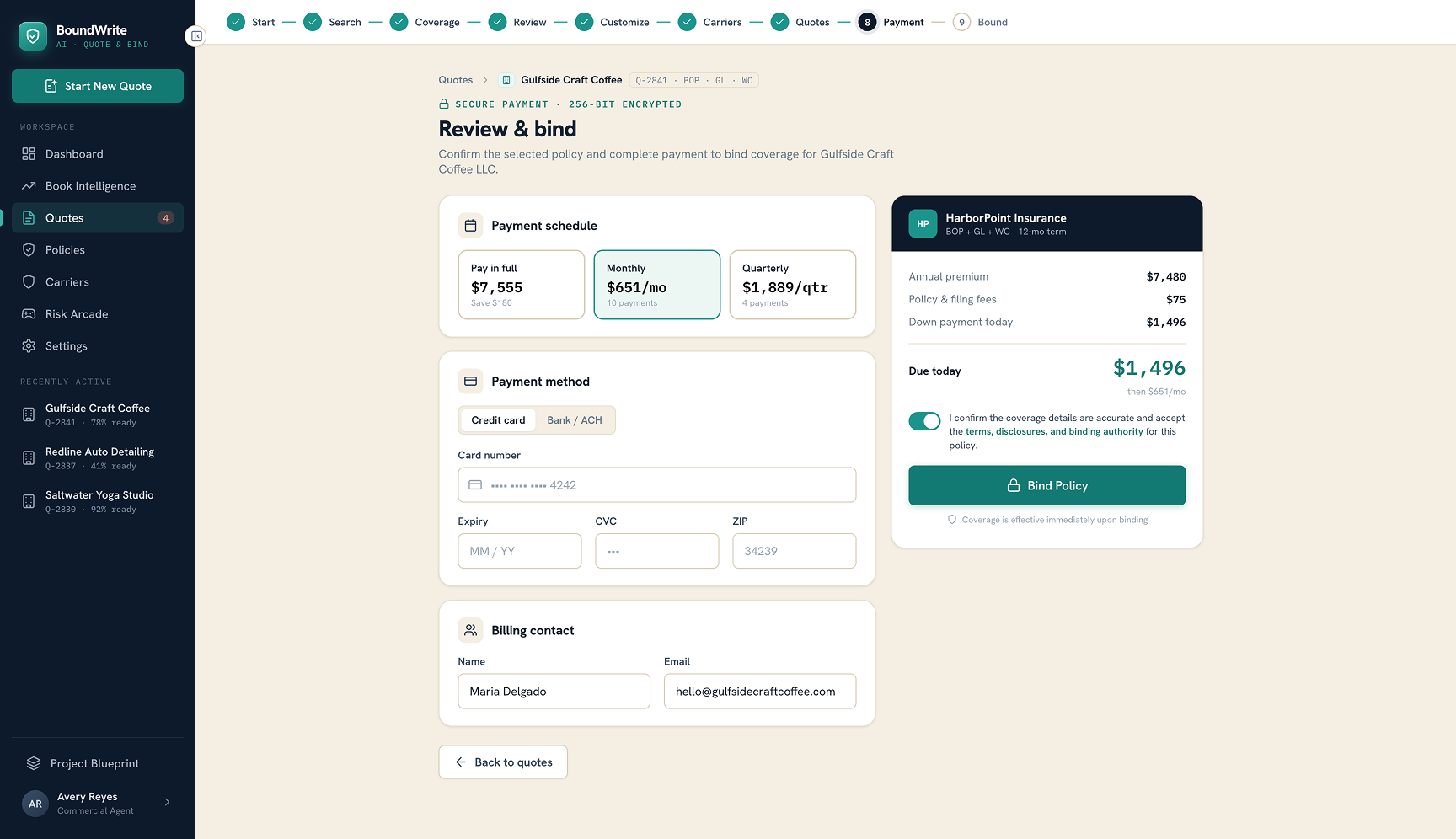
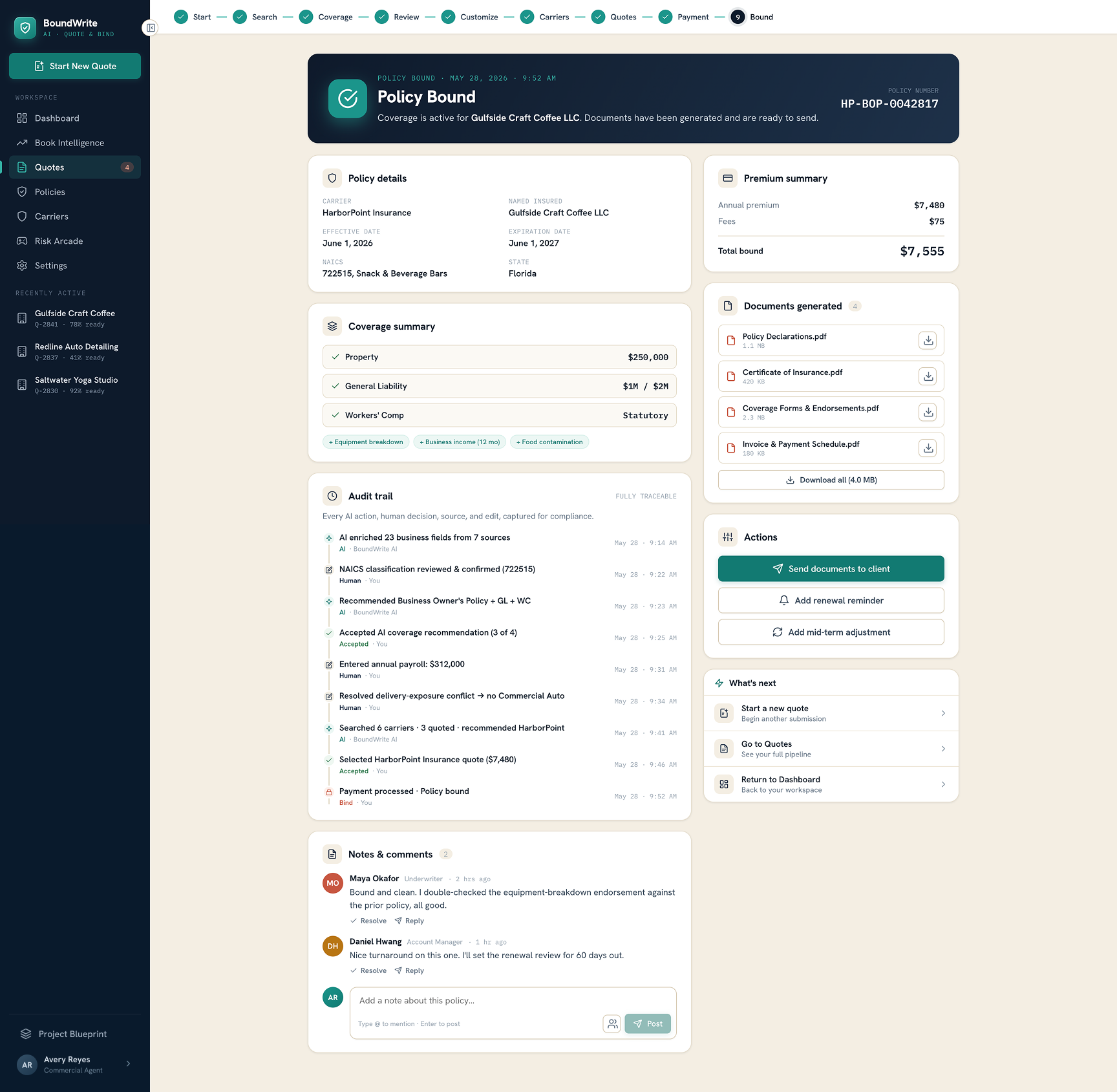
BoundWrite AI begins by reimagining one of the most time-consuming parts of commercial insurance: getting a quote started. Instead of forcing users through a long, manual intake process, the experience helps them begin with lightweight business information, uploaded documents, or available data sources, then uses AI to assist with prefill and classification. This creates a faster, more guided entry point while still keeping the user in control of the information being submitted. The result is a quoting experience designed to reduce repetitive data entry, improve quote readiness, and make complex insurance intake feel more approachable.
2. Meet Saige - Your AI Insurance Assistant
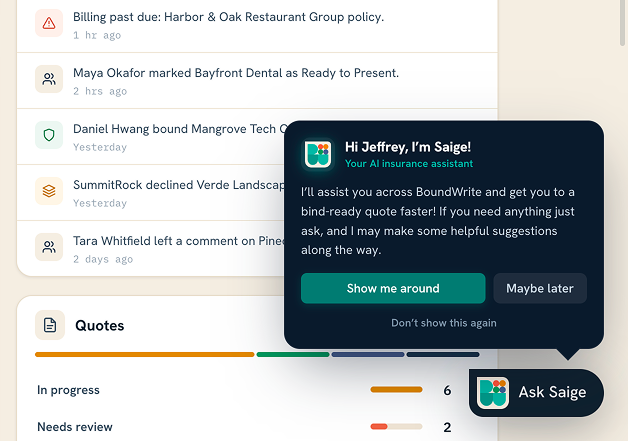
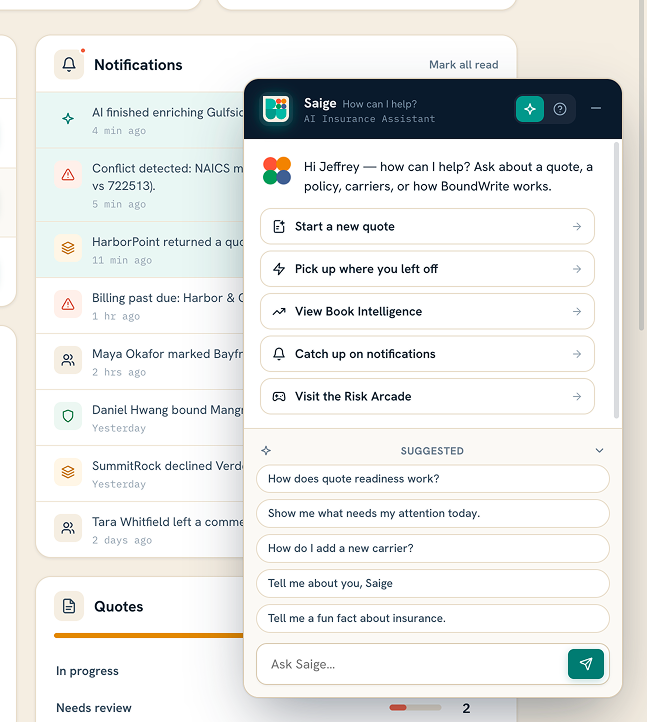
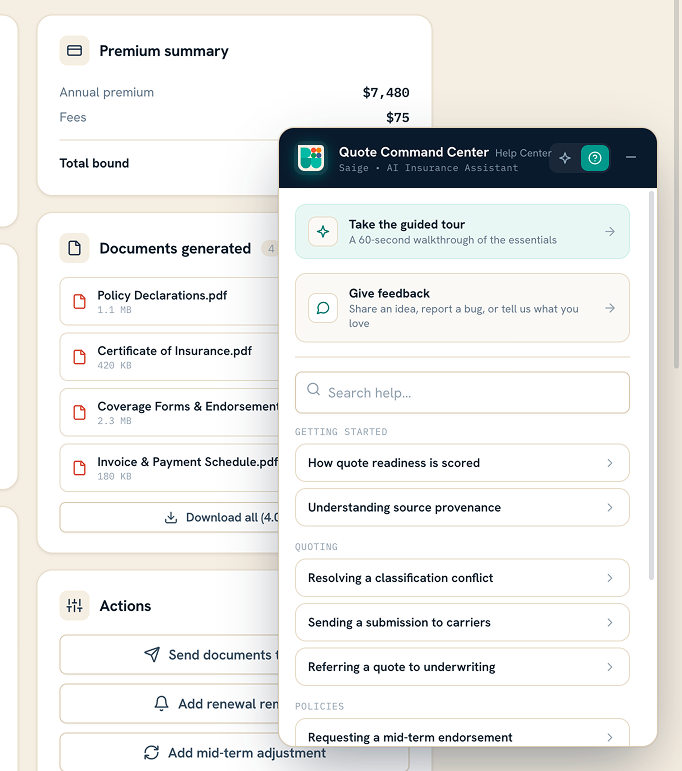
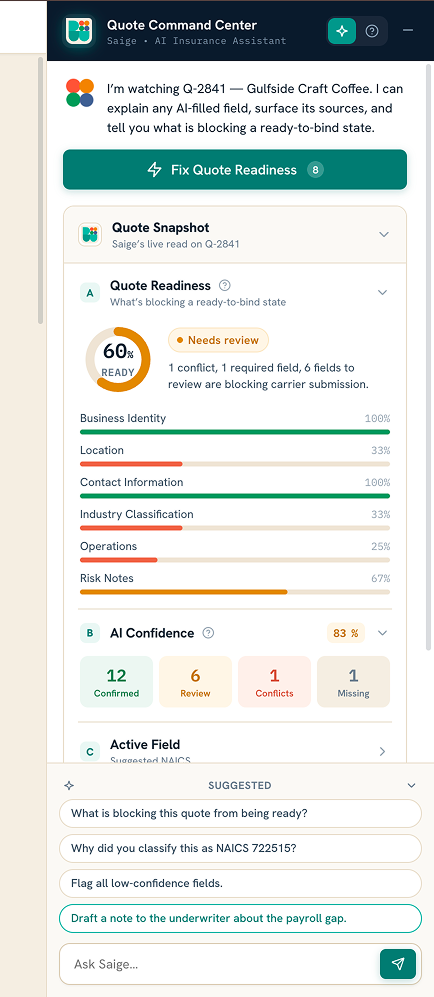
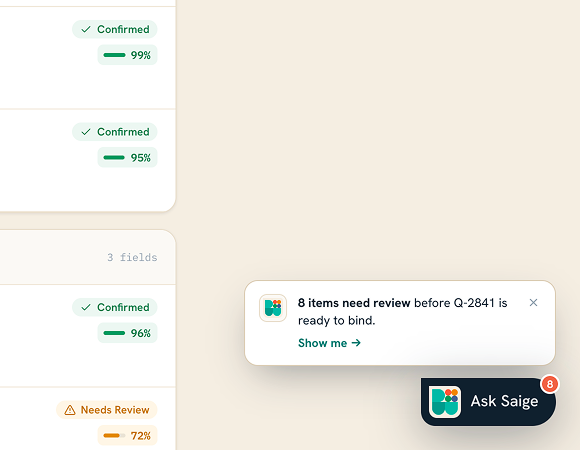
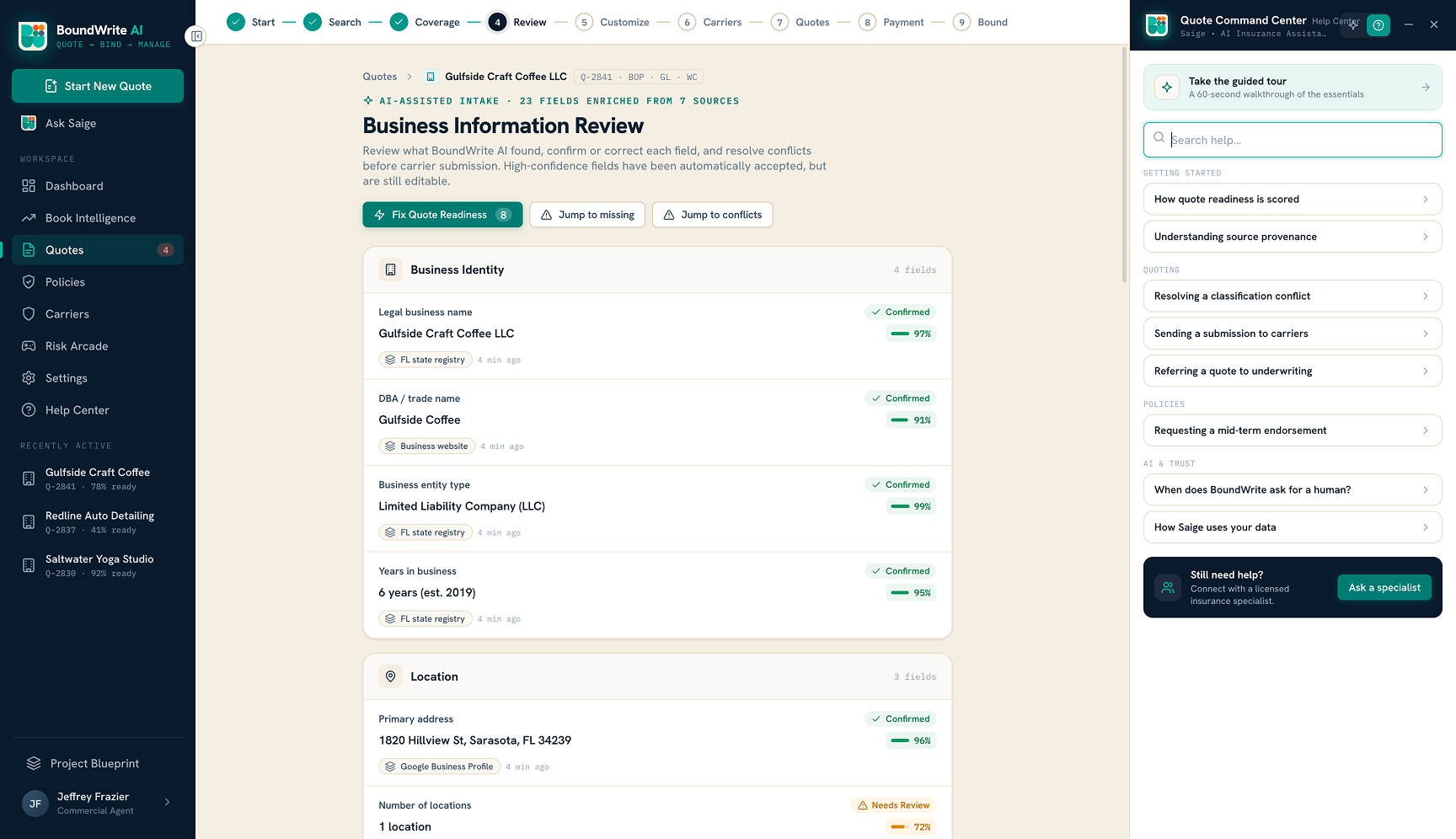
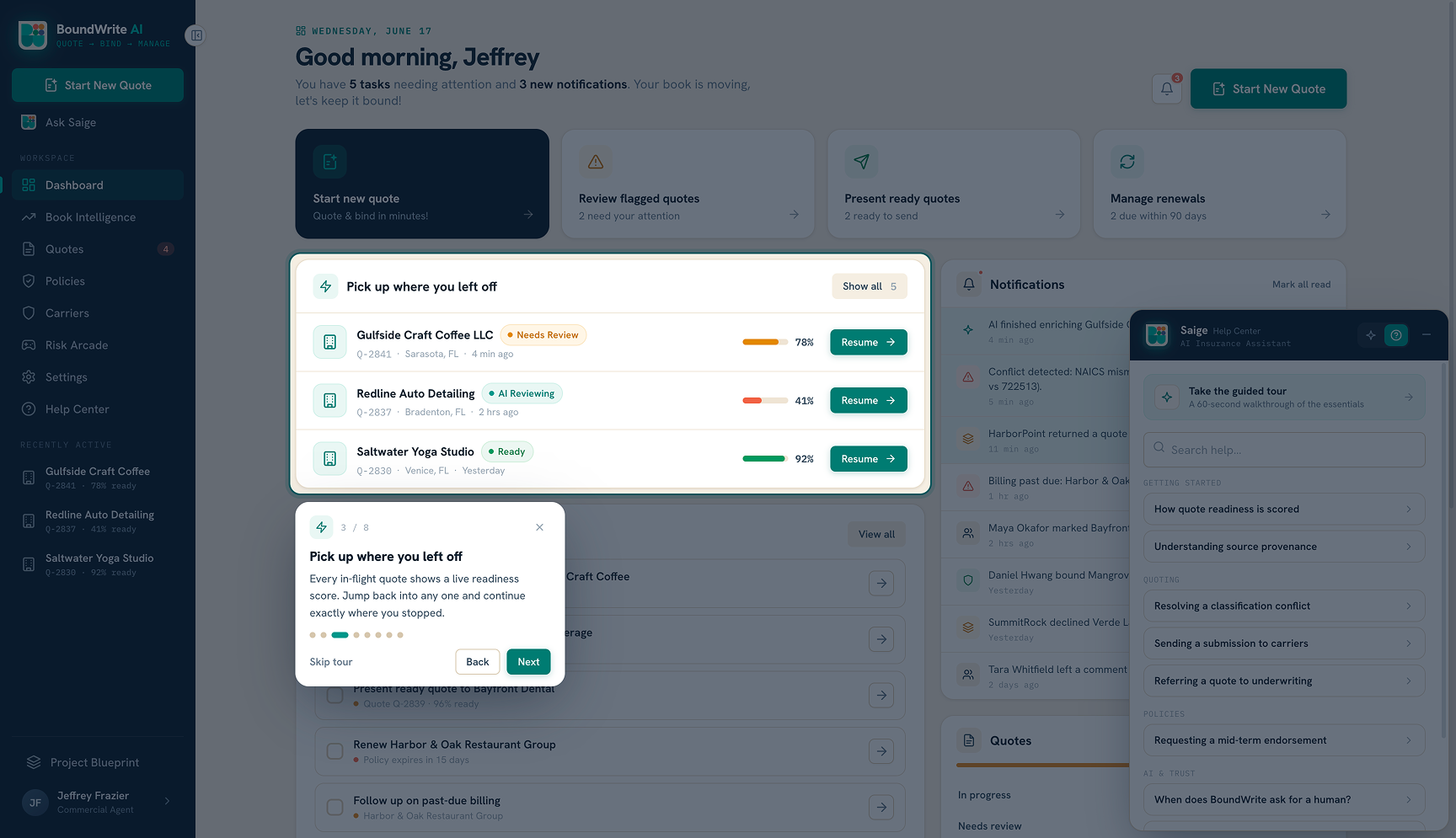
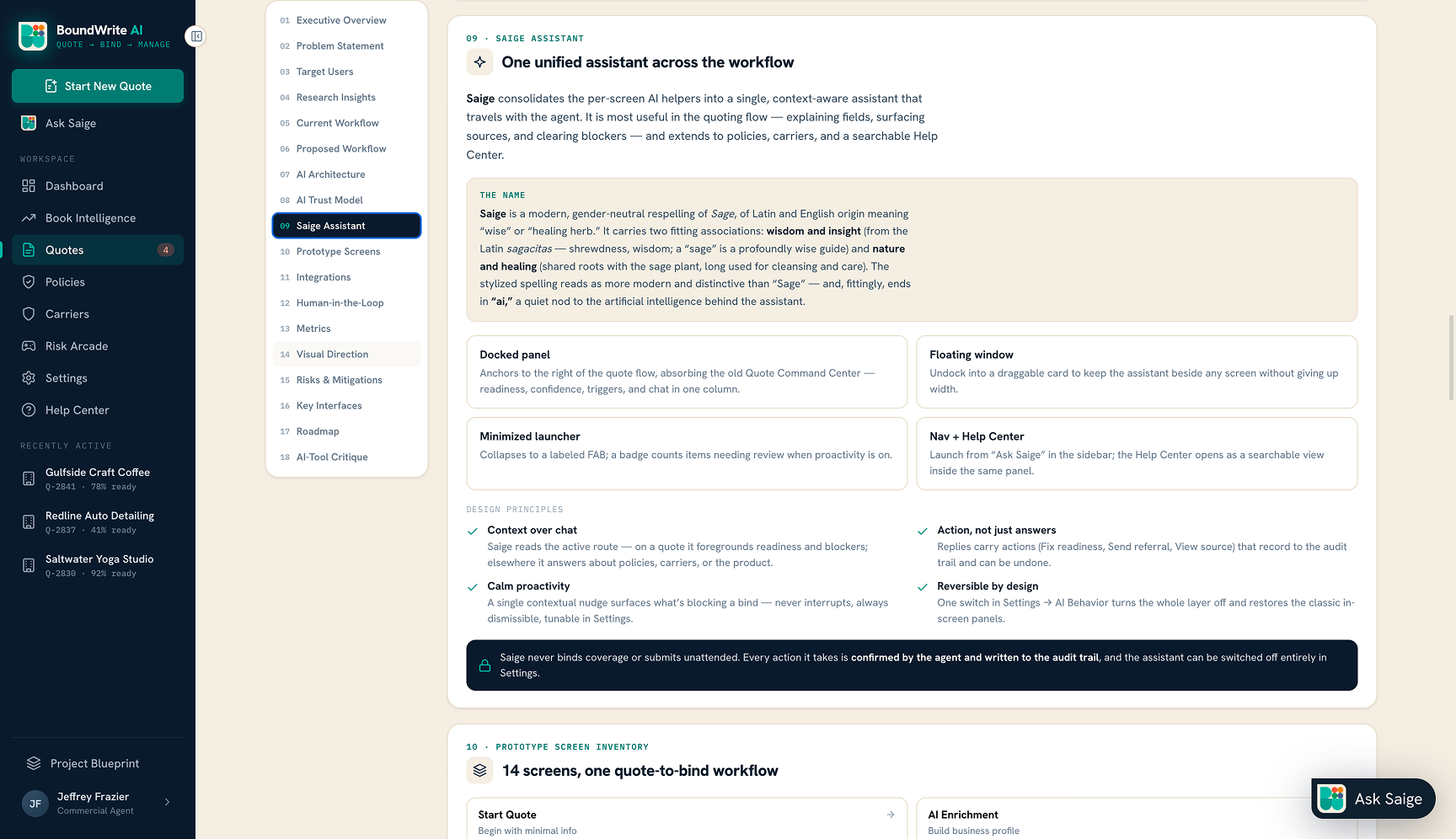
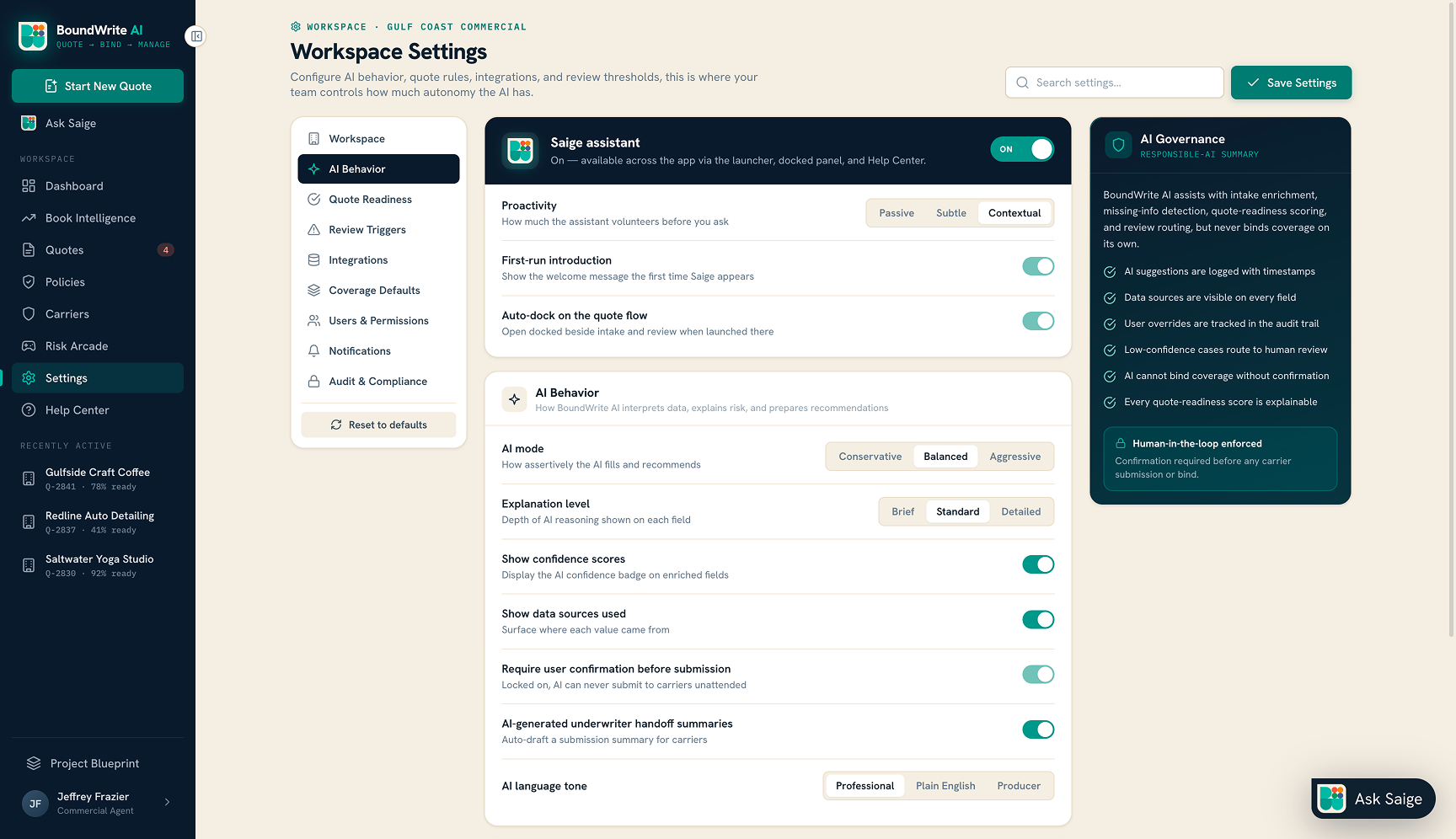
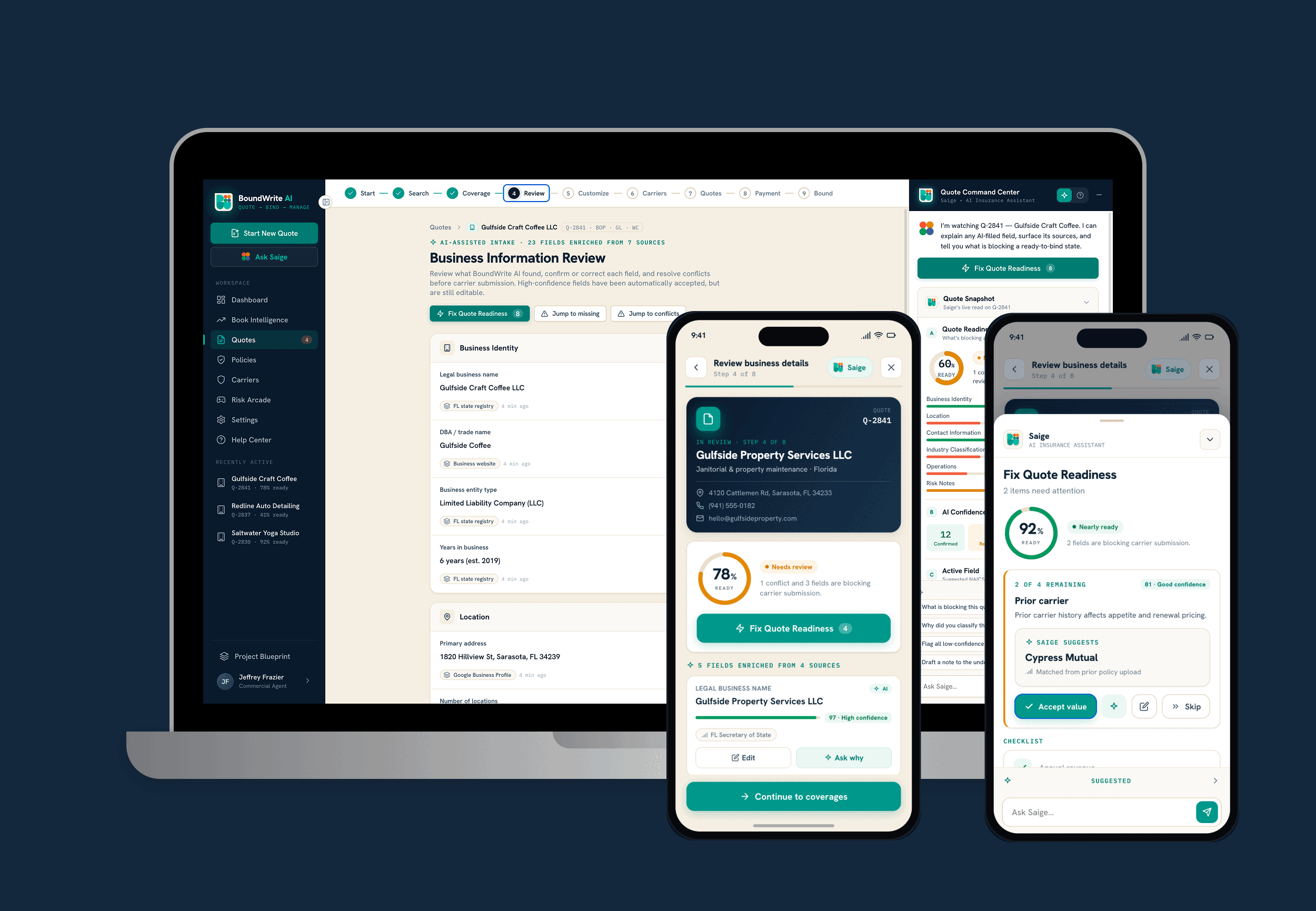
Saige is BoundWrite’s unified AI assistant for the commercial insurance quote workflow. Instead of relying on scattered per-screen help, Saige travels with the agent as a context-aware support layer that explains fields, surfaces sources, clarifies confidence scores, and helps resolve quote readiness blockers. It can dock beside the quote flow, float as a draggable window, or collapse into a minimized launcher when not needed. Saige provides searchable help, guided recommendations, underwriting referral support, and “Fix Quote Readiness” actions while keeping the user in control. Every suggested update requires agent confirmation, is reversible by design, and is written to the audit trail for transparent, responsible AI assistance.
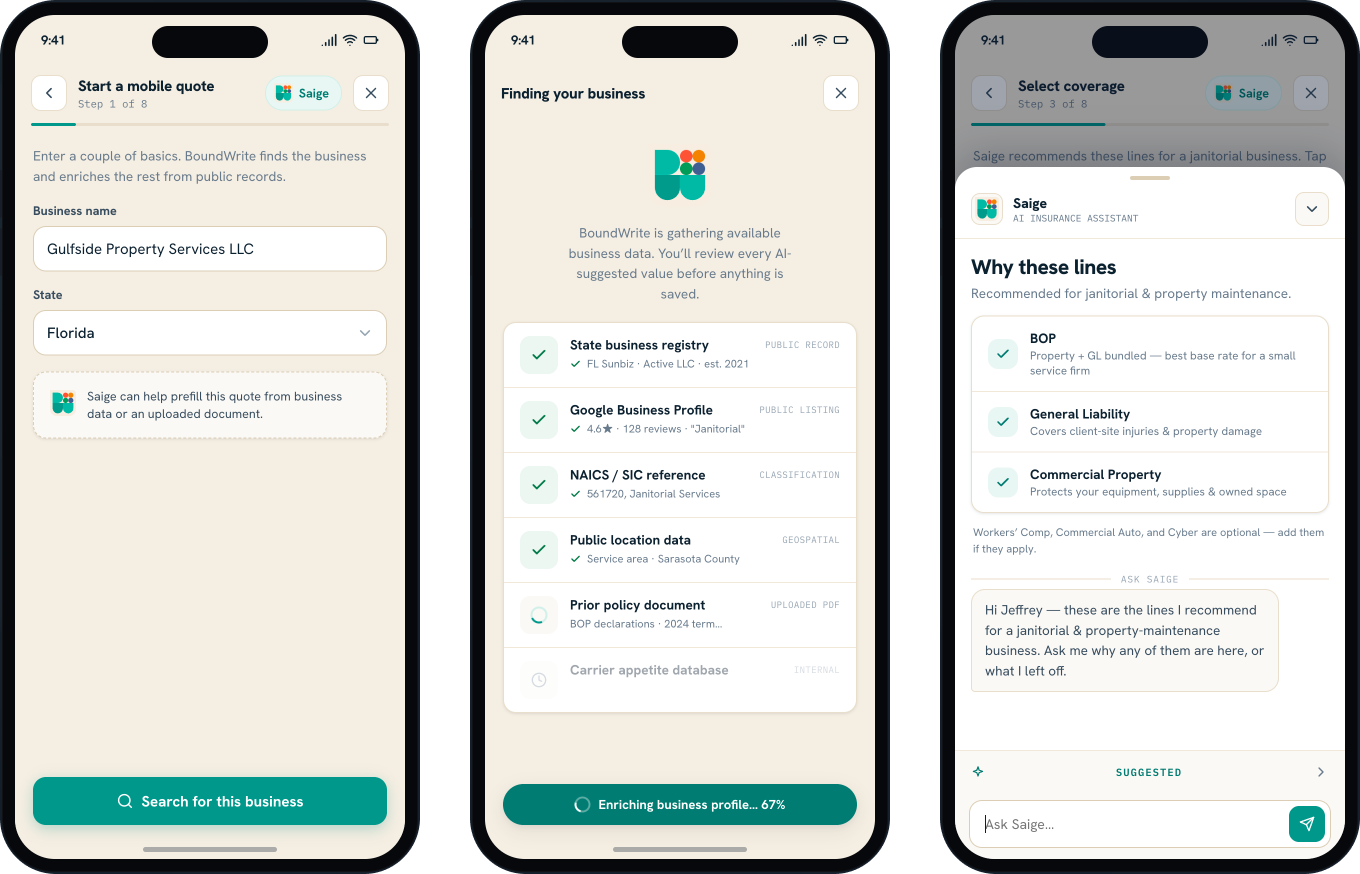
3. BoundWrite GO - Quote, Compare & Bind from anywhere!
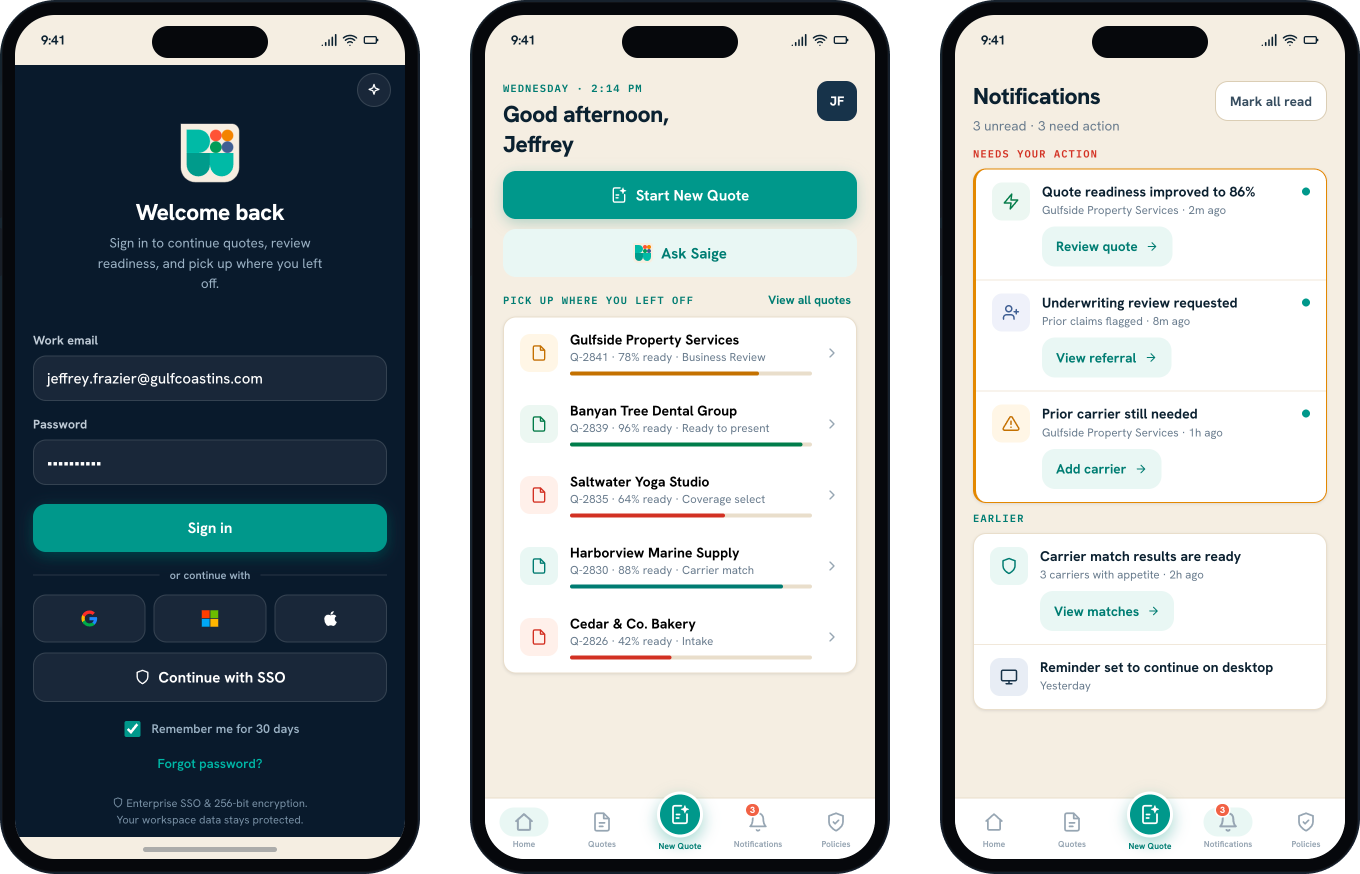
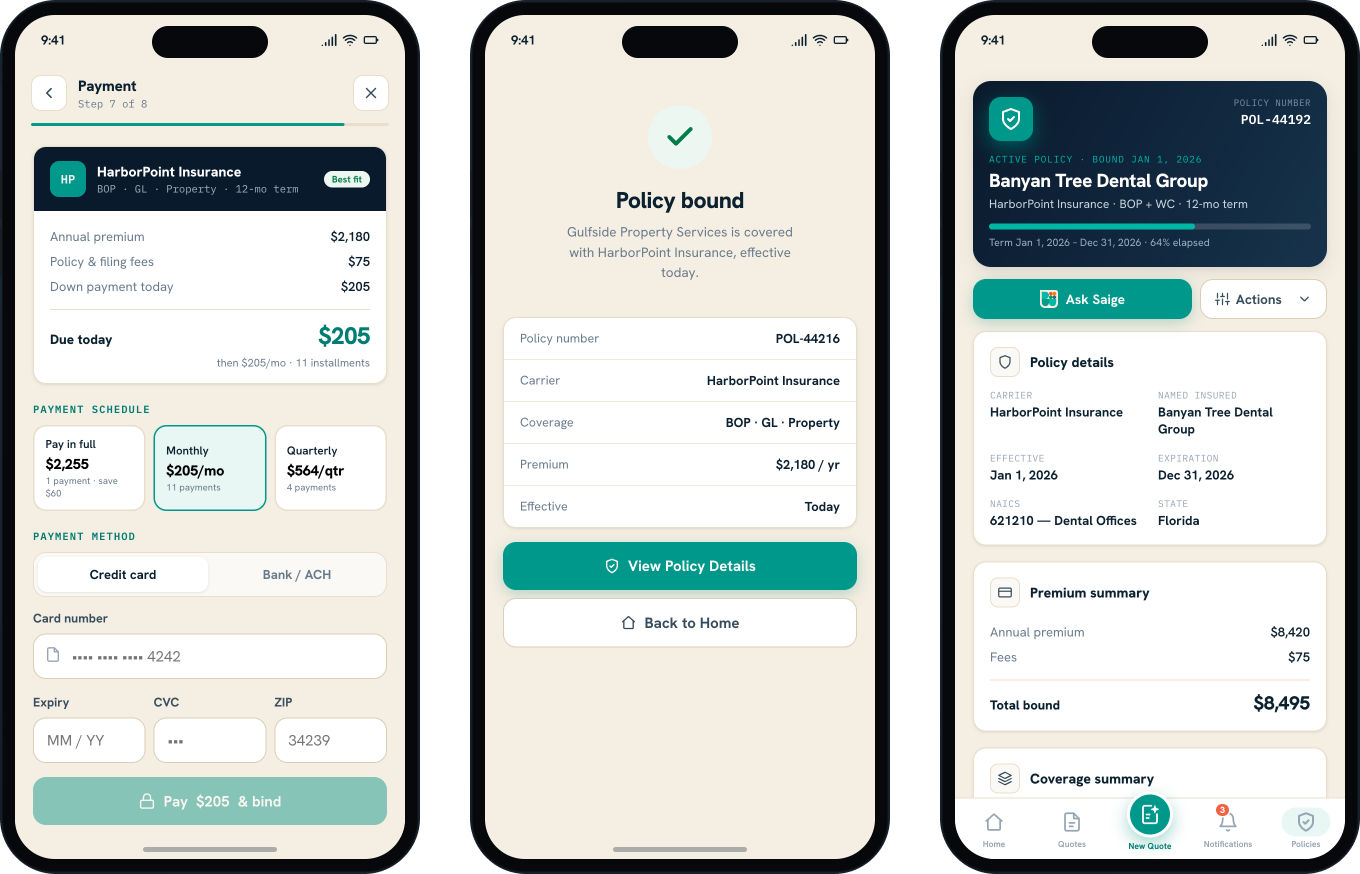
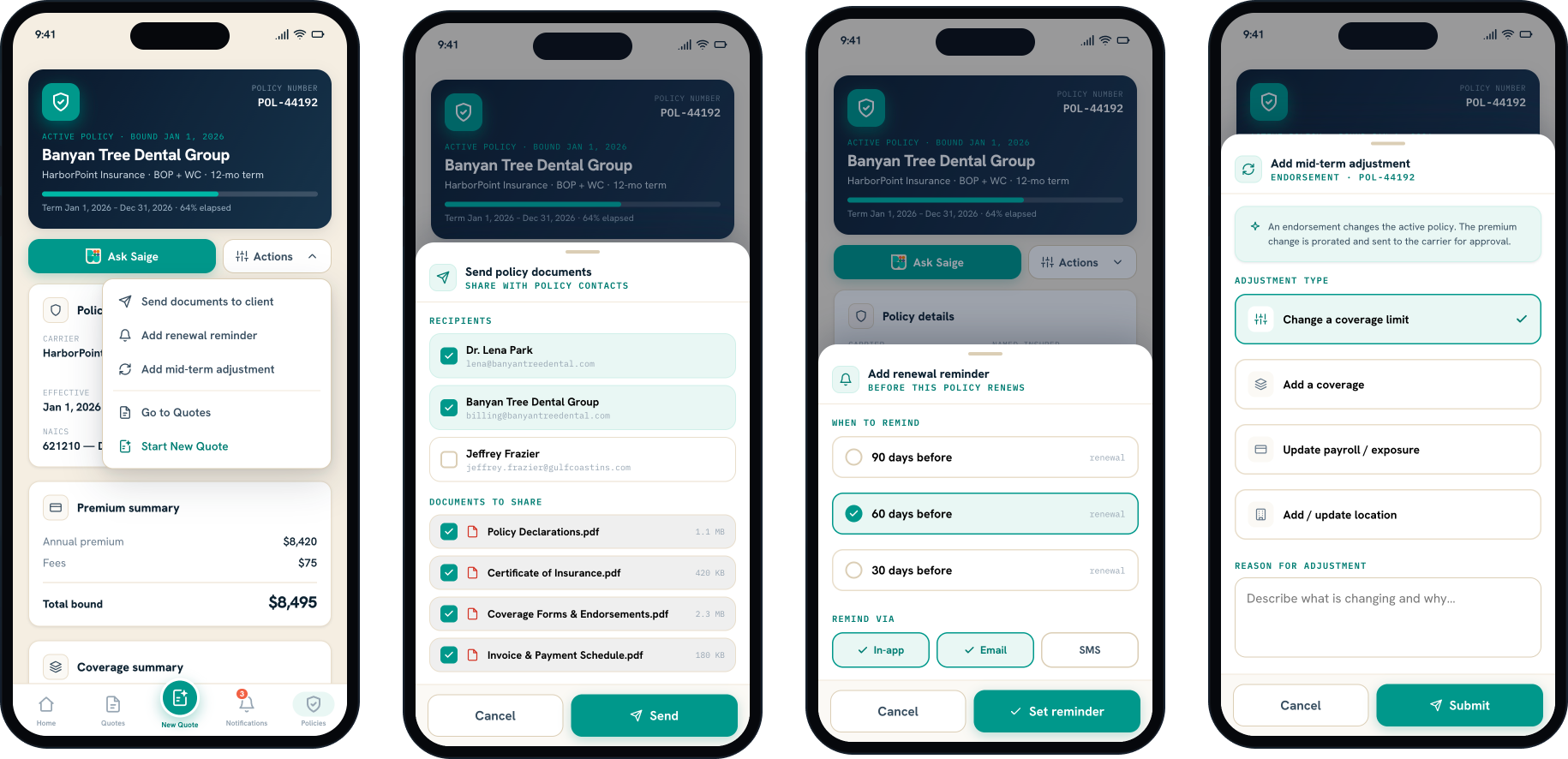
BoundWrite Go extends the BoundWrite AI quote-and-bind experience into a mobile-first workflow built for agents on the move. Designed for fast decision-making from a phone, the app helps users start a quote, capture business details, upload documents, review AI-prefilled information, compare carrier options, and move toward bind without returning to a desktop workflow. The experience prioritizes mobile UX best practices: smaller decision steps, thumb-friendly actions, clear progress states, simplified review moments, and concise AI guidance that keeps quoting fast without sacrificing trust or control.
As a companion to the full BoundWrite platform, BoundWrite Go shows how complex insurance workflows can become lightweight, context-aware mobile experiences. By combining document capture, guided intake, quote readiness signals, carrier comparison, and human-in-the-loop review, it supports real-world agent behavior: quoting faster, responding sooner, and binding business from anywhere.
4. Quote Readiness Review: Missing & Flagged Information
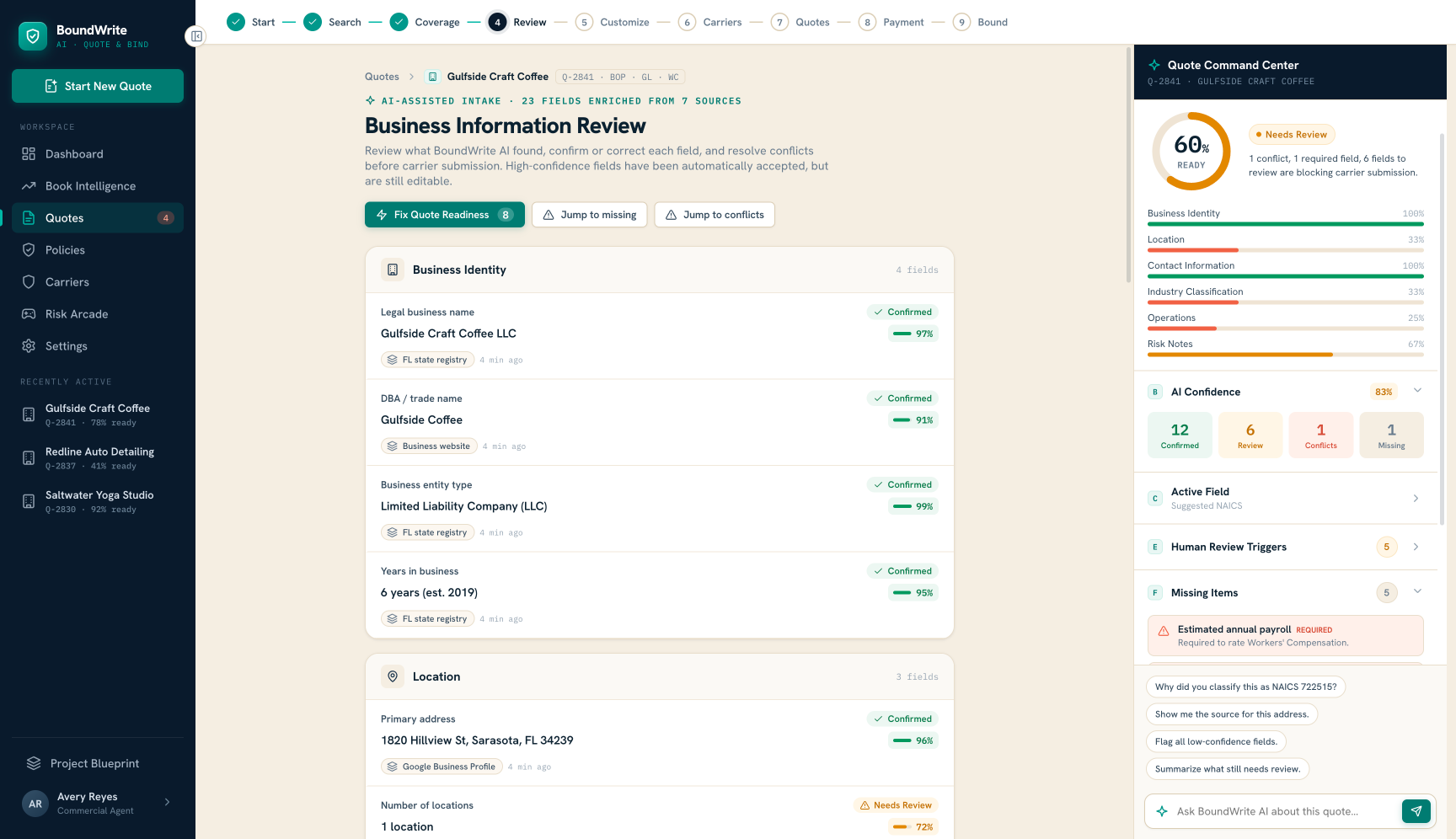
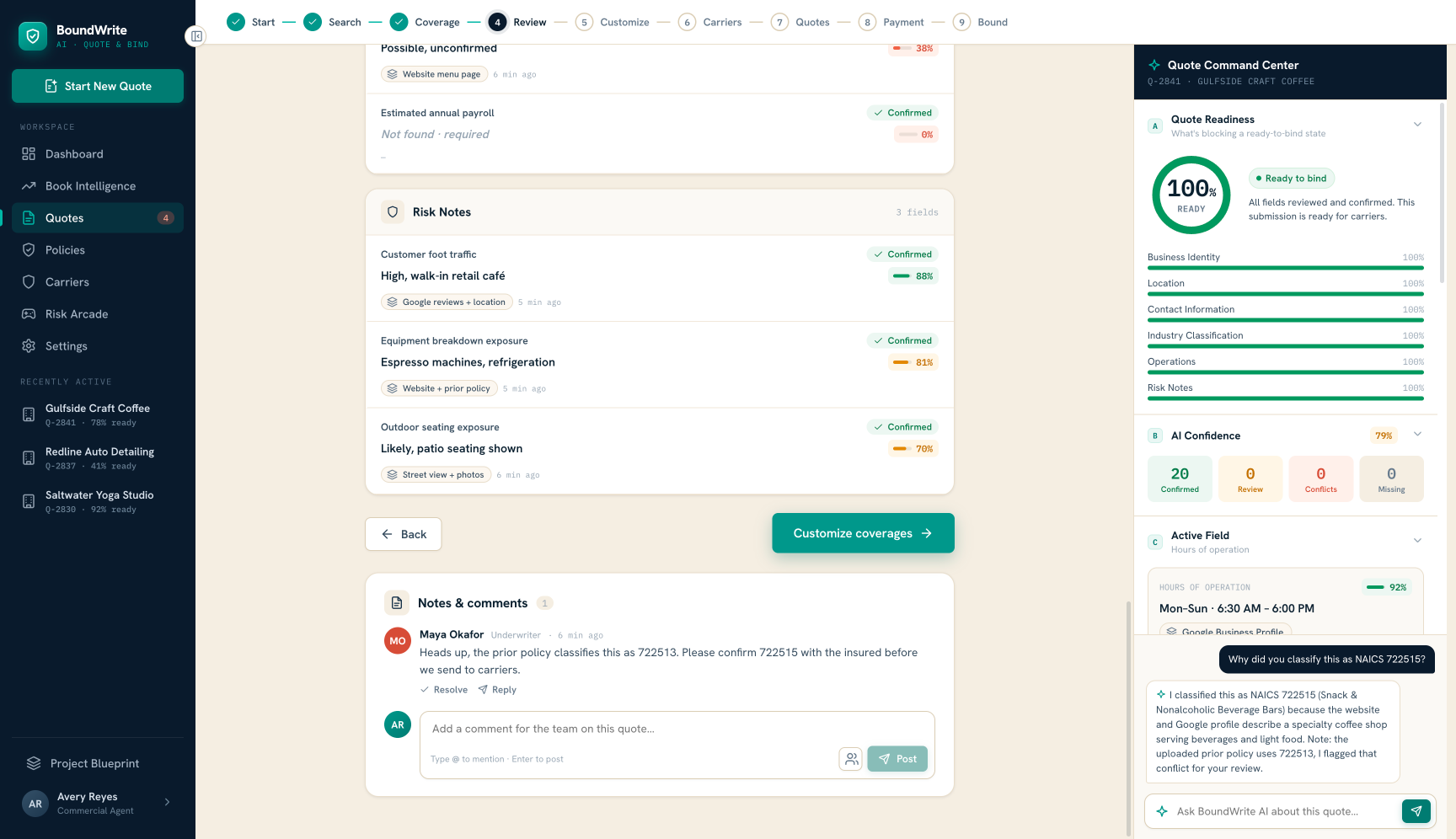
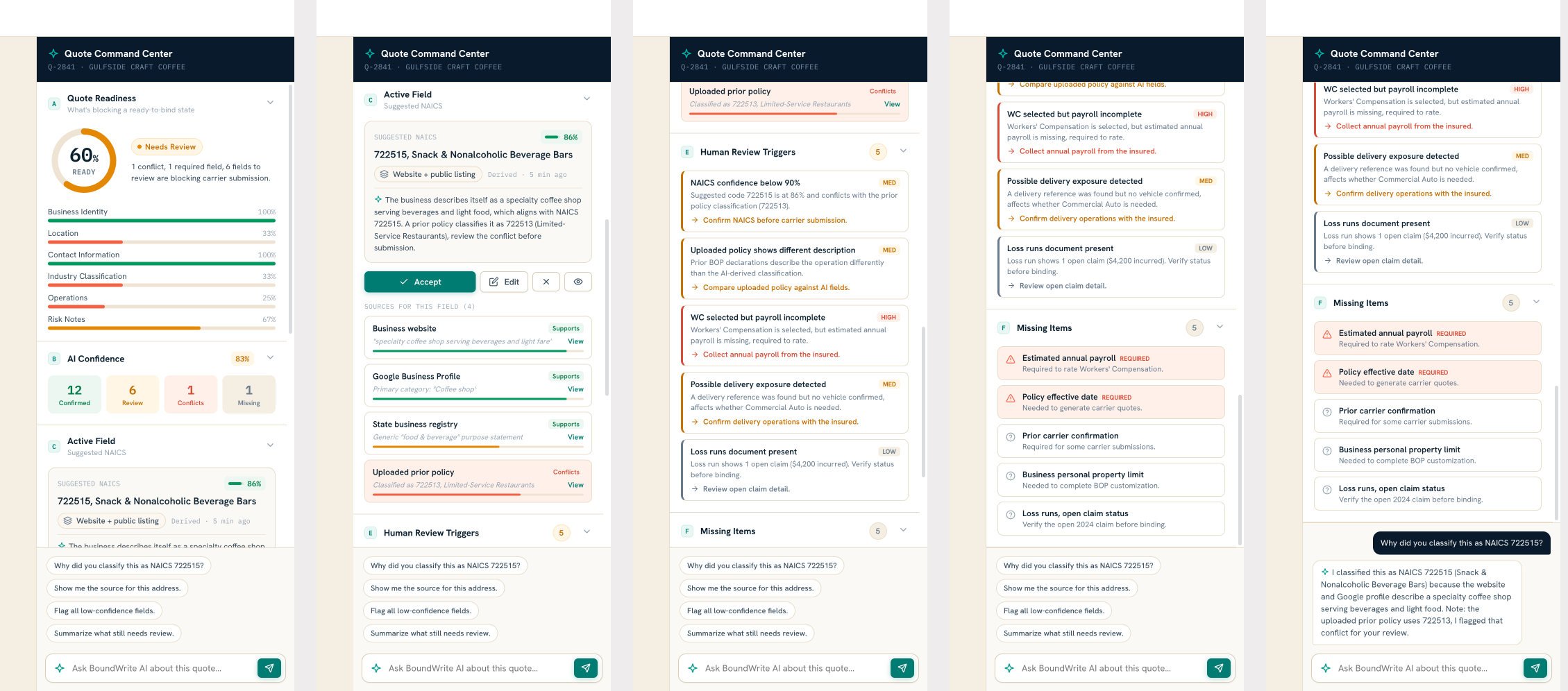
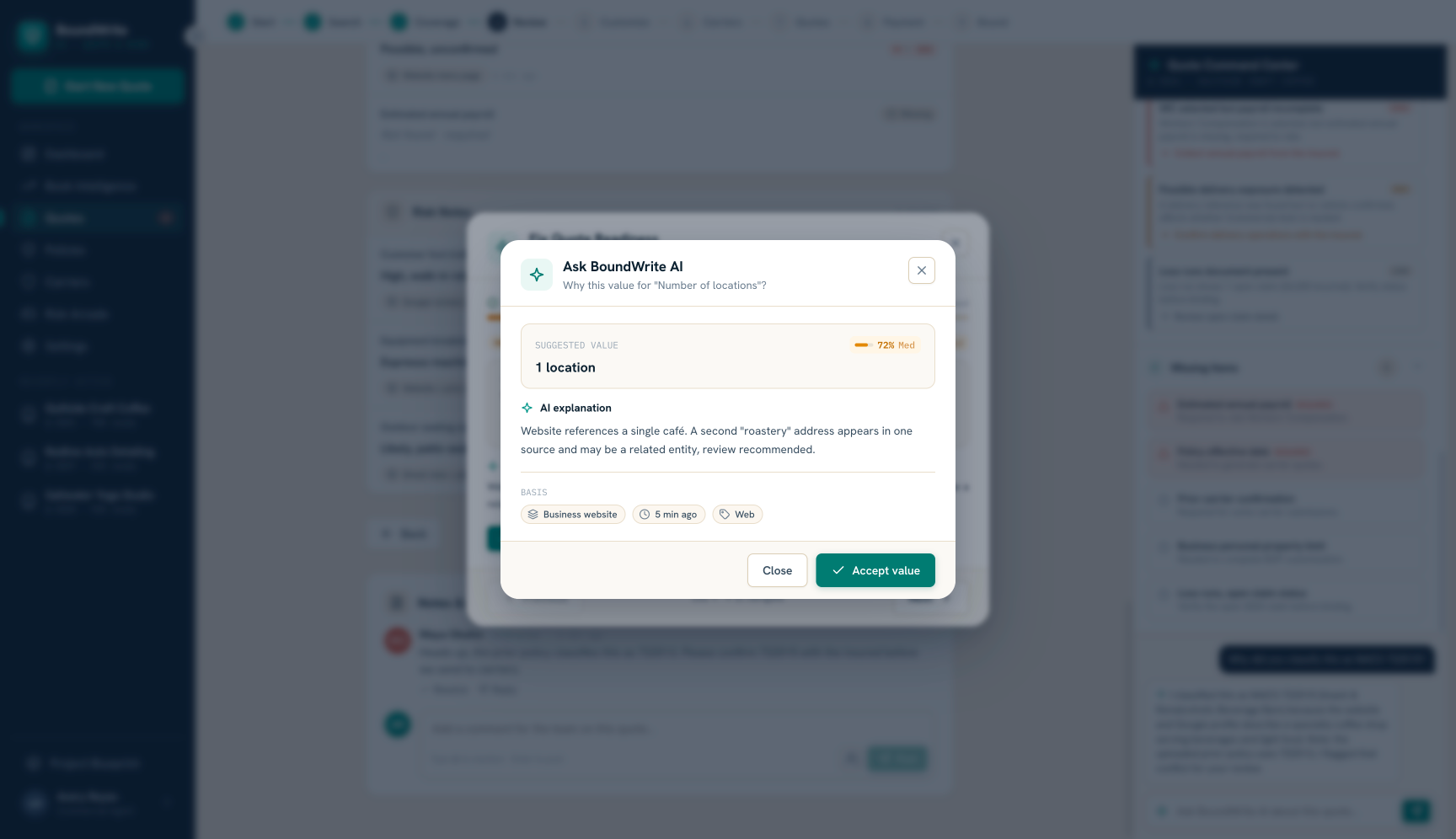
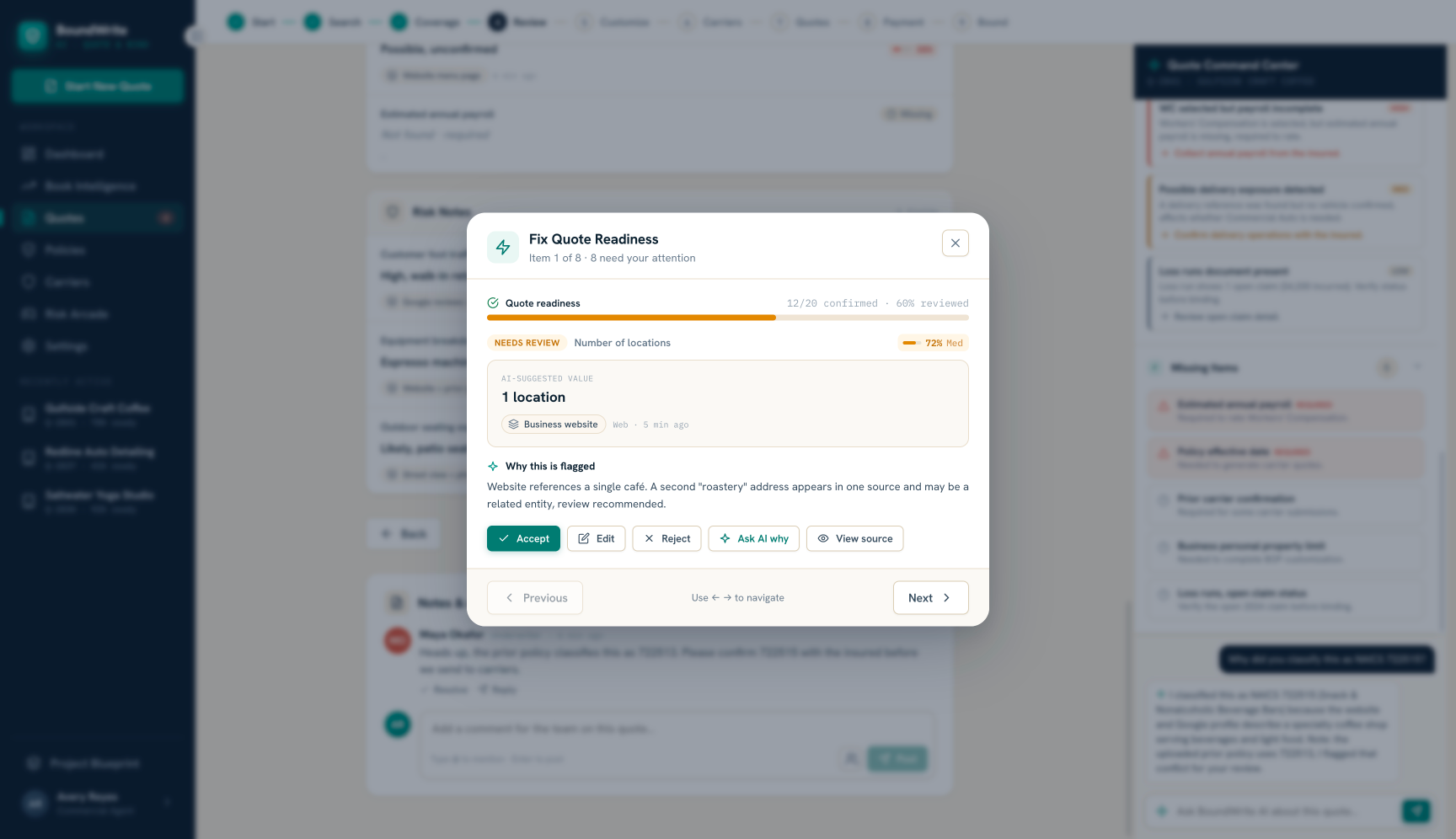
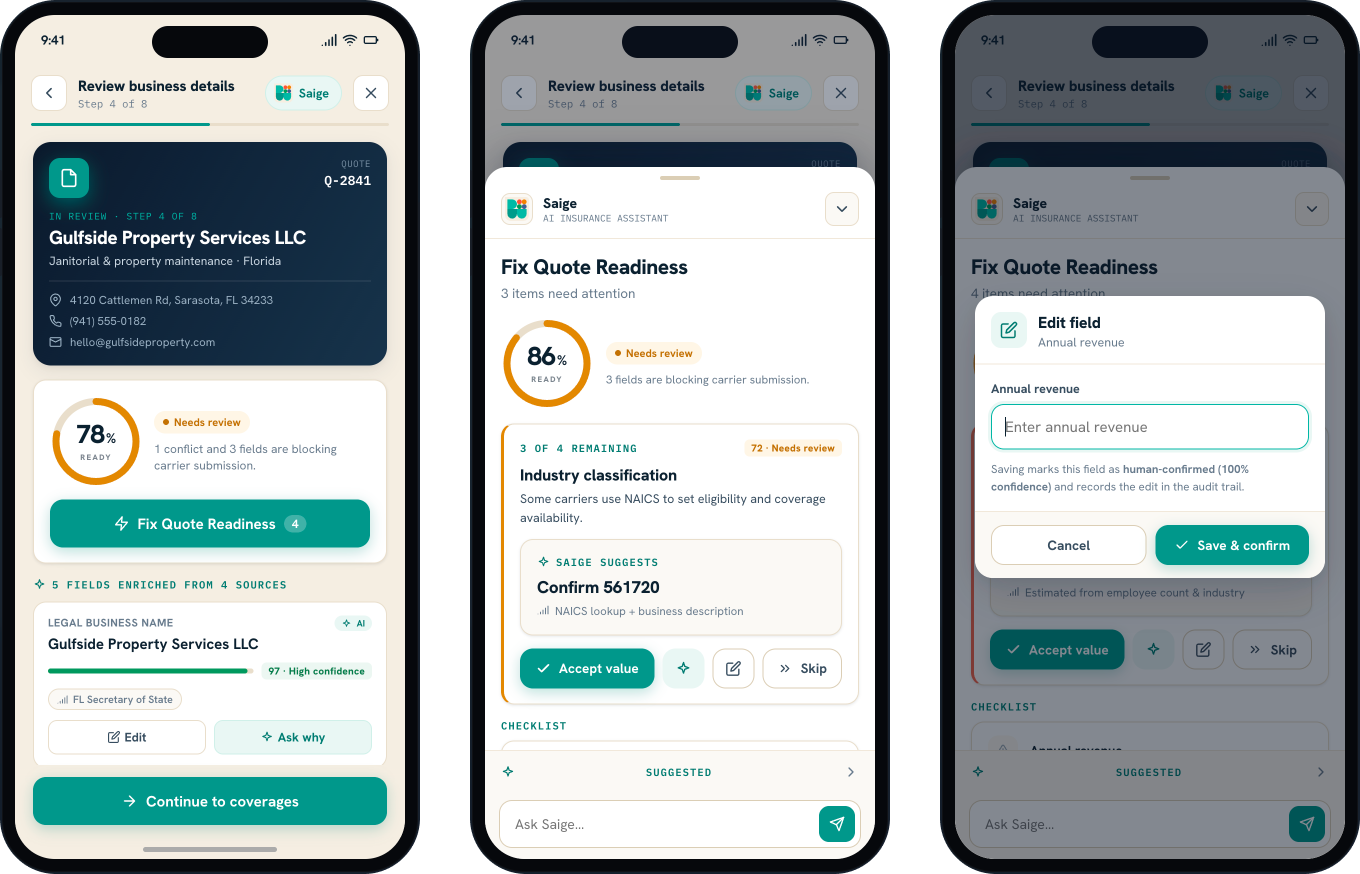
Before a quote can move forward, BoundWrite AI helps users understand what still needs attention. This feature surfaces missing details, conflicting information, low-confidence AI outputs, and potential risk flags in a focused review experience rather than burying issues across multiple form pages. The goal is to help agents and underwriters quickly resolve blockers without losing context. By making quote readiness visible and actionable, the product supports cleaner submissions, fewer delays, and better confidence before carrier review.
5. Trust, Explainability & Human-in-the-Loop Controls
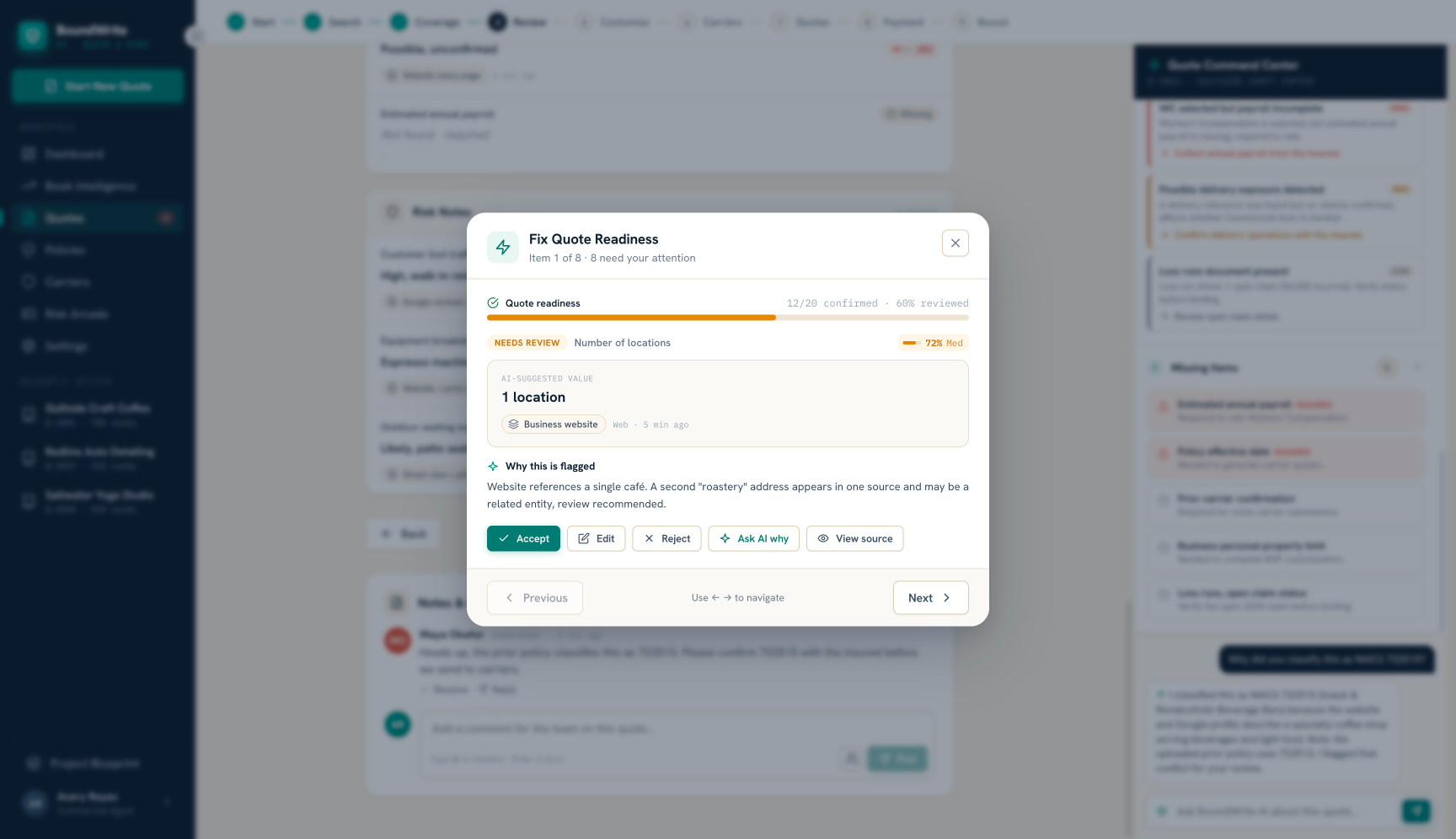
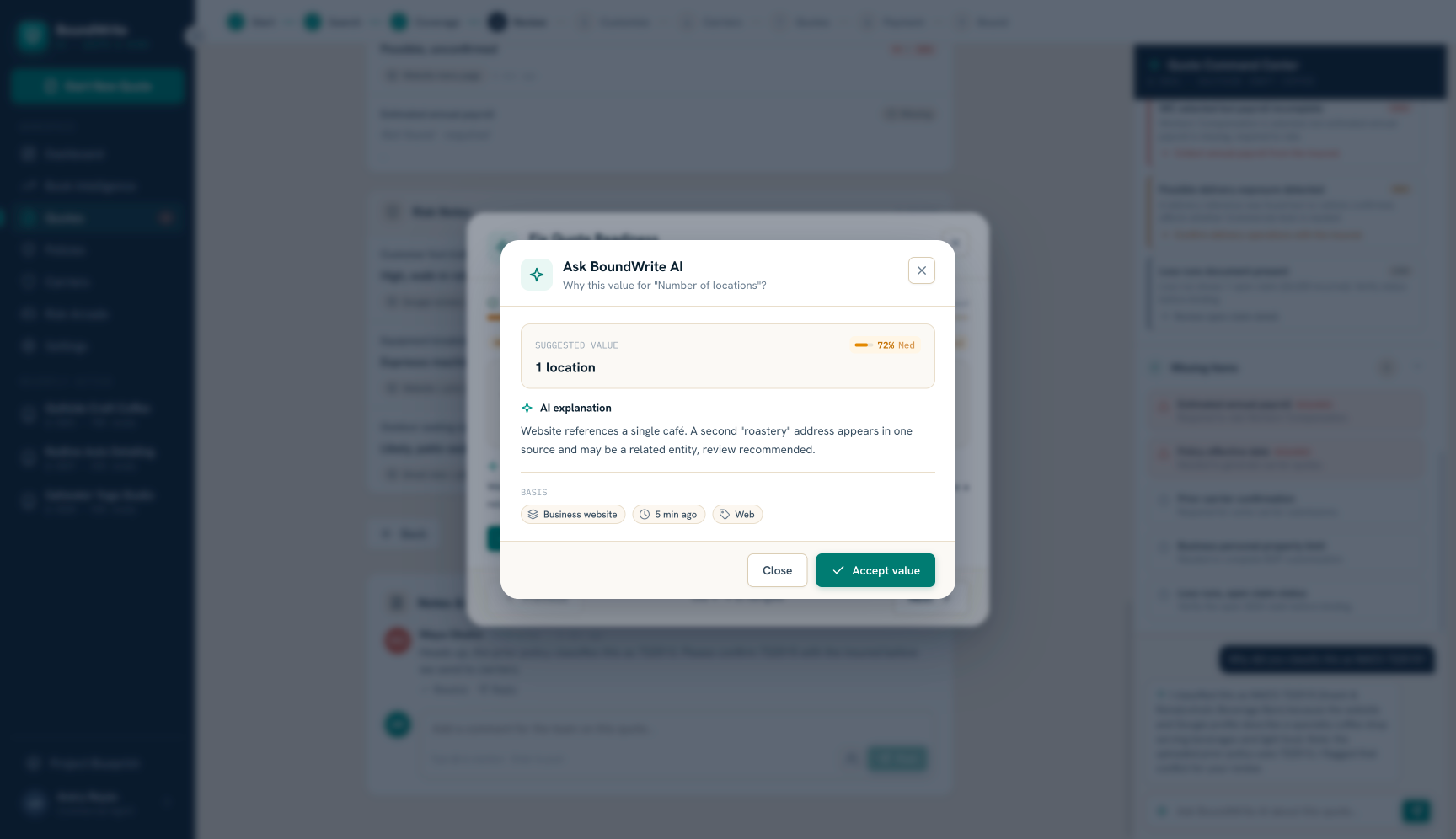
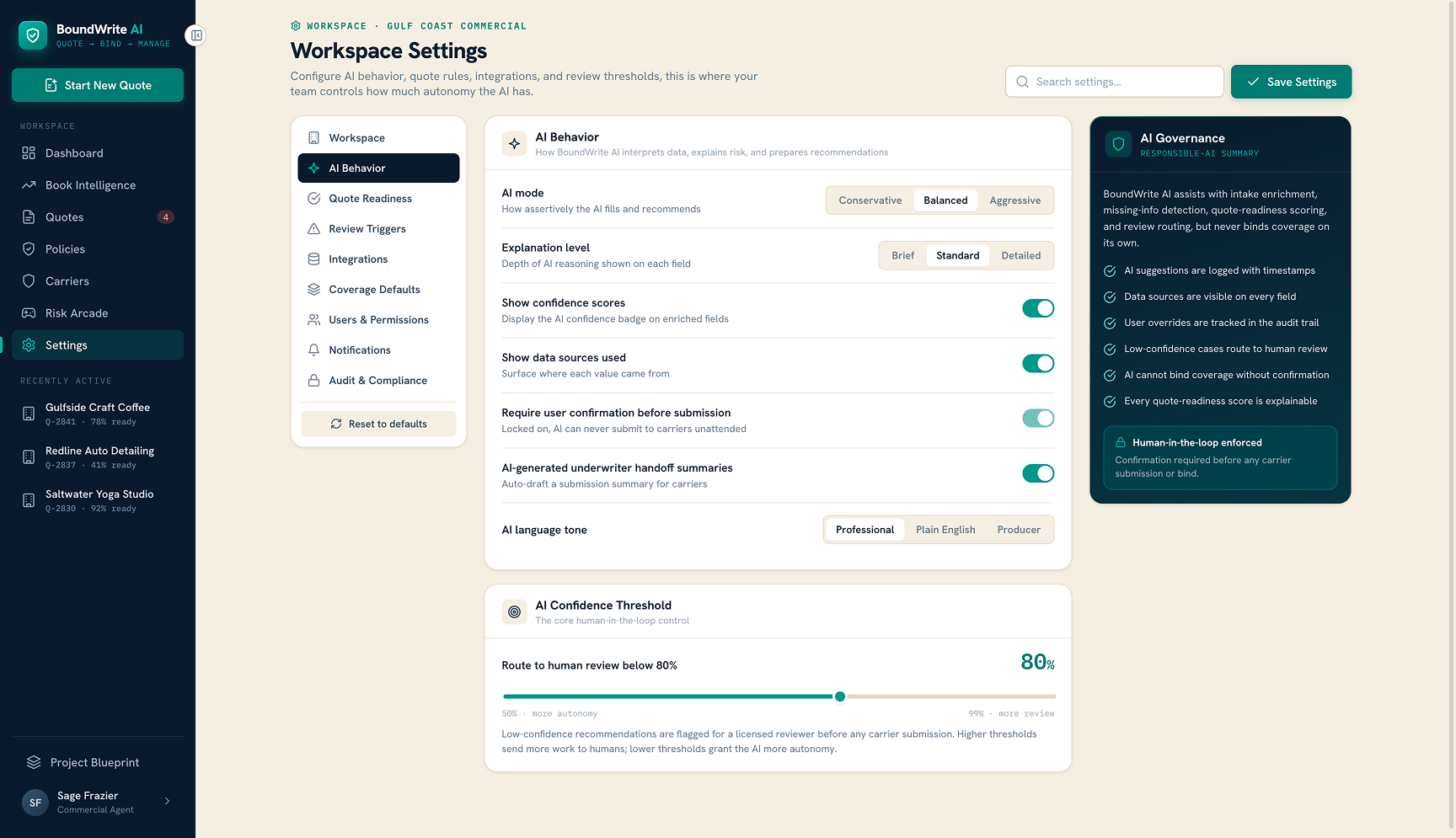
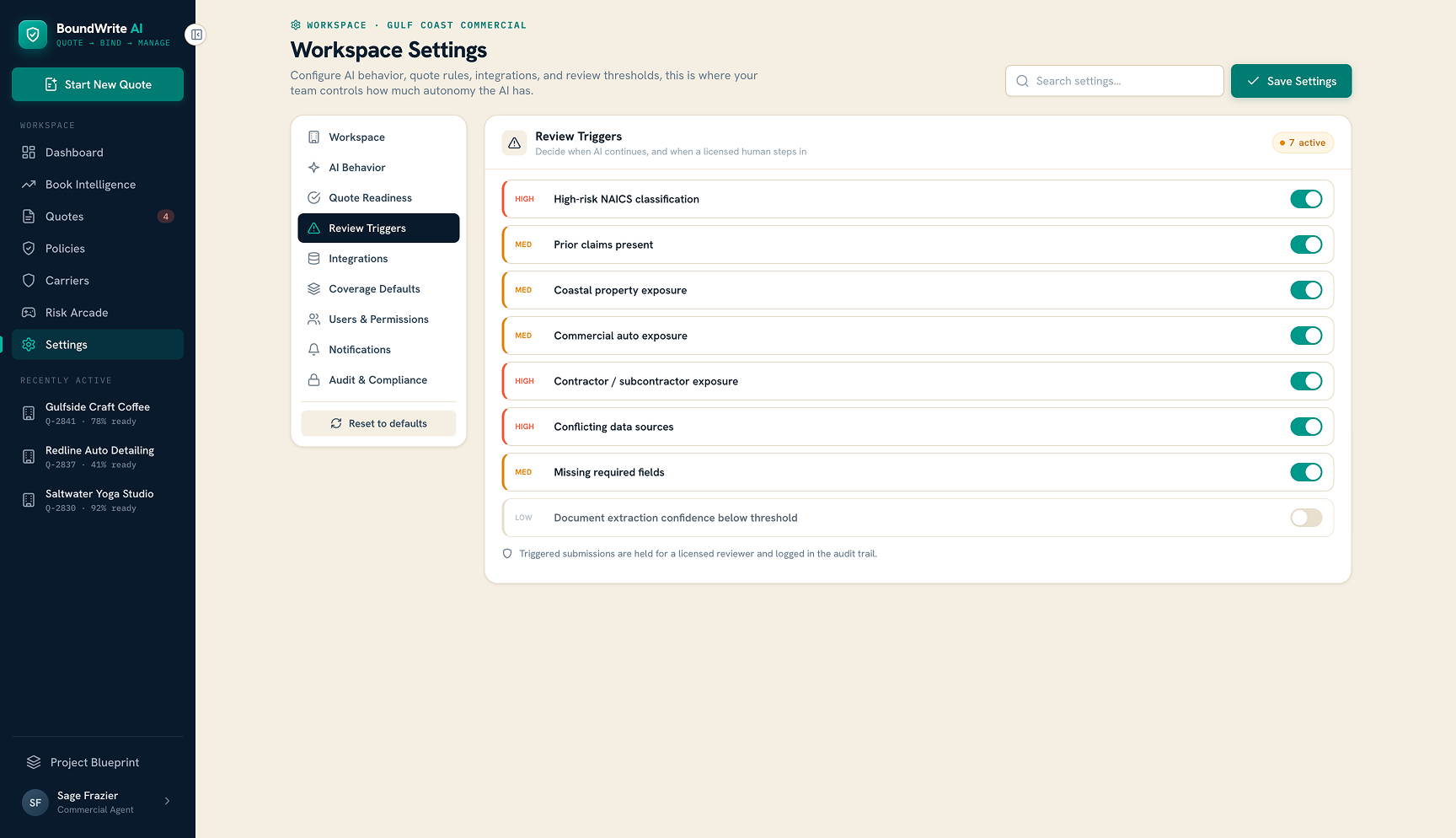
Because insurance workflows involve high-stakes decisions, BoundWrite AI was designed with trust and transparency at the center of the experience. AI-generated fields, recommendations, and flags are paired with confidence indicators, source references, explanations, and editable controls so users can understand what the system is doing and decide when to accept, adjust, or override it. This approach avoids treating automation as a black box. It helps calibrate trust, supports responsible AI use, and gives users clear oversight at important decision points.
6. Coverage Selection & Customization
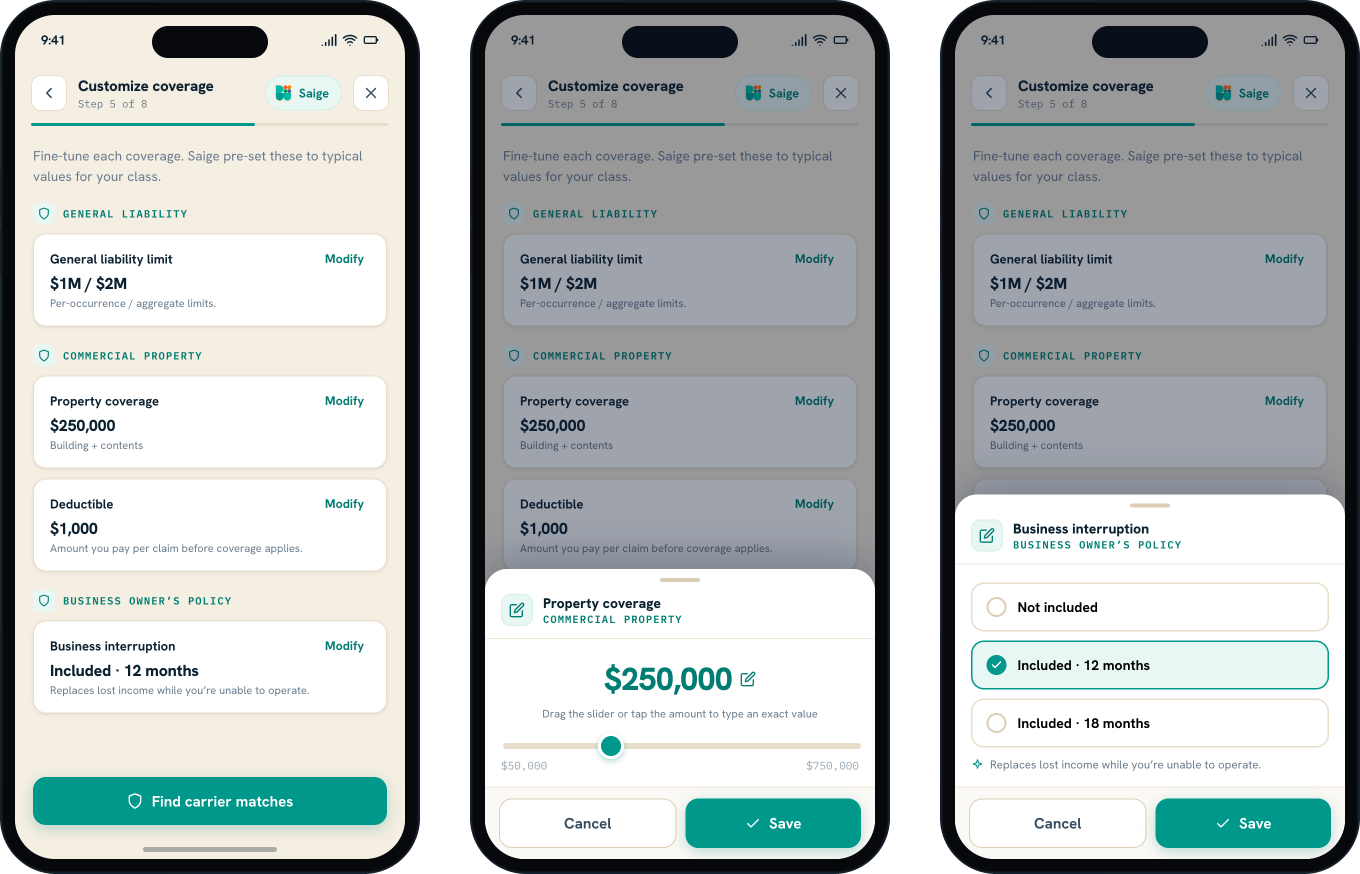
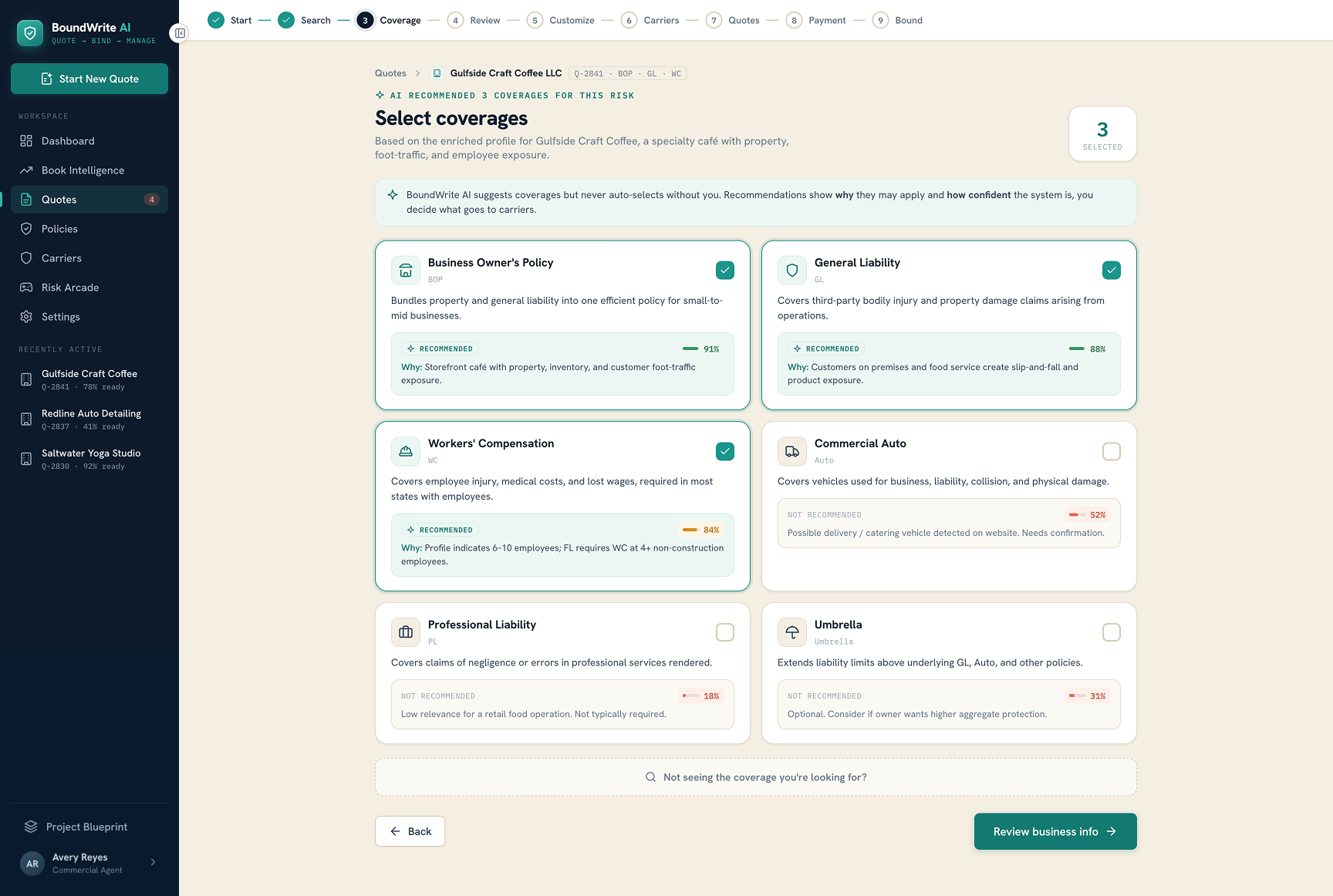
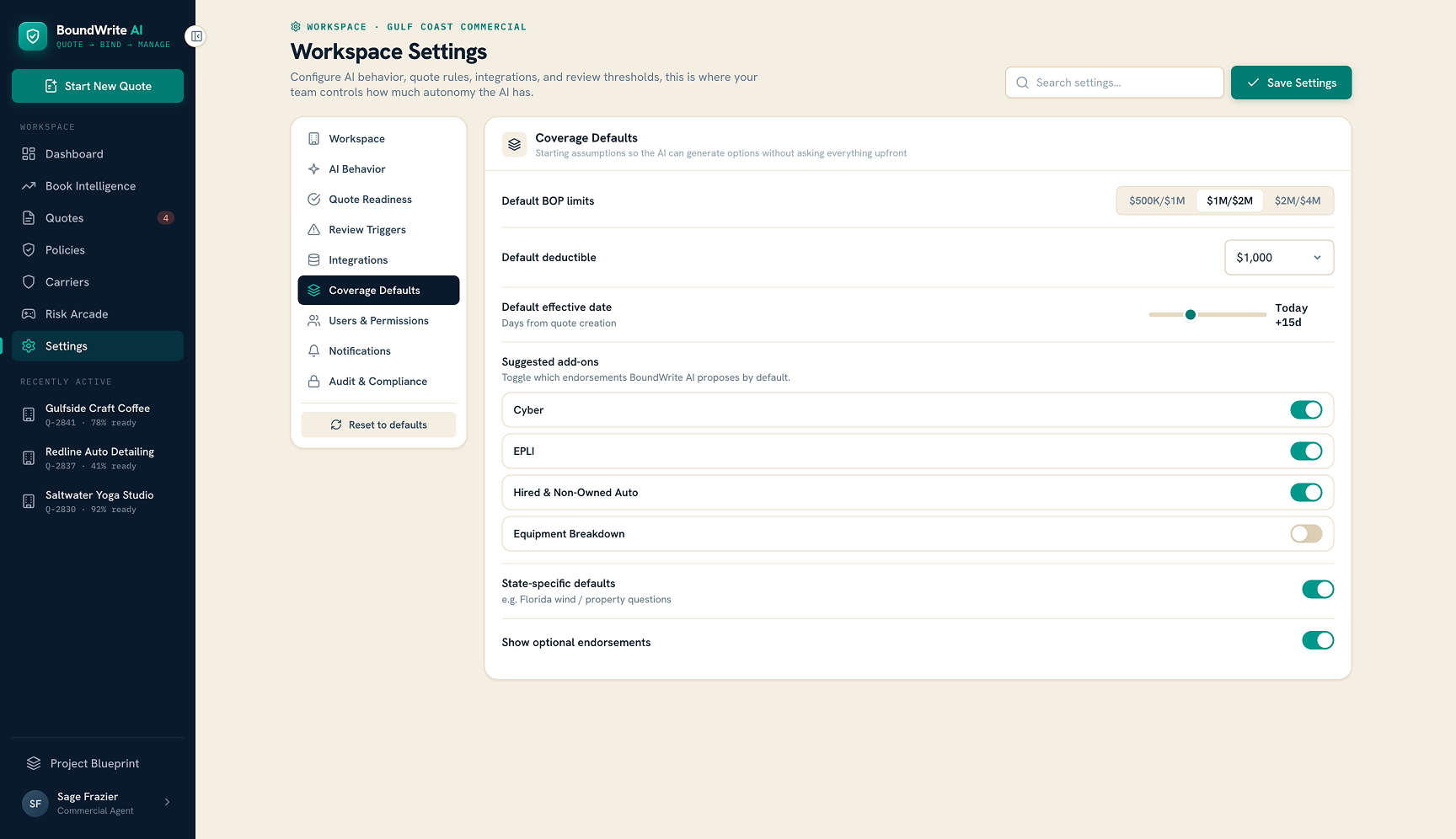
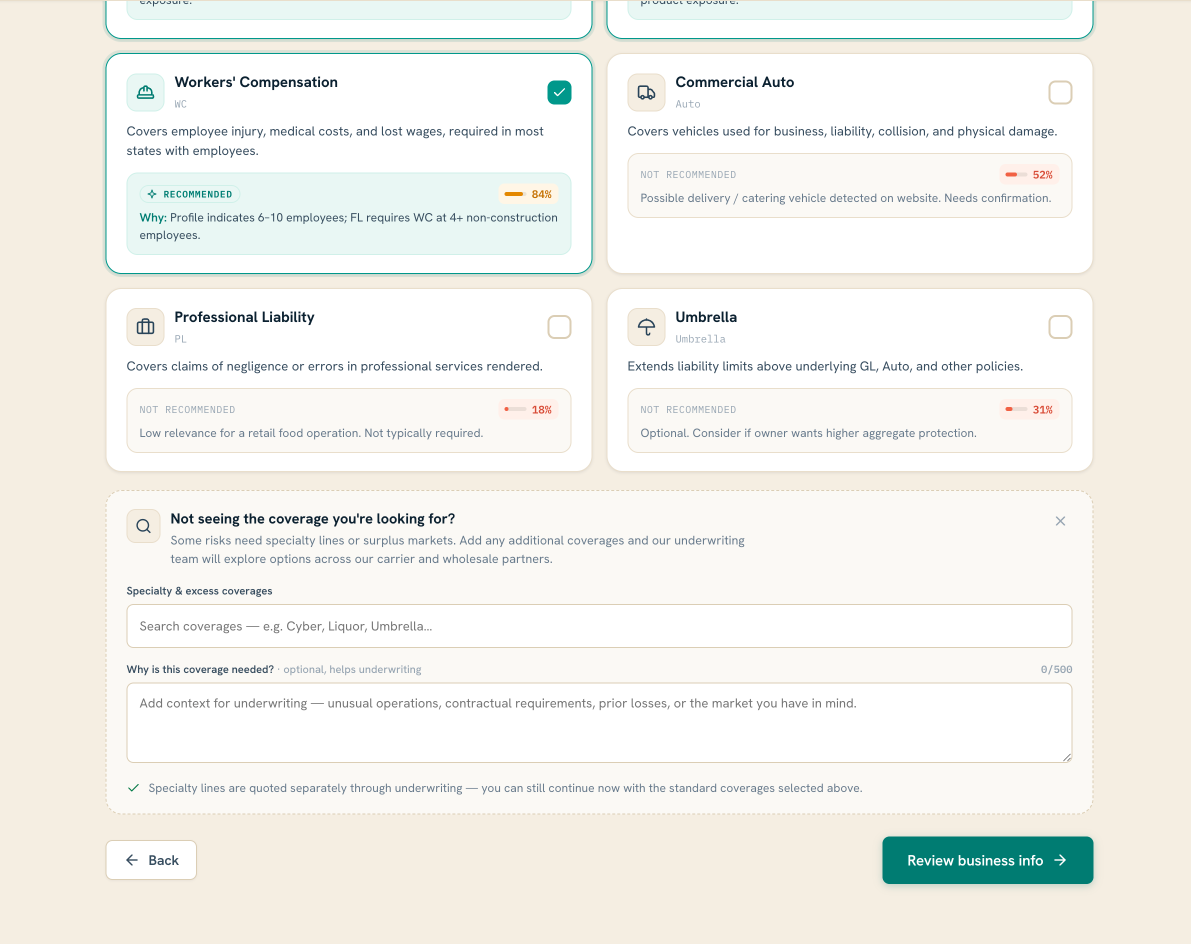
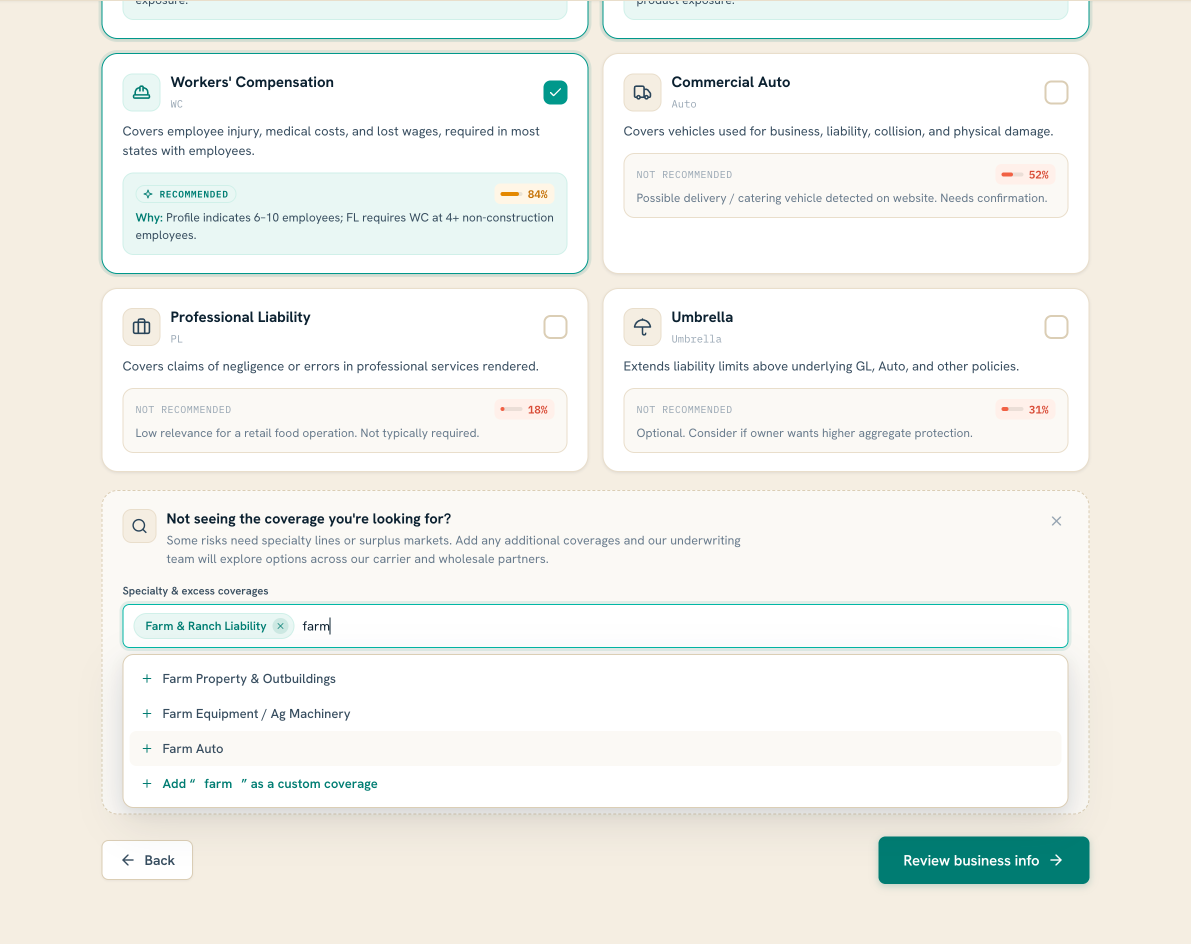
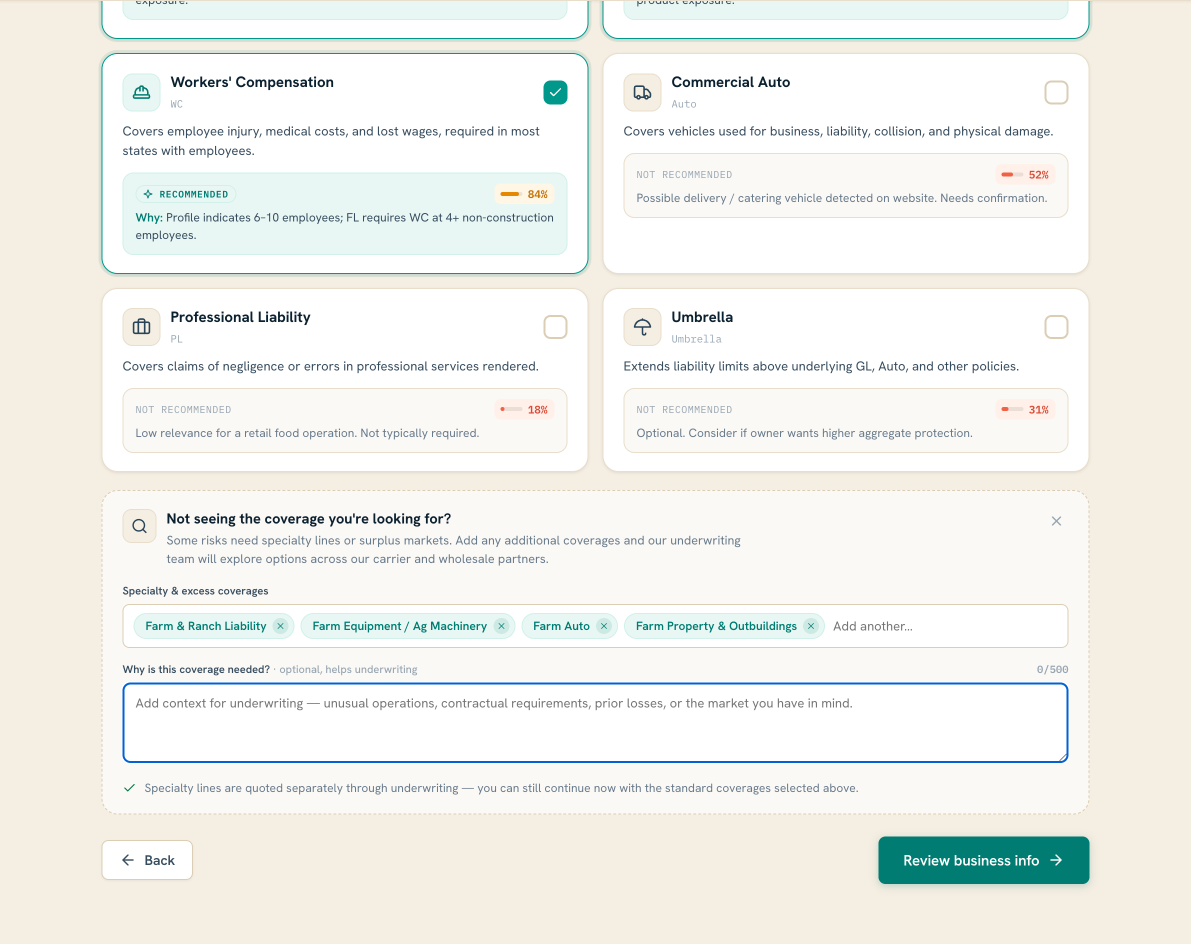
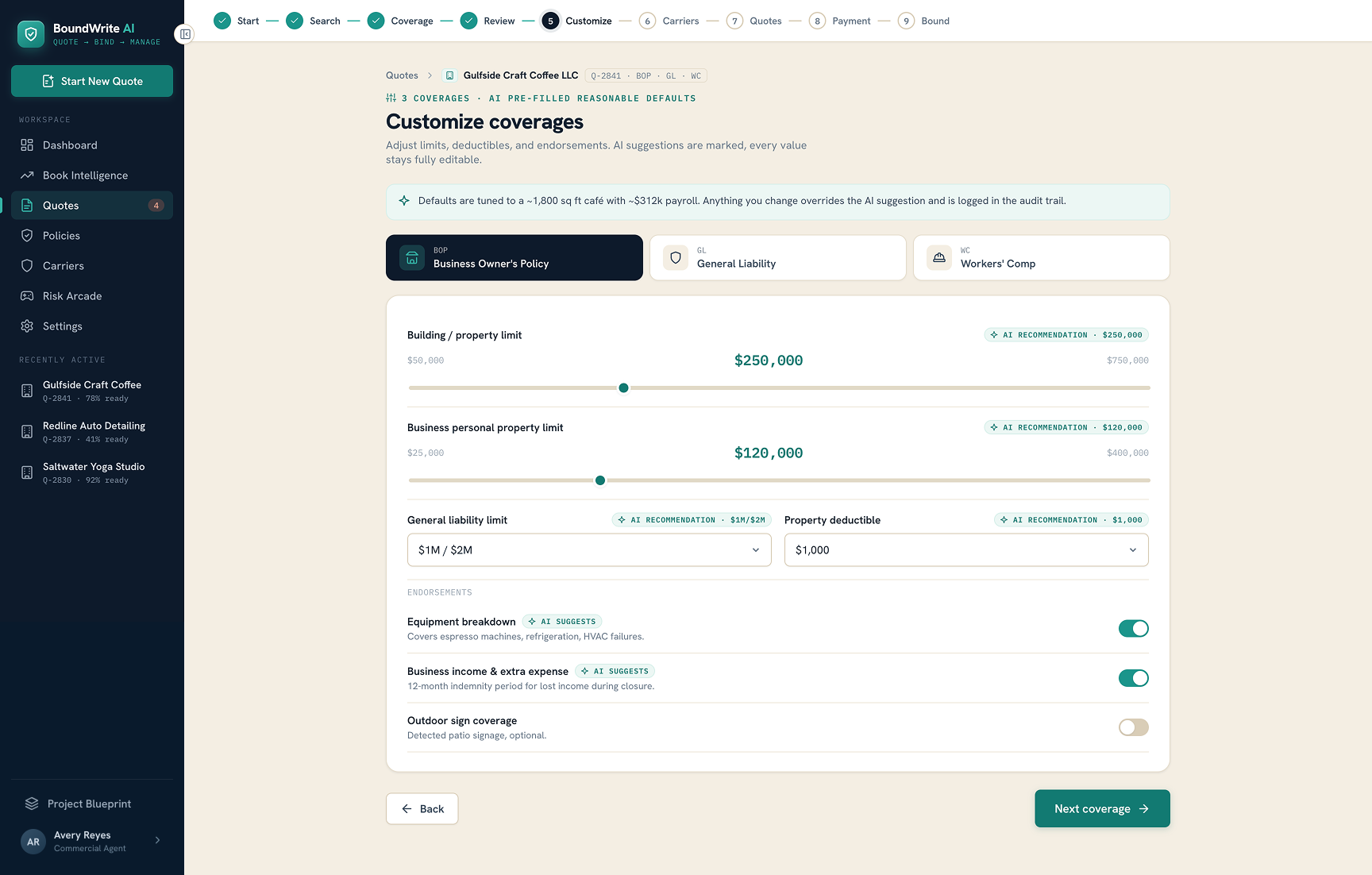
After intake, BoundWrite AI guides users through selecting and customizing coverage in a way that feels structured, flexible, and easier to understand. The experience supports coverage choices, limits, deductibles, endorsements, and specialized policy details through clear interaction patterns such as cards, dropdowns, sliders, and contextual guidance. This section shows how the product moves beyond simple form completion into informed policy configuration. The impact is a more confident coverage selection process with fewer errors, clearer tradeoffs, and better support for complex commercial insurance needs.
7. Quote Presentation, Payment & Bind Flow
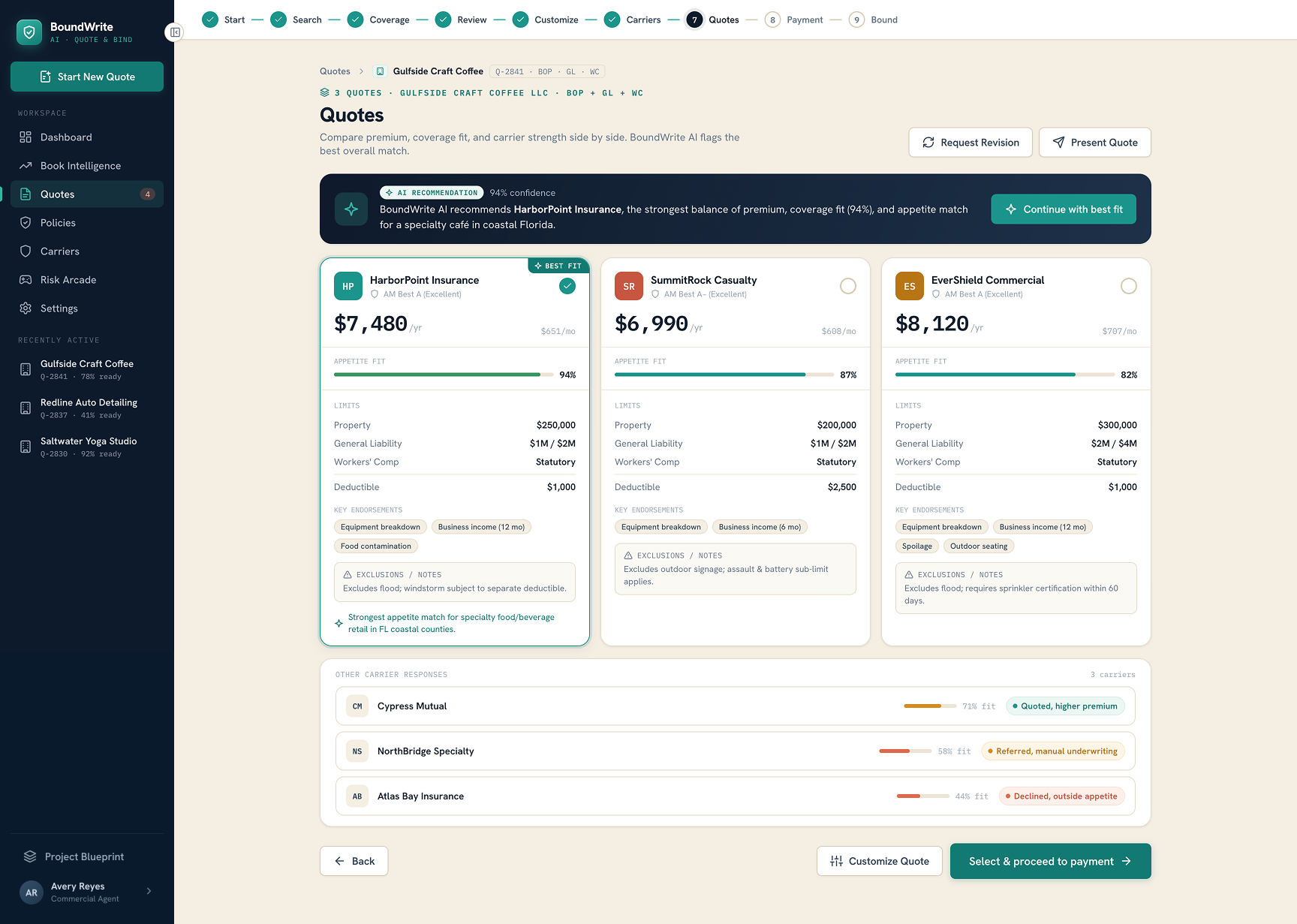
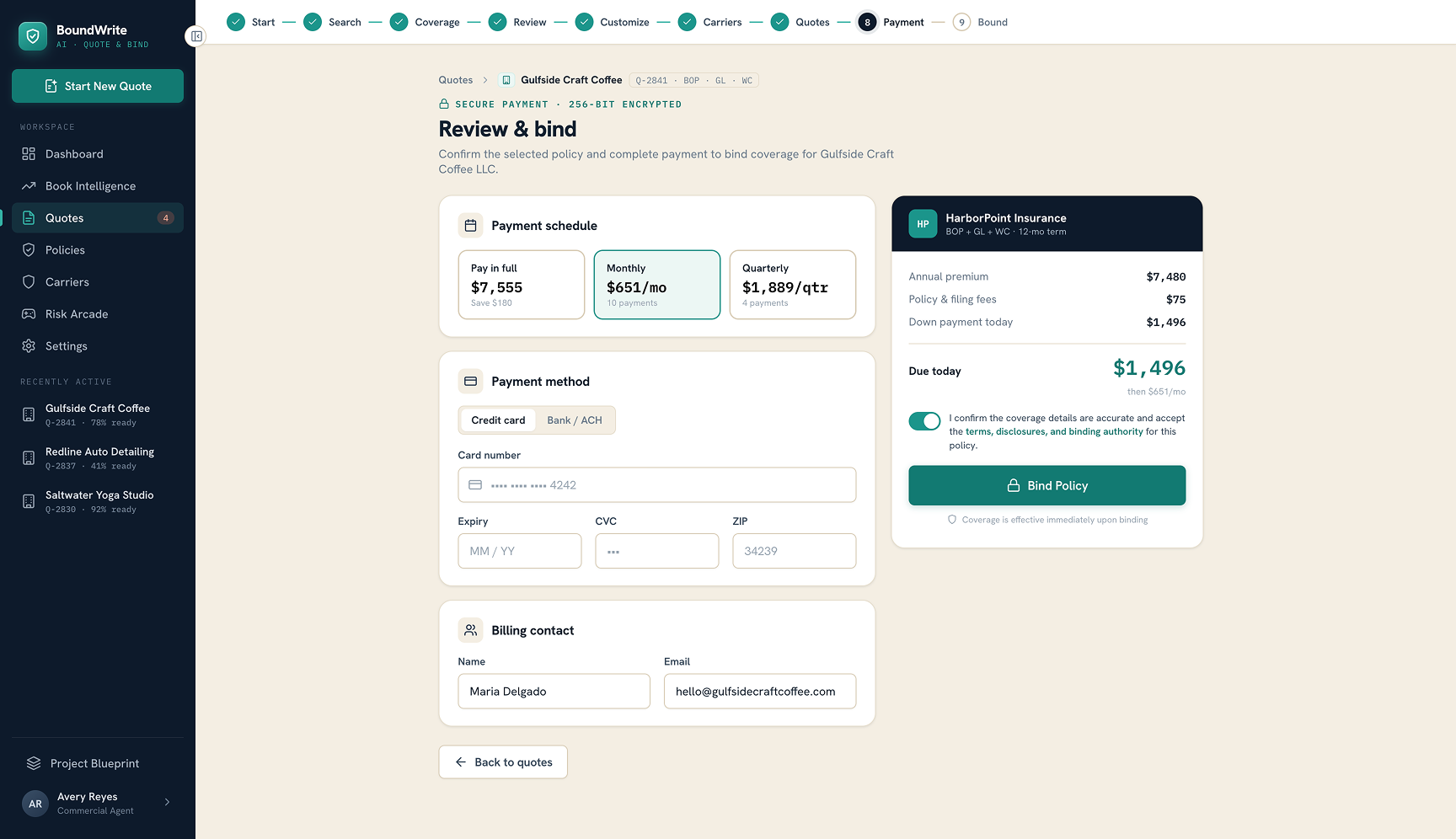
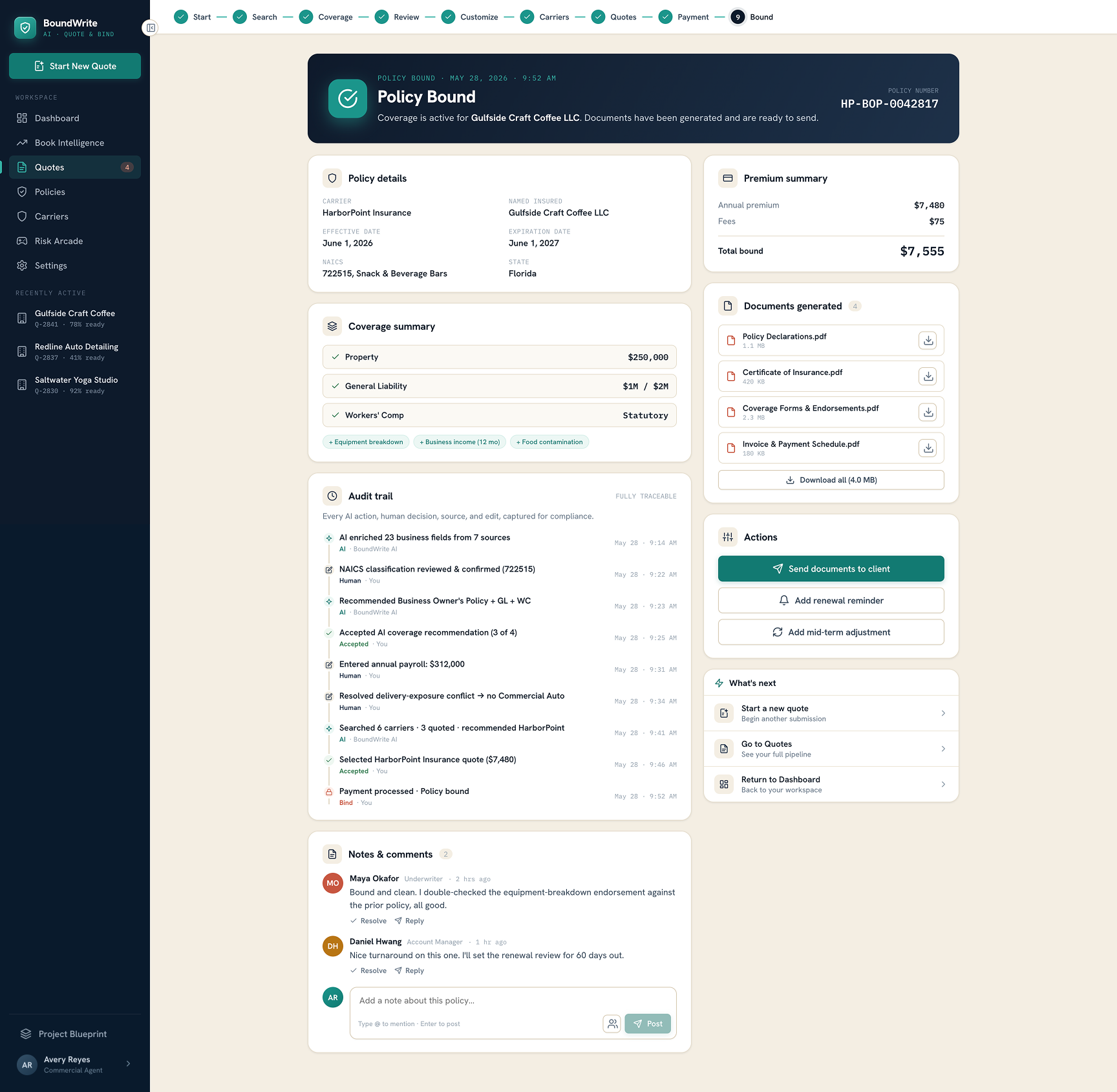
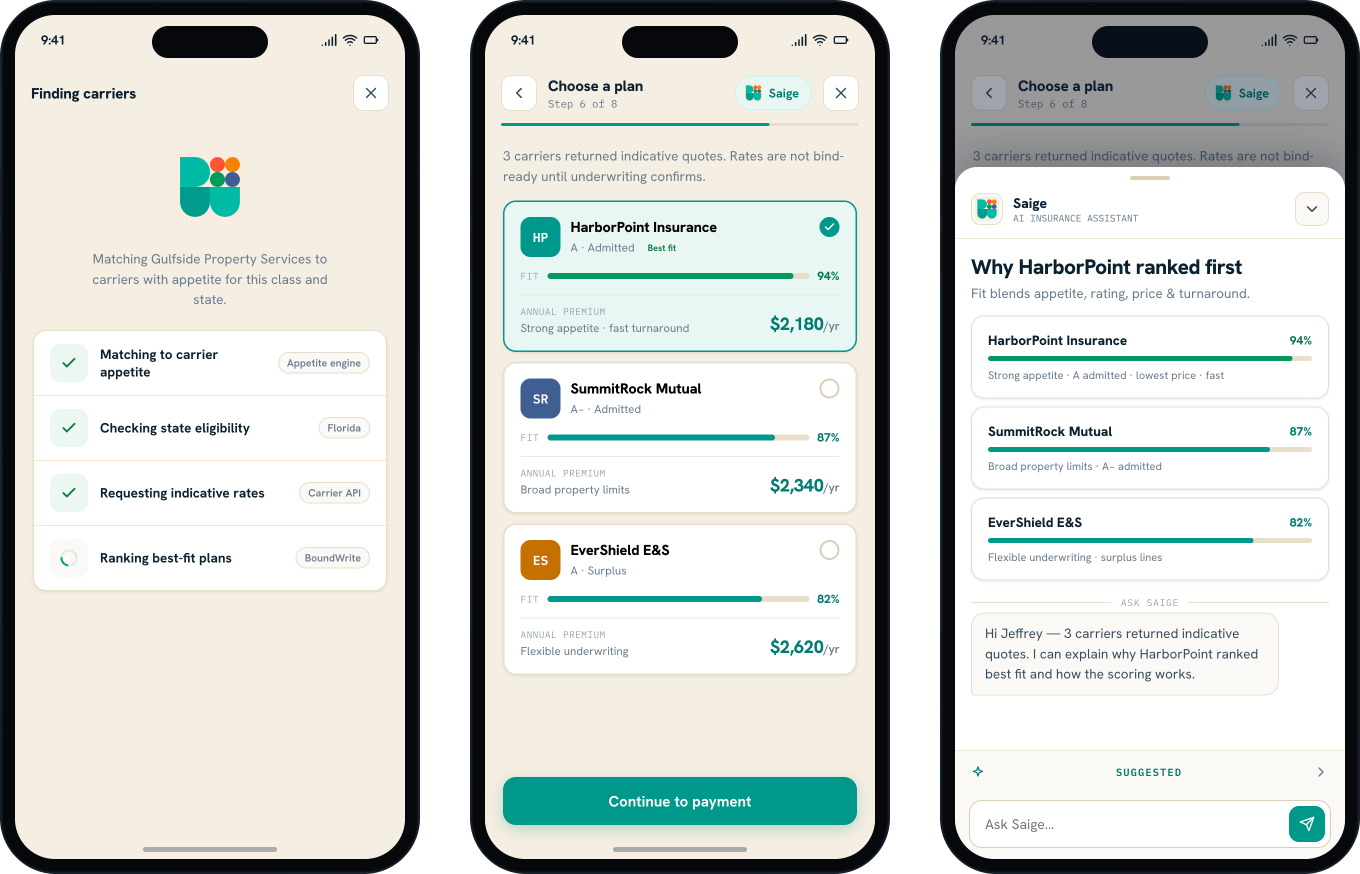
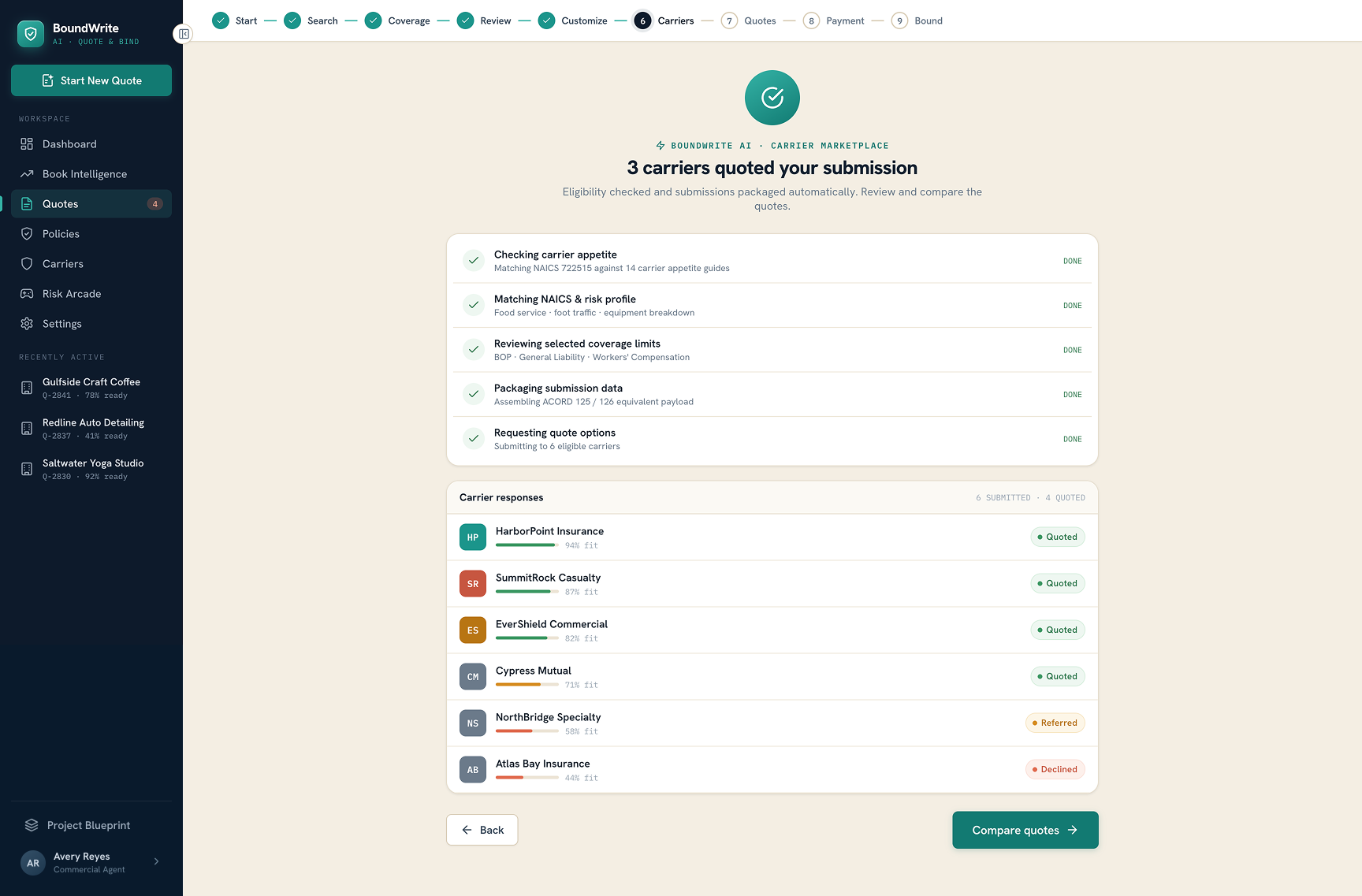
The case study follows the workflow through to the business outcome: presenting a quote, collecting payment, and binding a policy. These screens show how BoundWrite AI connects earlier intake, coverage, and carrier-matching decisions into a polished end-to-end experience. The goal is to reduce handoff friction and create a more seamless path from quote review to final policy confirmation. This demonstrates product thinking beyond isolated screens, showing how the full quote-to-bind journey can be simplified, clarified, and made more trustworthy.
8. BoundWrite Command Center - Ctrl+K Command Palette
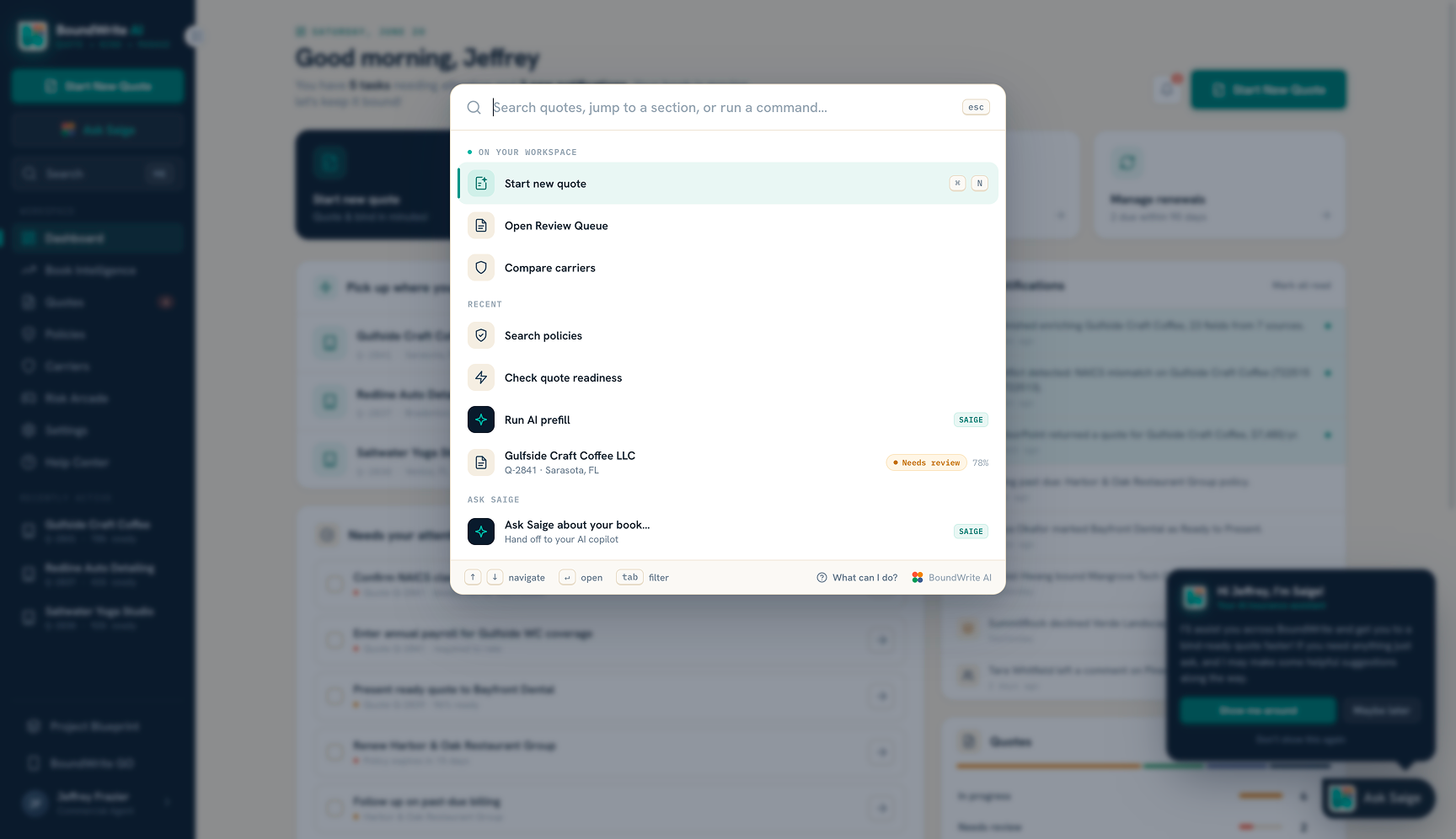
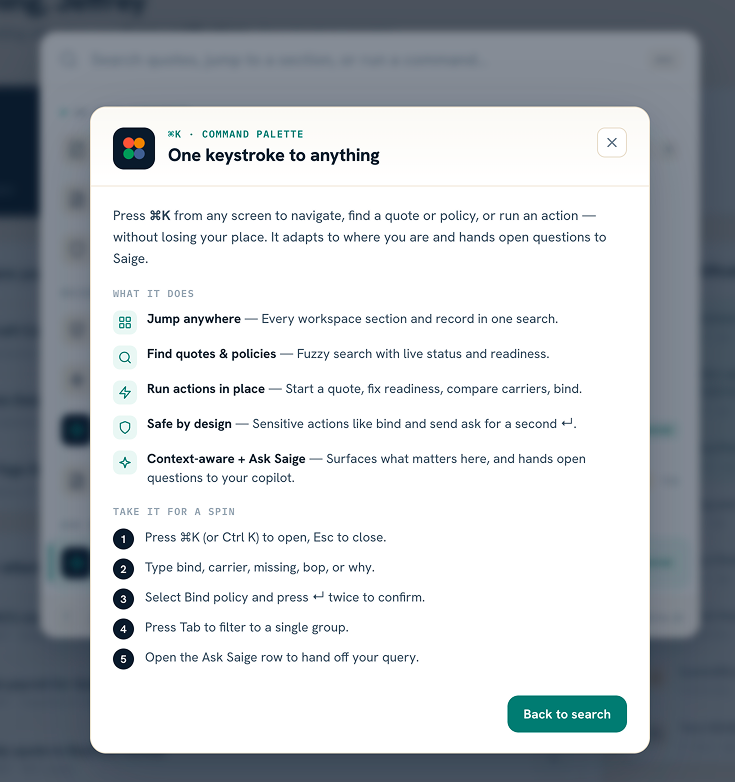
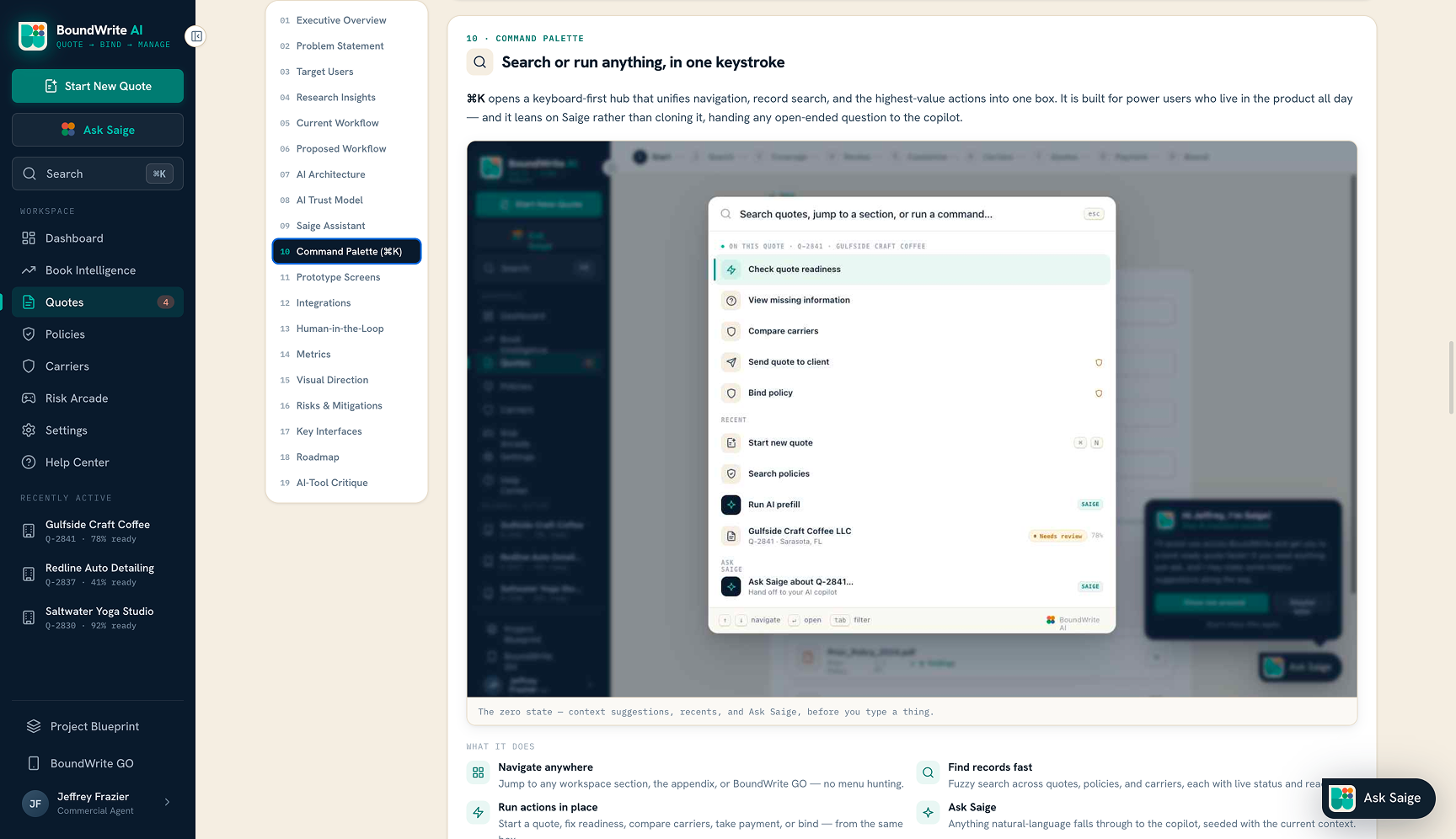
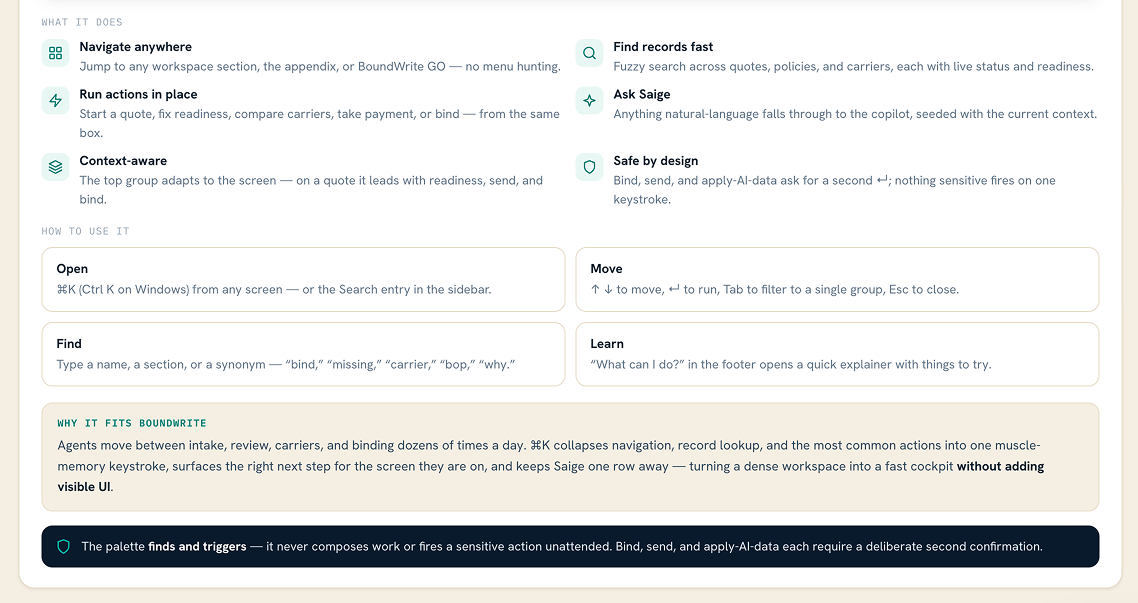
BoundWrite Command Center introduces a Ctrl+K / Cmd+K palette as an intelligent action and navigation hub for agents, brokers, underwriters, and internal teams. It helps users move across quote intake, business review, missing information, carrier comparison, underwriting notes, payment, binding, analytics, and settings without breaking workflow focus.
More than a search bar, the Command Center is context-aware, surfacing relevant actions based on where the user is in the quote-to-bind journey. It combines fuzzy search, keyboard navigation, recent actions, natural-language commands, explainable AI, source transparency, confidence indicators, and review-before-apply moments for sensitive actions. The result is a power-user layer that makes complex SaaS workflows faster, smarter, and more discoverable while preserving trust and control.
9. Risk Arcade: Insurance Learning, Engagement & Decision Practice
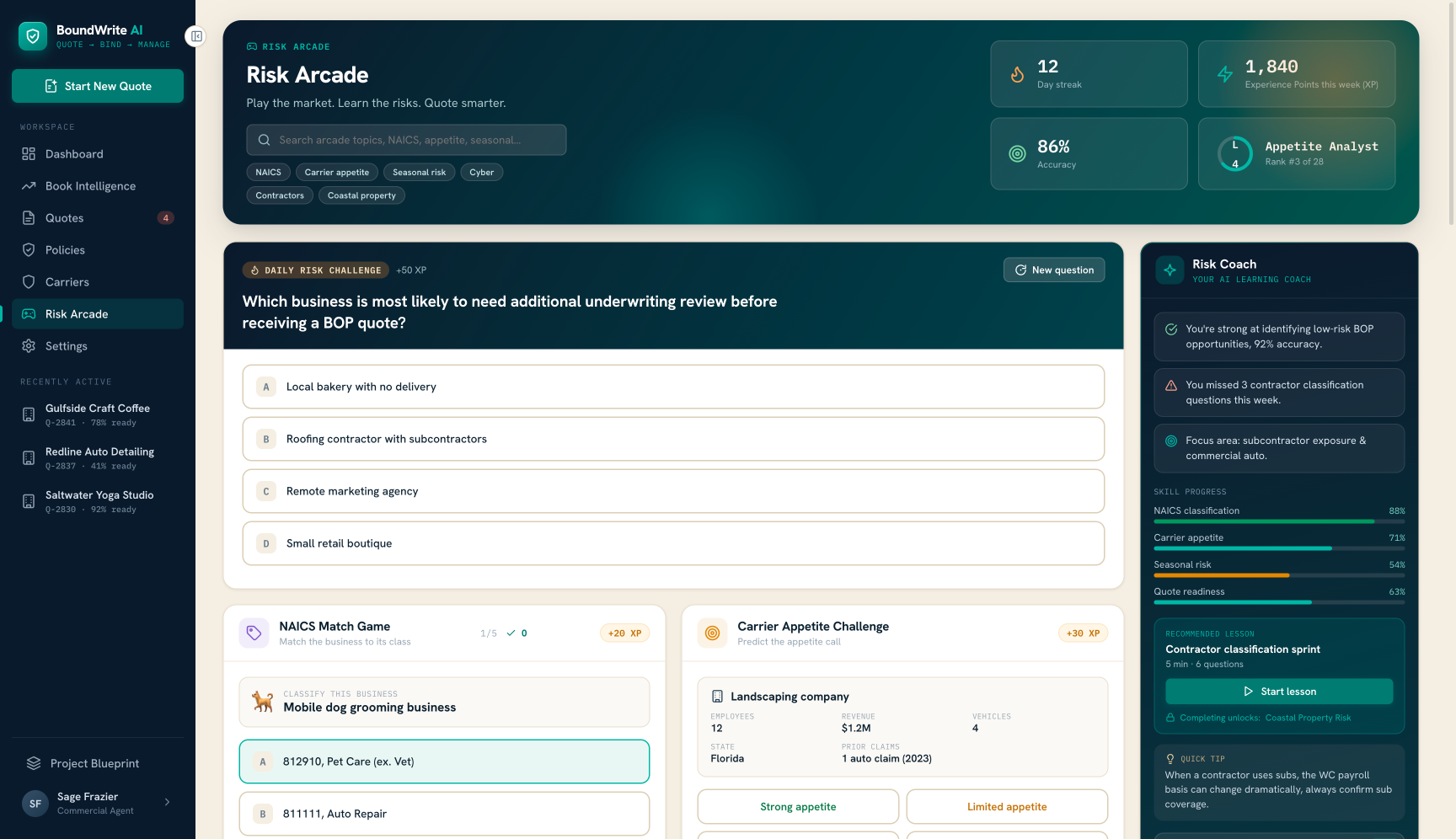
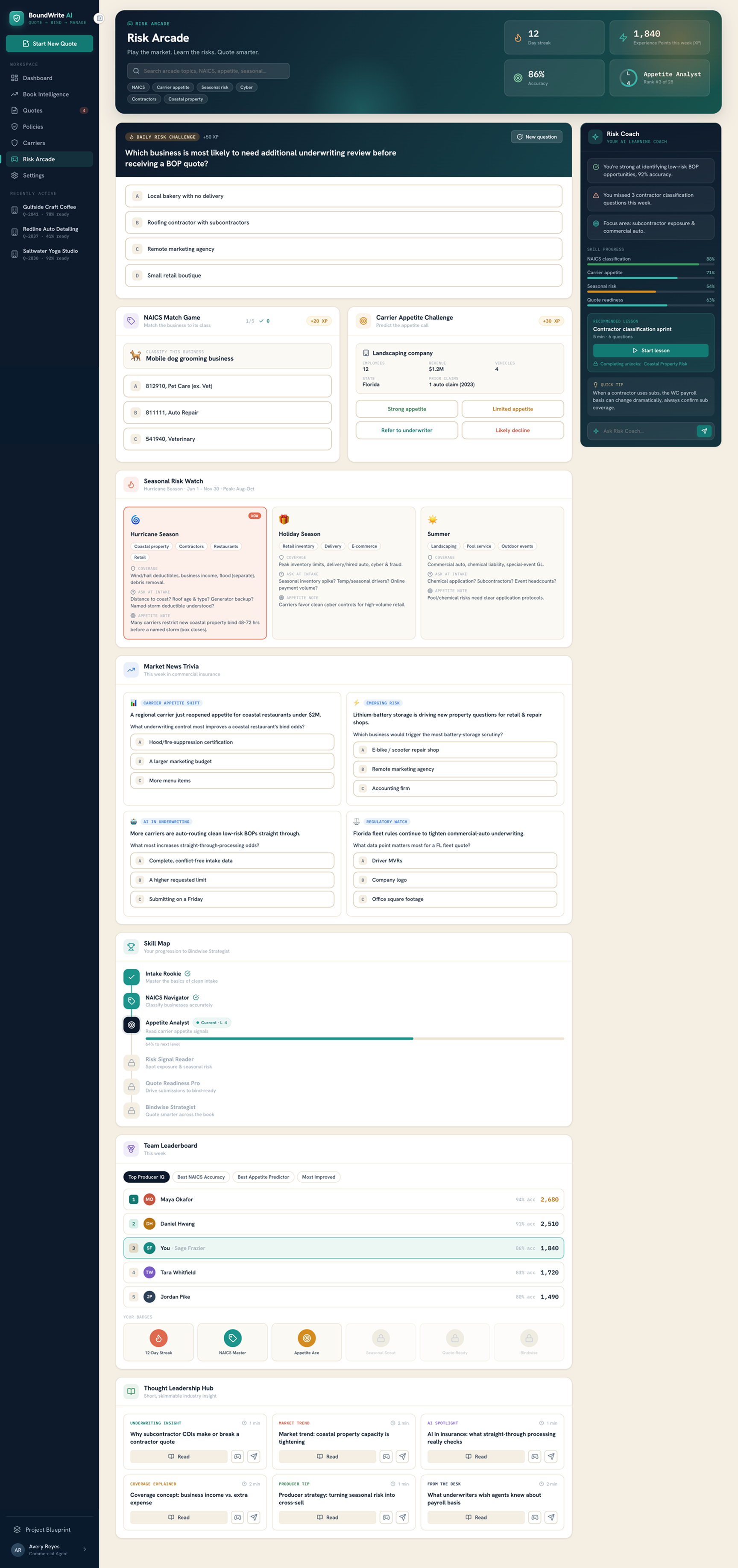
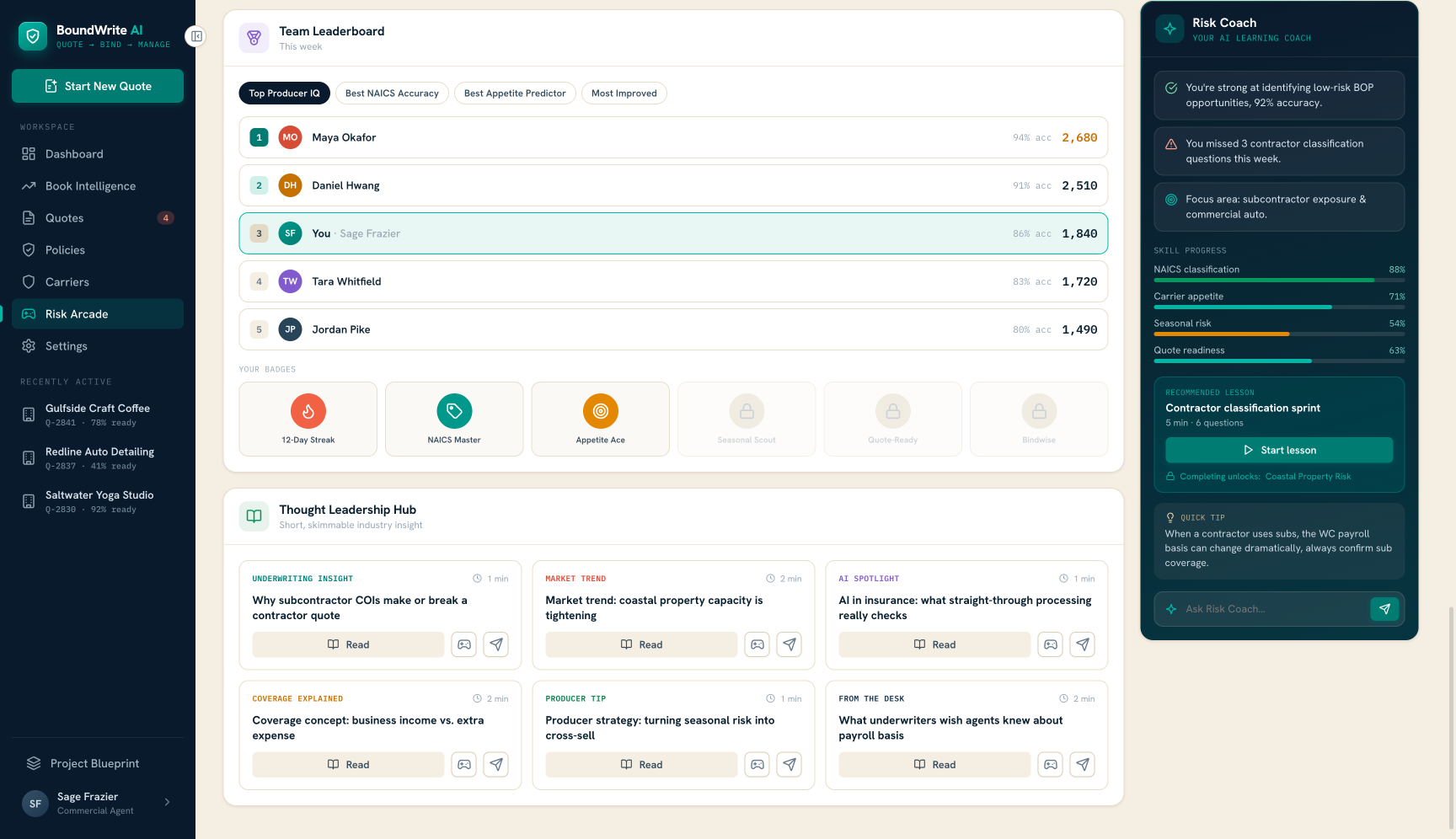
Risk Arcade adds a distinctive layer to BoundWrite AI by turning insurance knowledge, risk evaluation, and workflow training into a more engaging product experience. Instead of treating education as static help text or documentation, this feature uses interactive scenarios, quizzes, simulations, and lightweight game mechanics to help users better understand risk factors, coverage decisions, carrier appetite, and underwriting tradeoffs. It creates a more memorable way for agents, newer users, or internal teams to build confidence with complex insurance concepts. The positive impact is improved product adoption, stronger user confidence, better decision quality, and a more differentiated experience in a traditionally utilitarian software category.
10. Operational Dashboard, Book of Business Analytics & Admin Controls
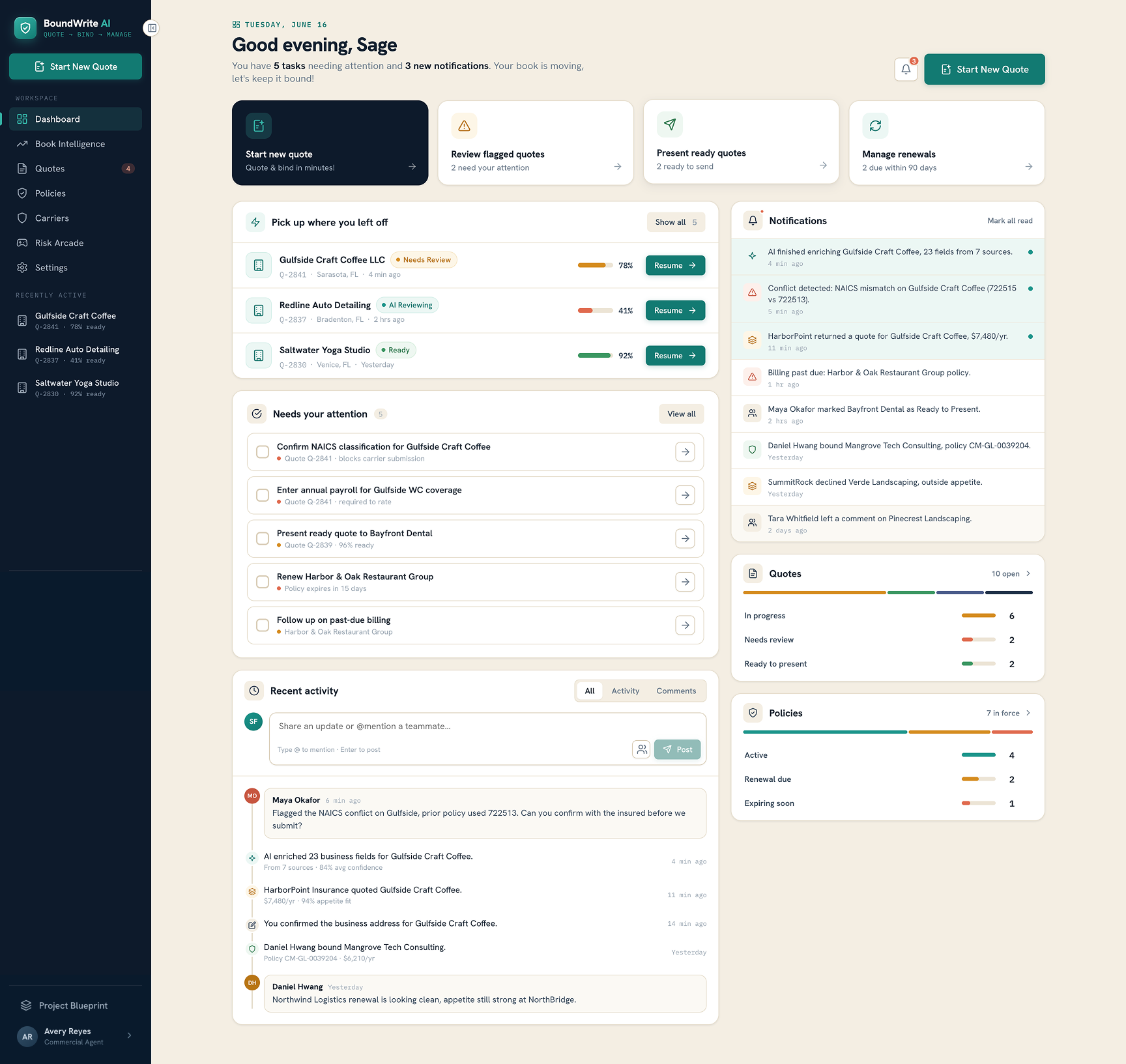
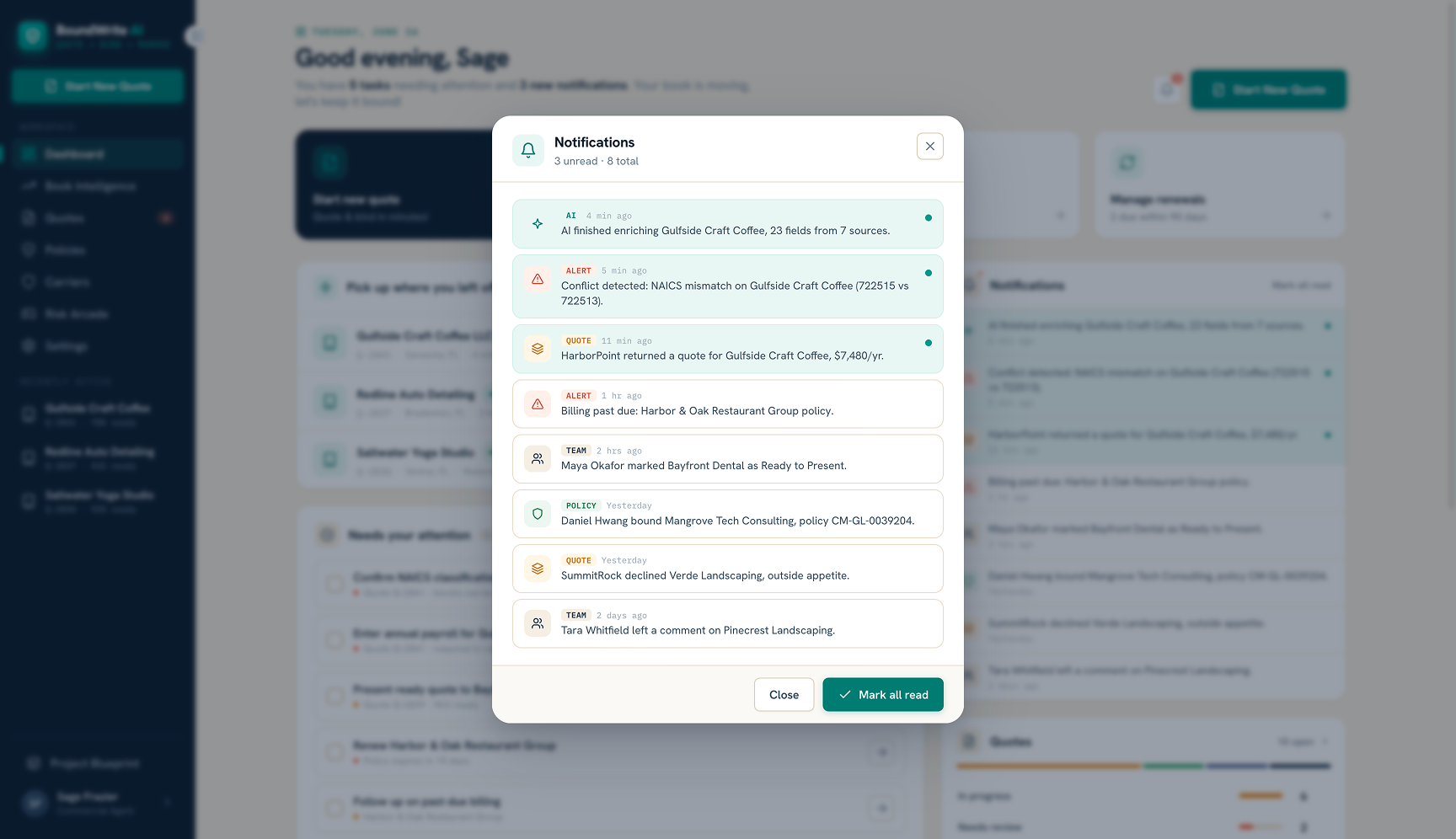
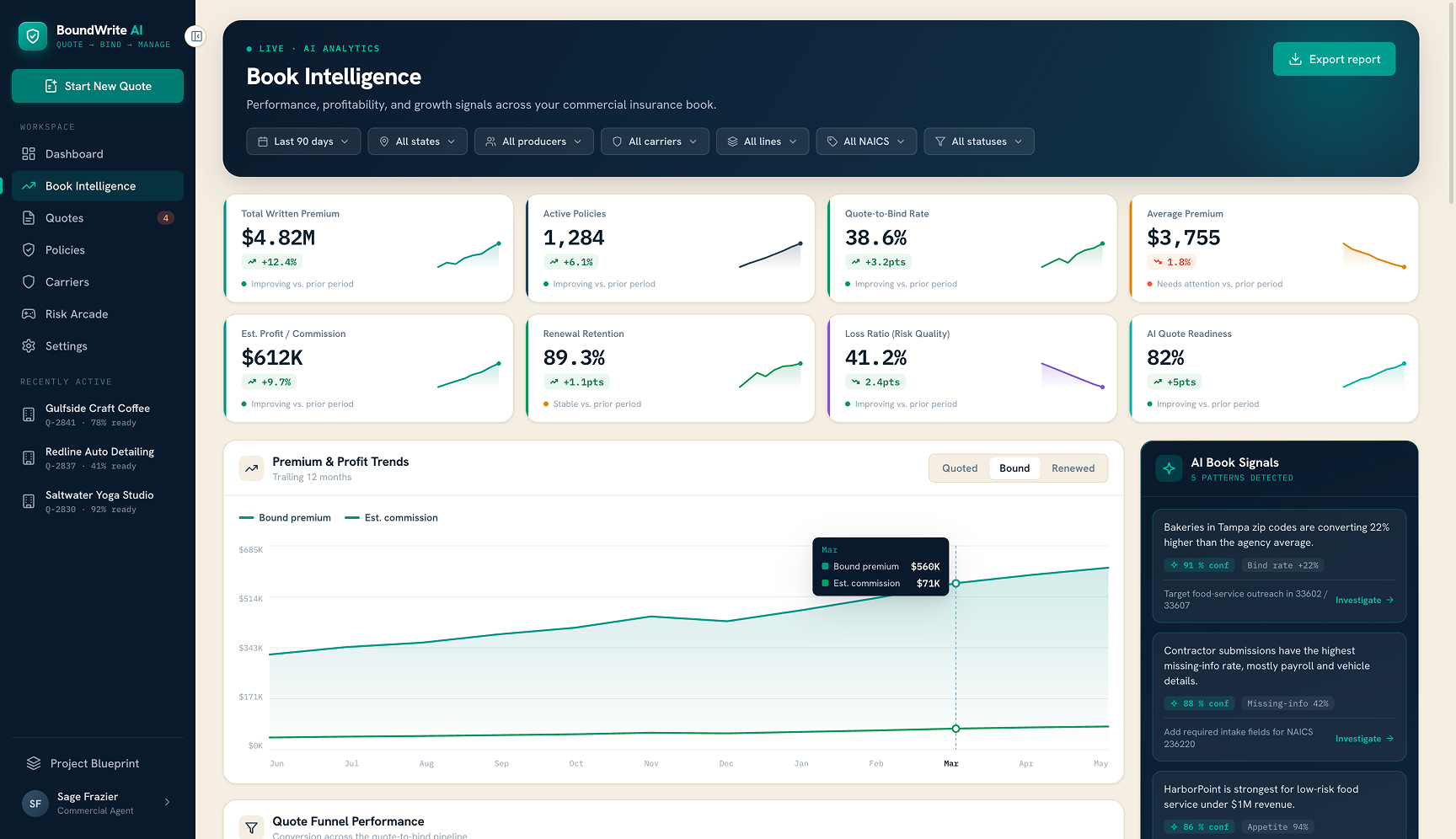
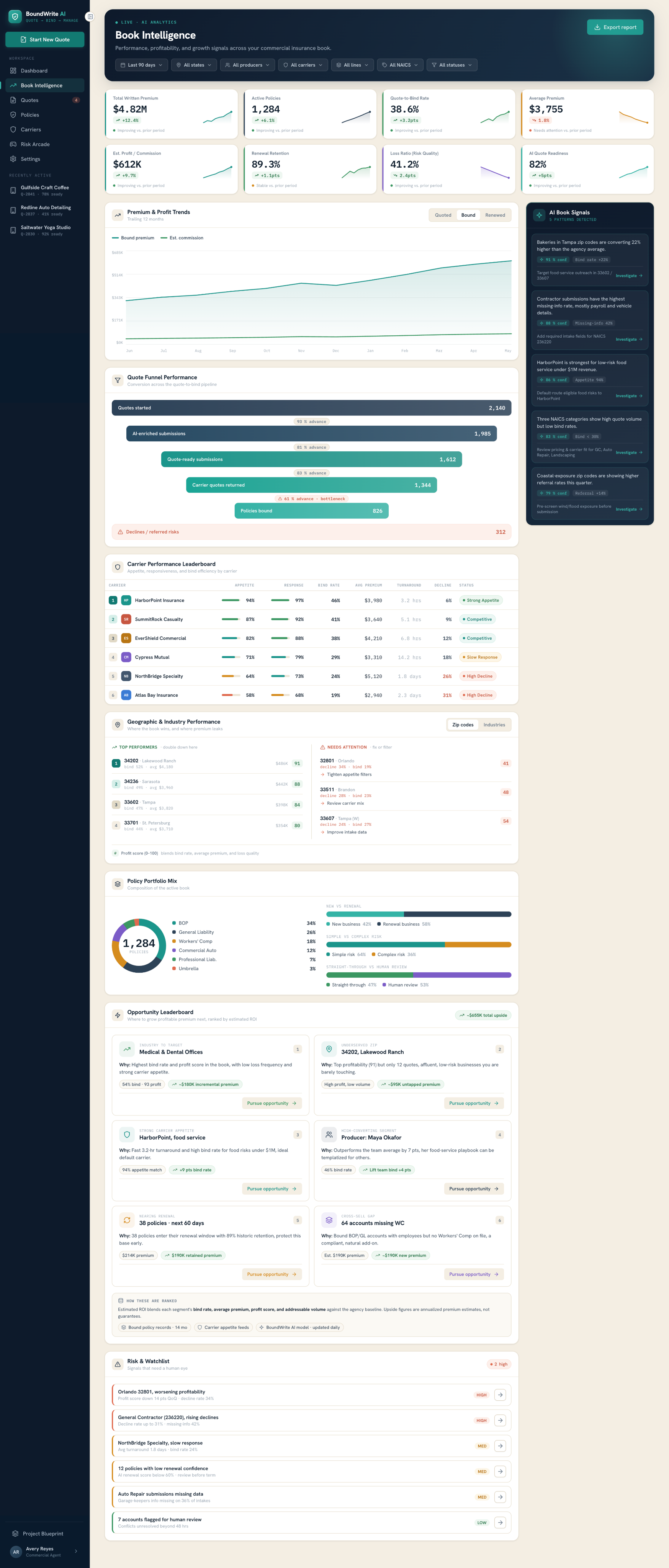
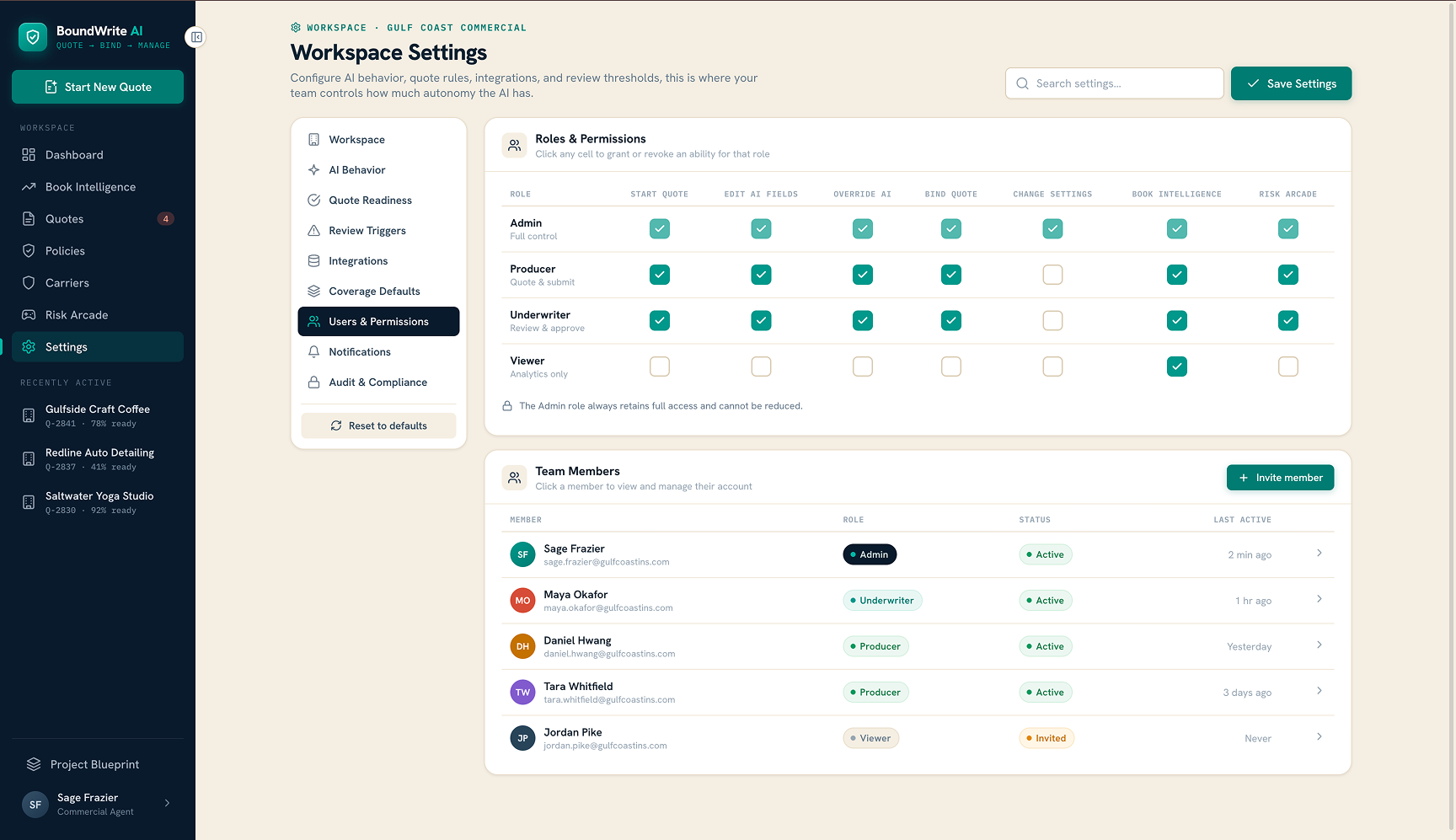
BoundWrite AI also includes a platform layer designed for visibility, configuration, and operational control. Dashboards can surface quoting activity, premium, bound policies, profitability, carrier performance, ZIP code trends, NAICS performance, and workflow bottlenecks, while admin tools support carrier setup, appointment status, state availability, coverage types, NAICS appetite, automation rules, and user settings. This expands the product from a single quoting workflow into a system that supports smarter business decisions and scalable operations. For portfolio viewers, this section highlights the ability to design for frontline users, leadership teams, and enterprise administrators within one connected product ecosystem.
11. Carrier Settings, Admin Controls & Scalable Product System
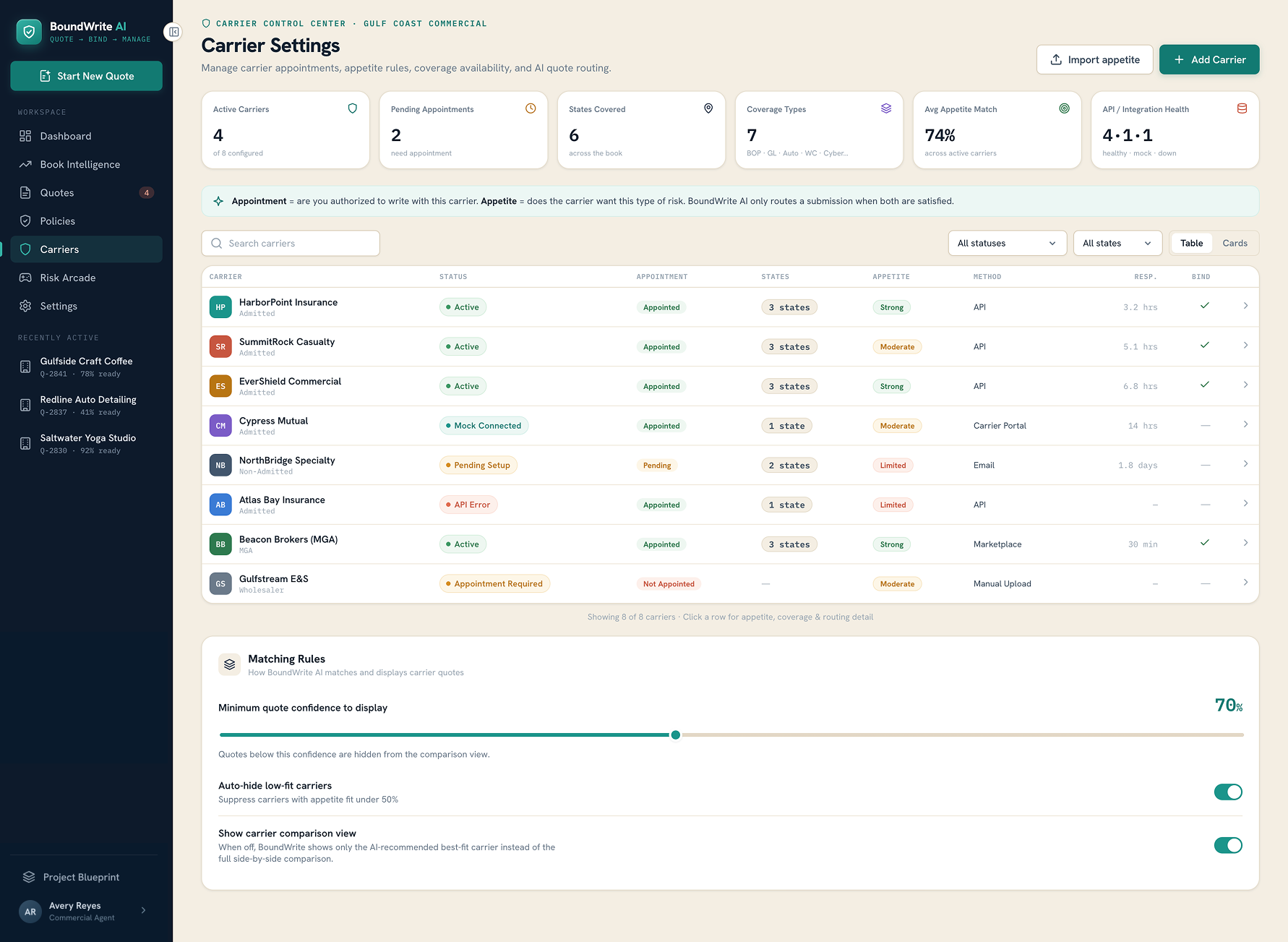
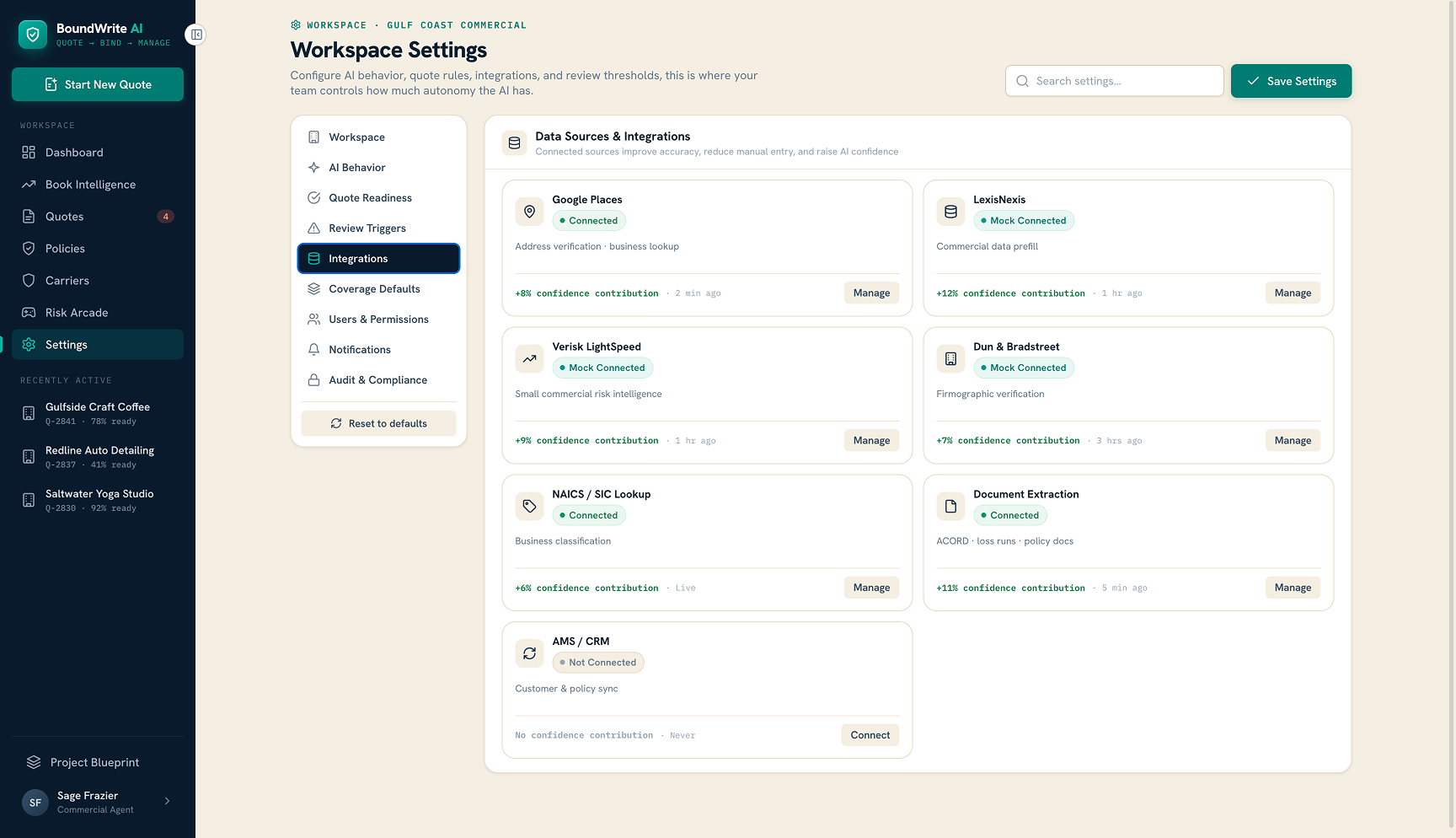
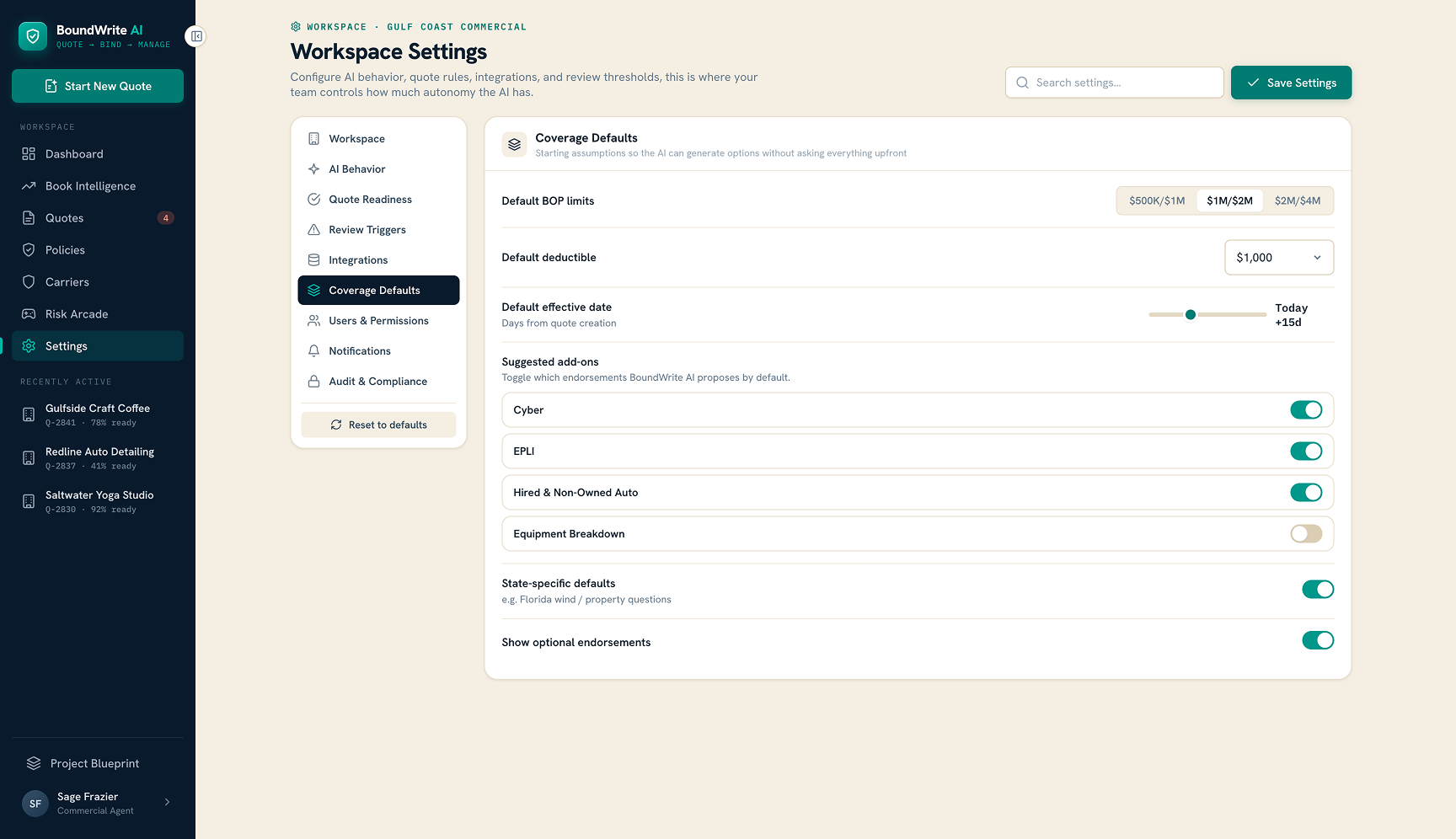
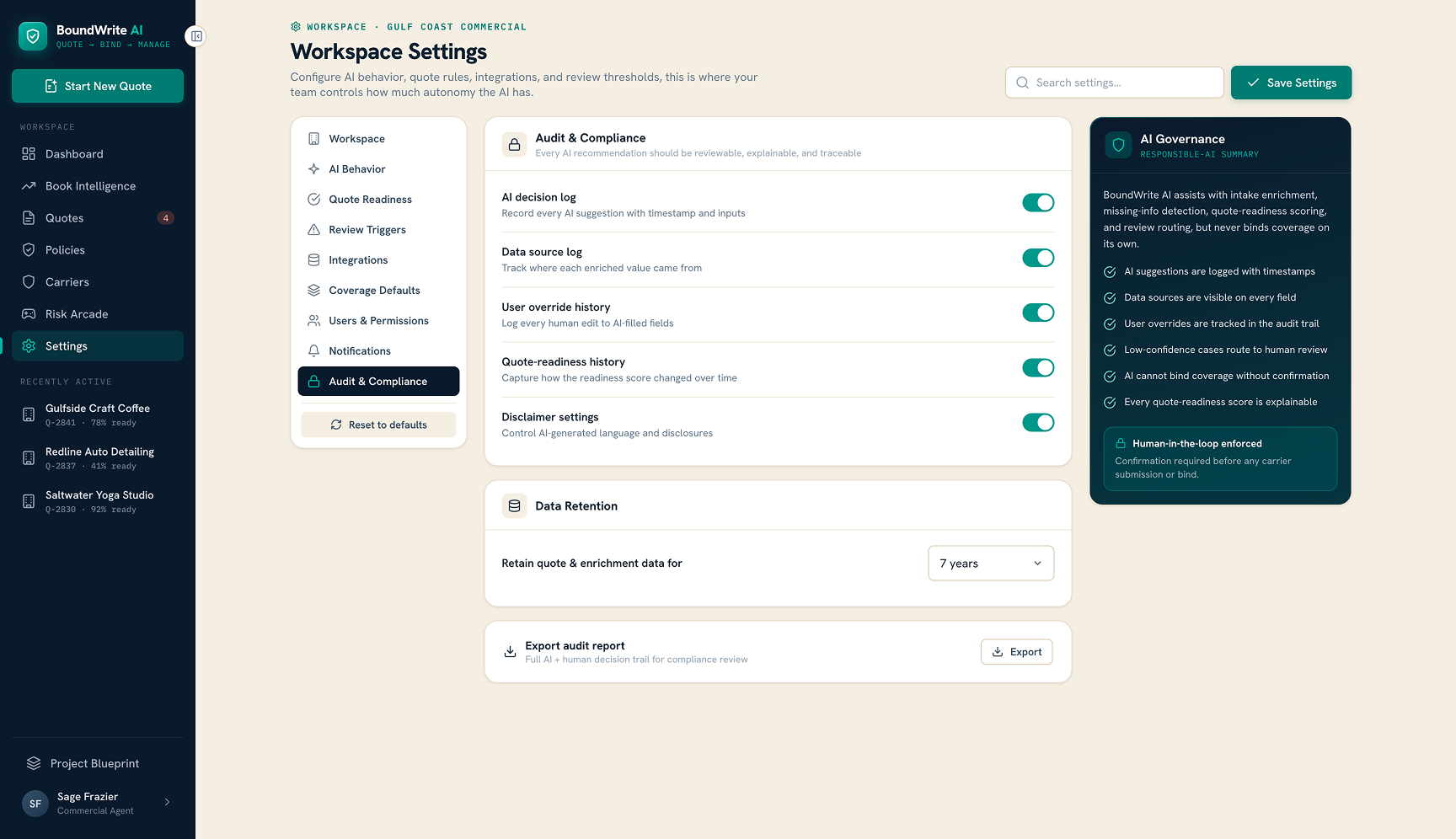
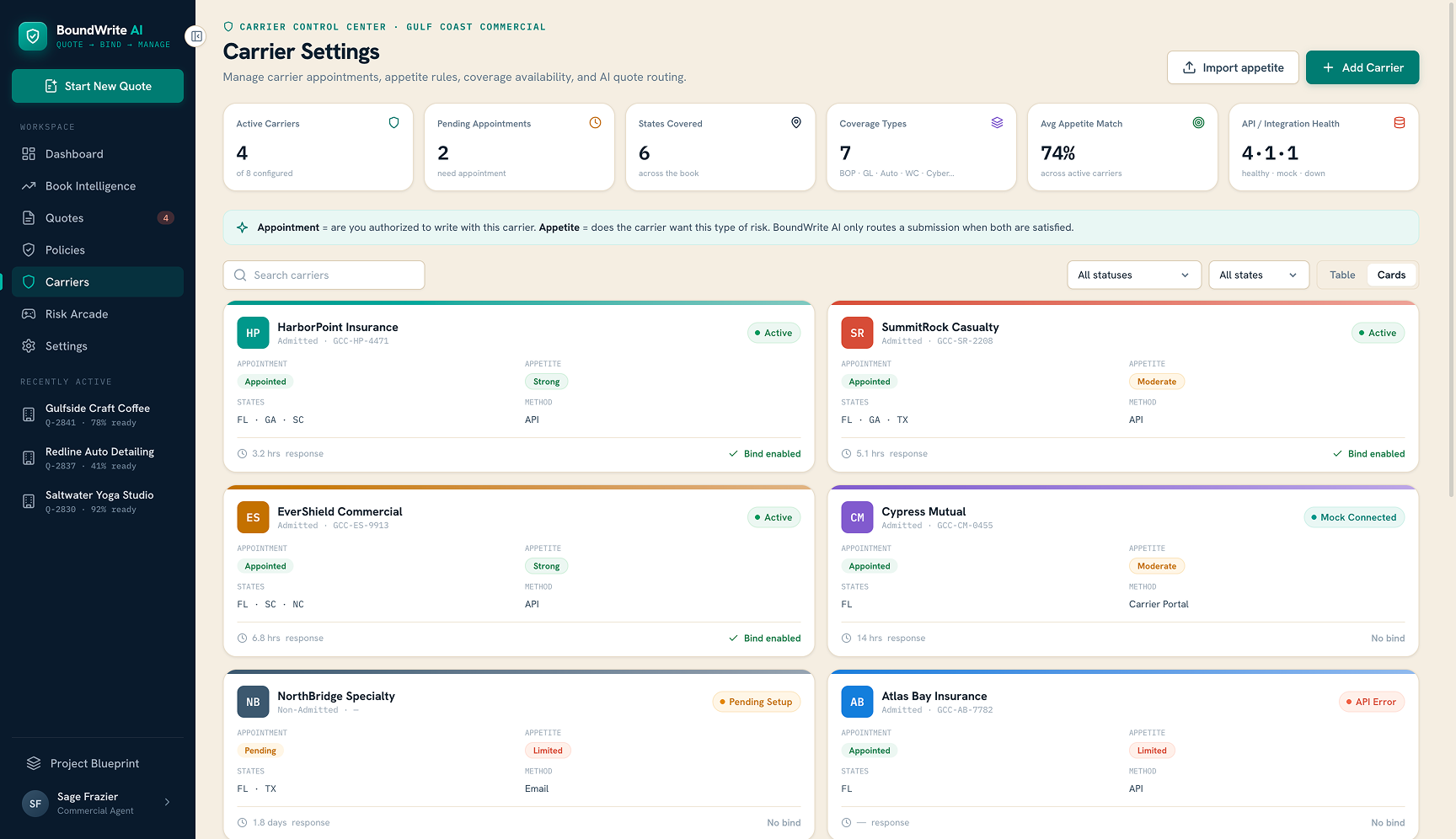
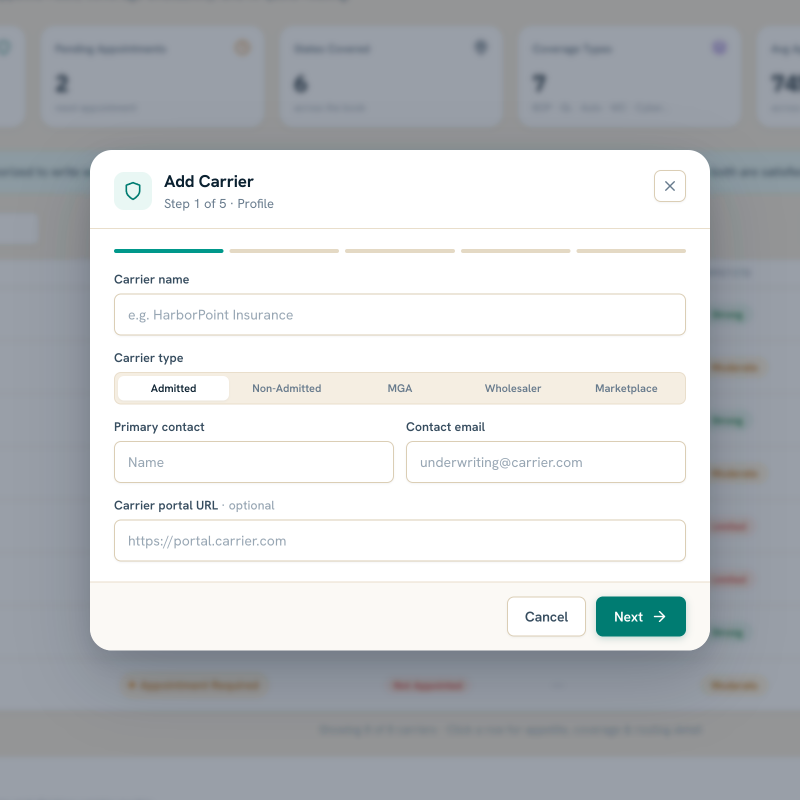
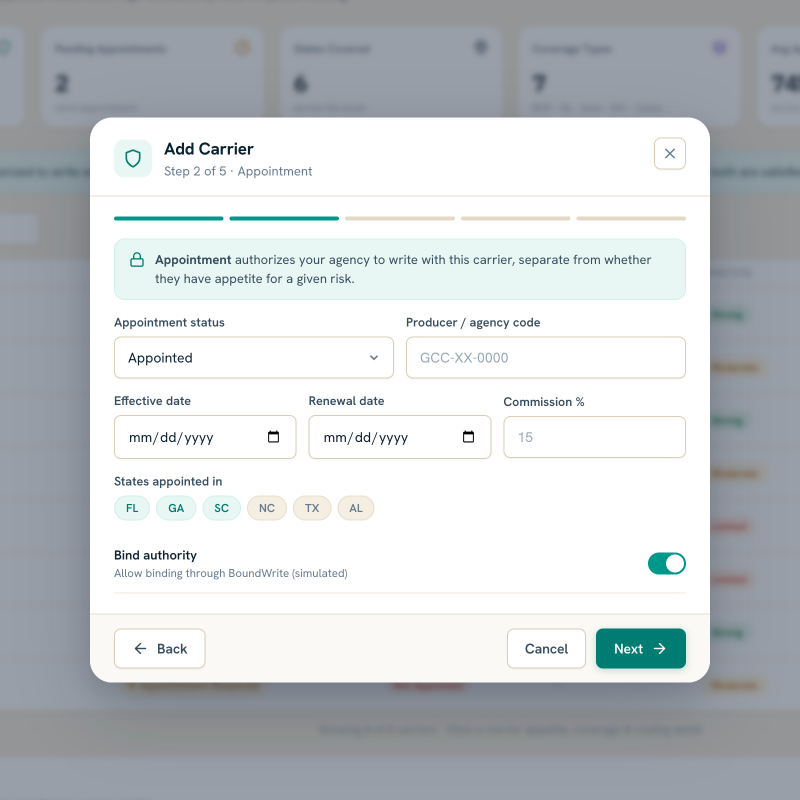
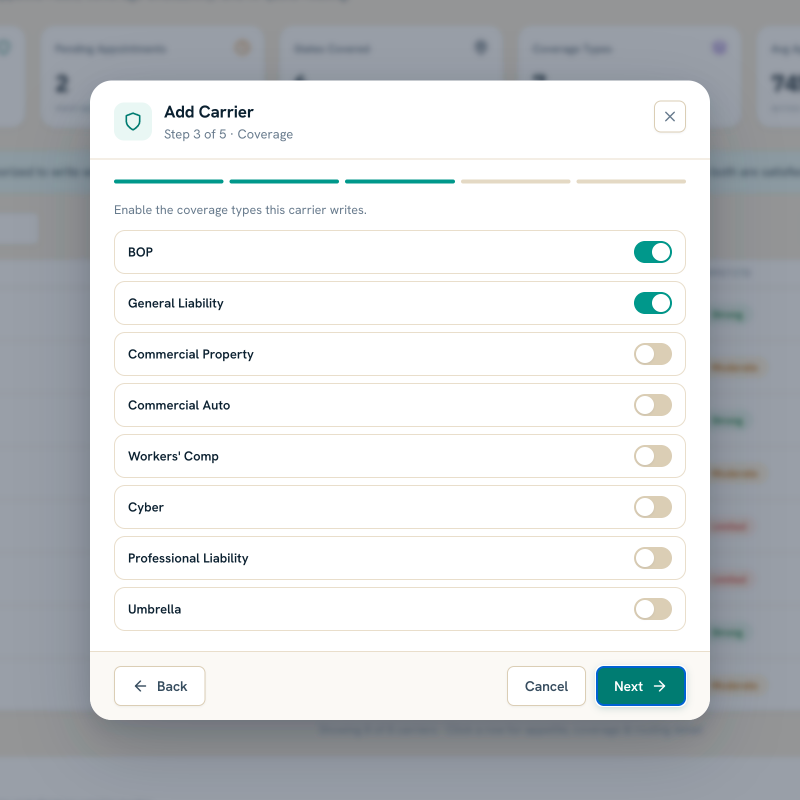
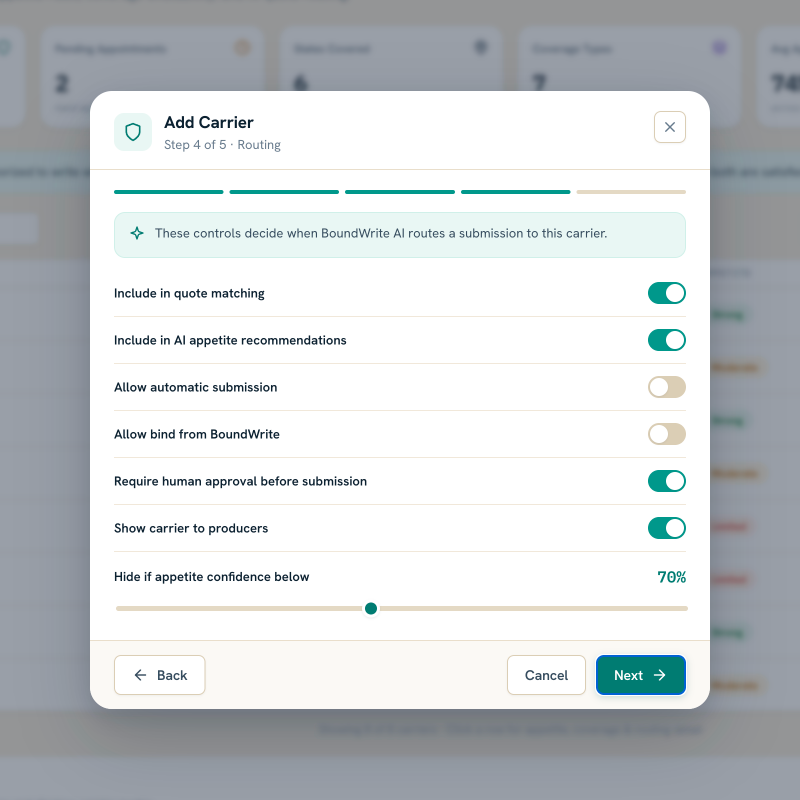
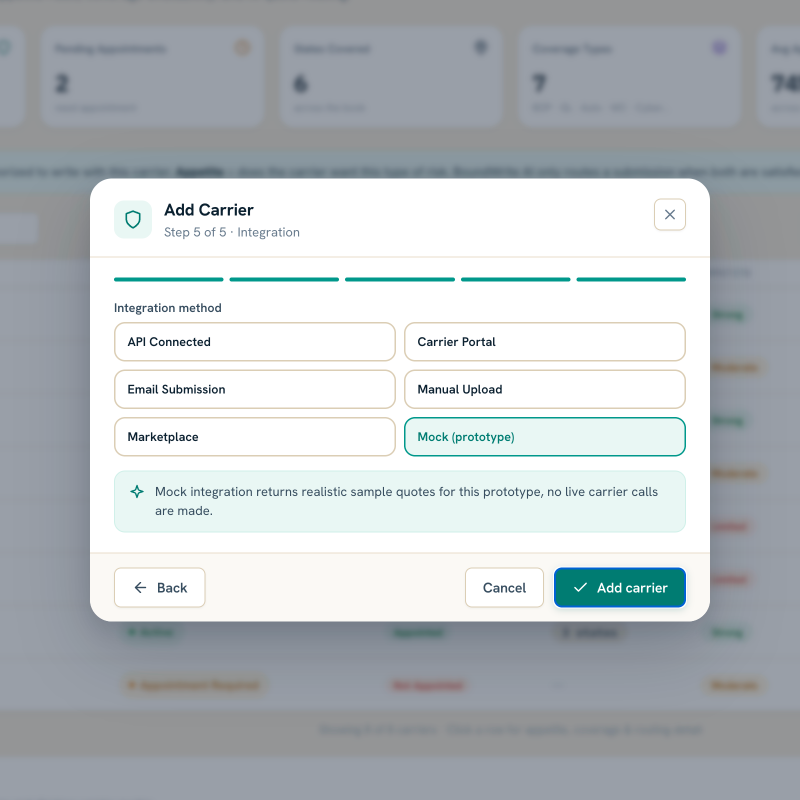
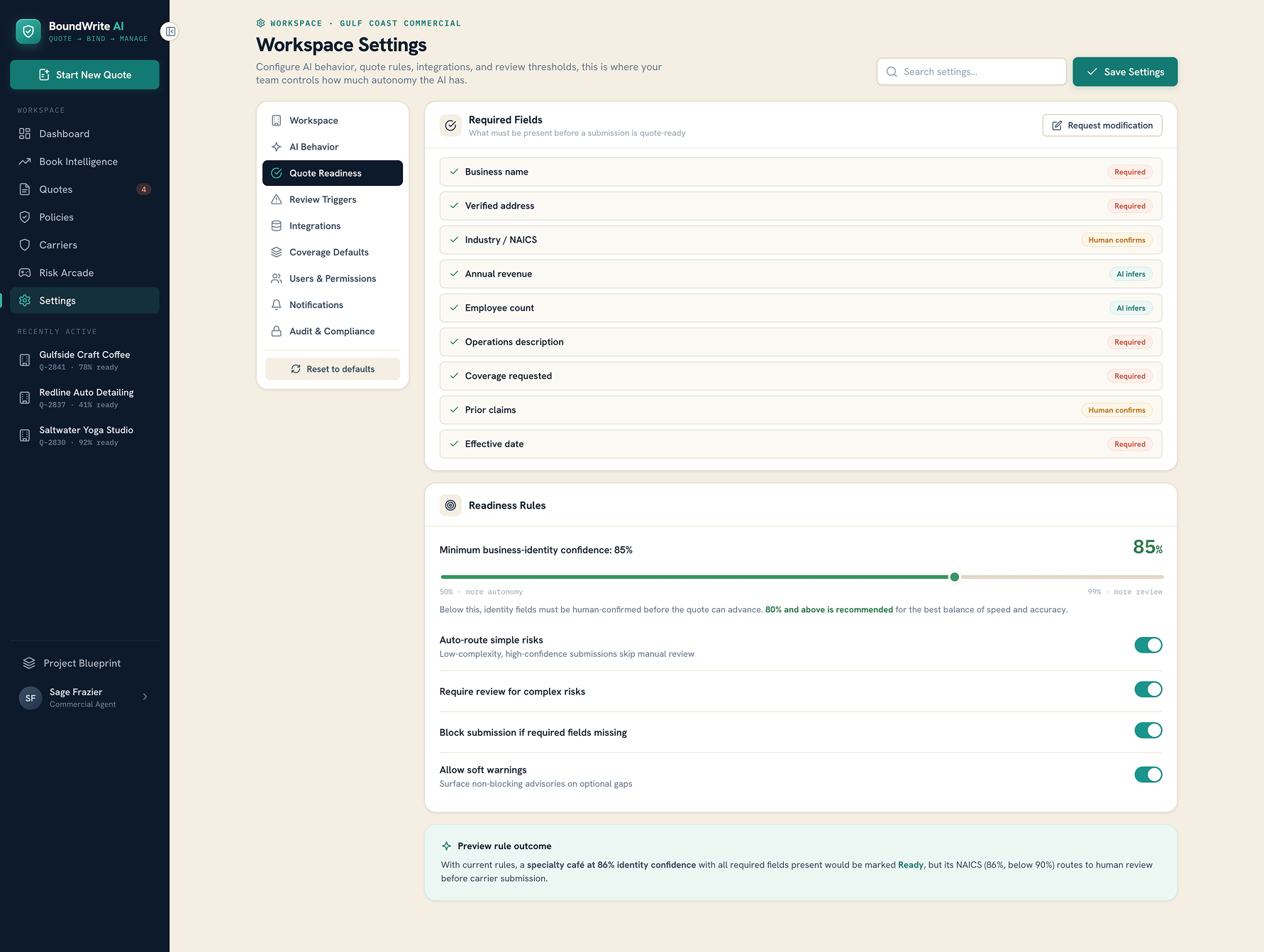
To support real-world insurance complexity, BoundWrite AI includes administrative tools for configuring carriers, appointments, state availability, coverage types, NAICS appetite, automation rules, and user settings. This section shows how the product could scale across agencies, carriers, states, and lines of business without requiring every workflow to be custom-built from scratch. The design emphasizes flexibility, governance, and maintainability. It reinforces BoundWrite AI as a scalable enterprise product system, not just a concept for a single quoting flow.
12. Design System, UX Patterns & Scalable Product Architecture
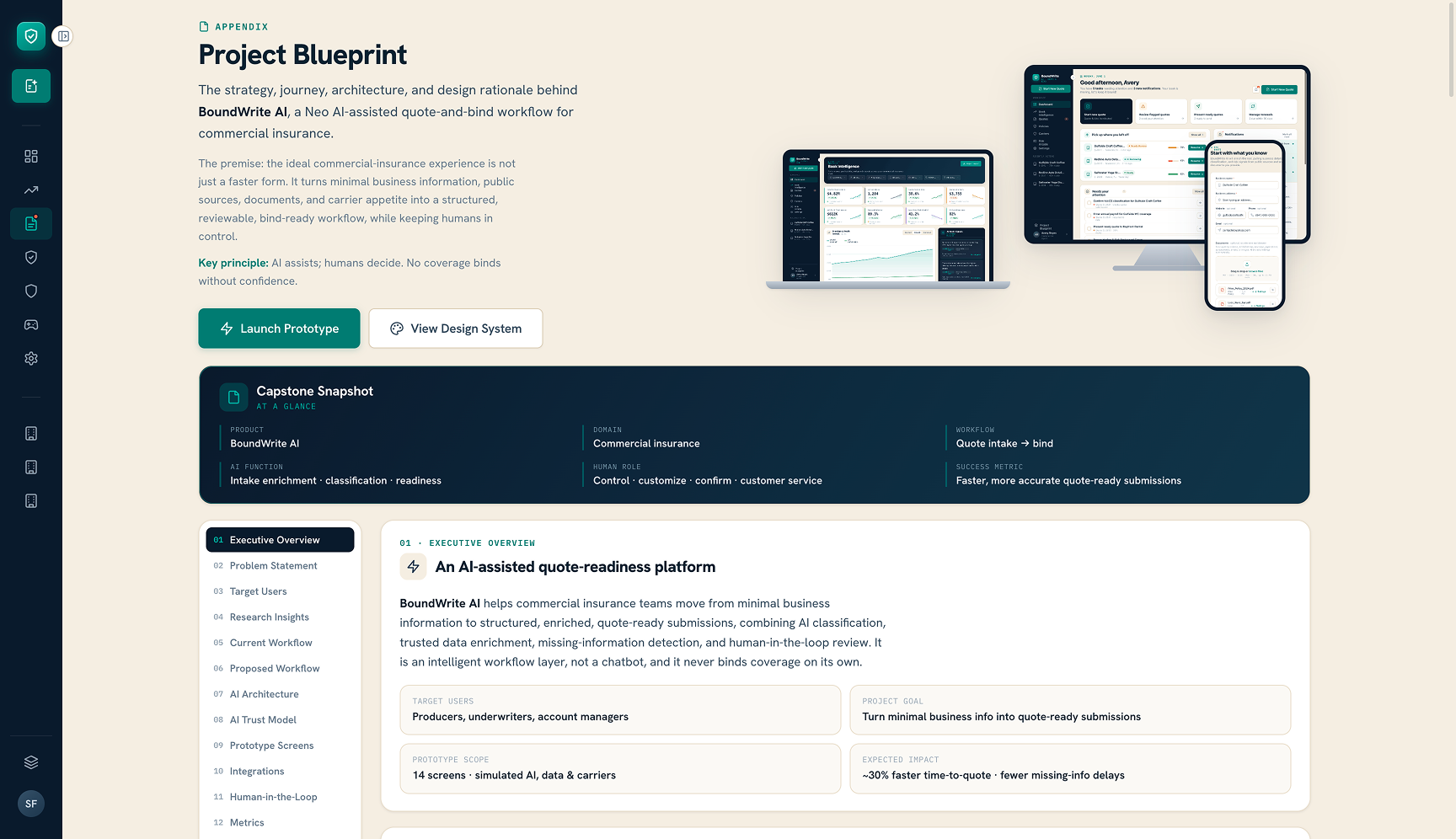
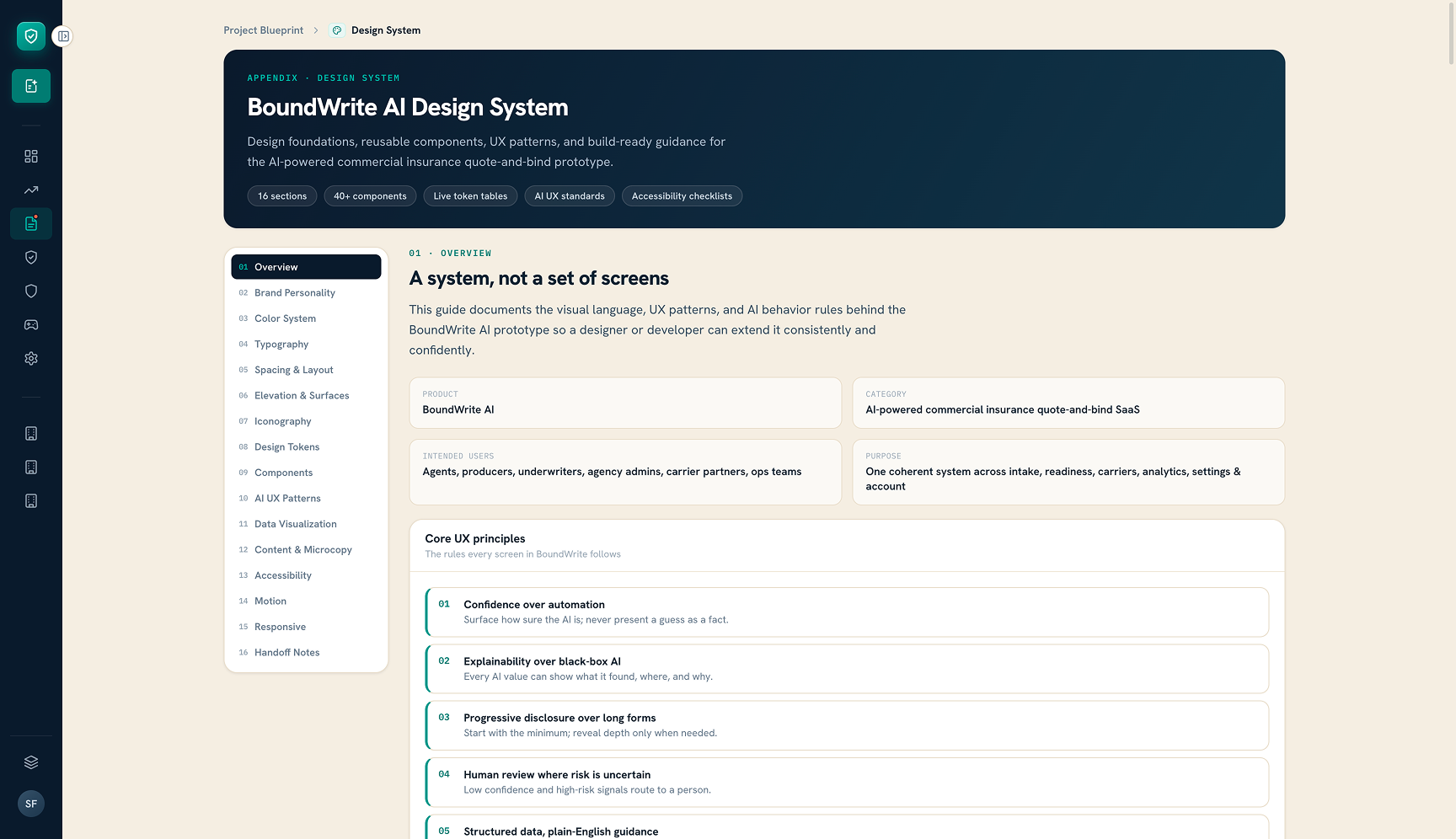
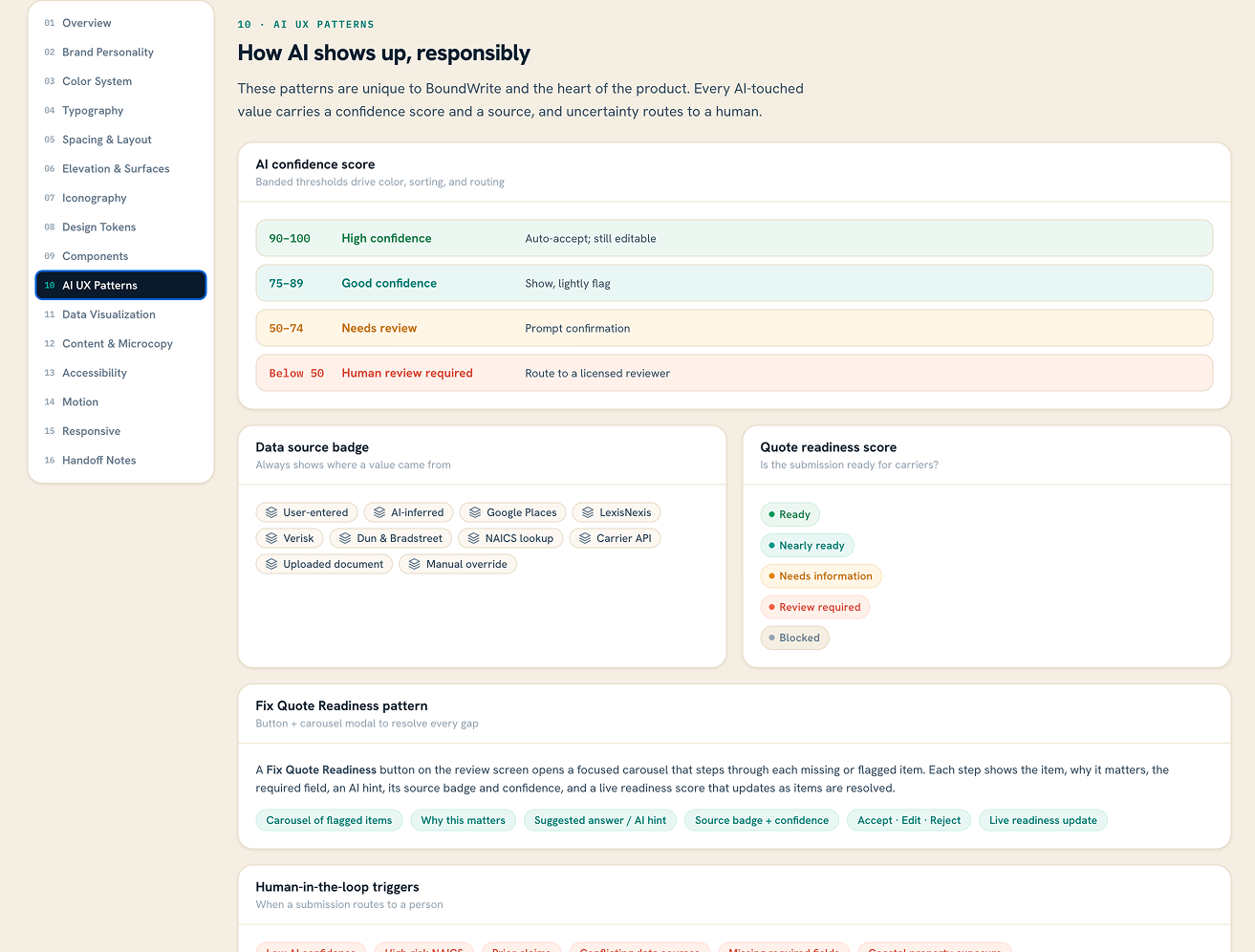
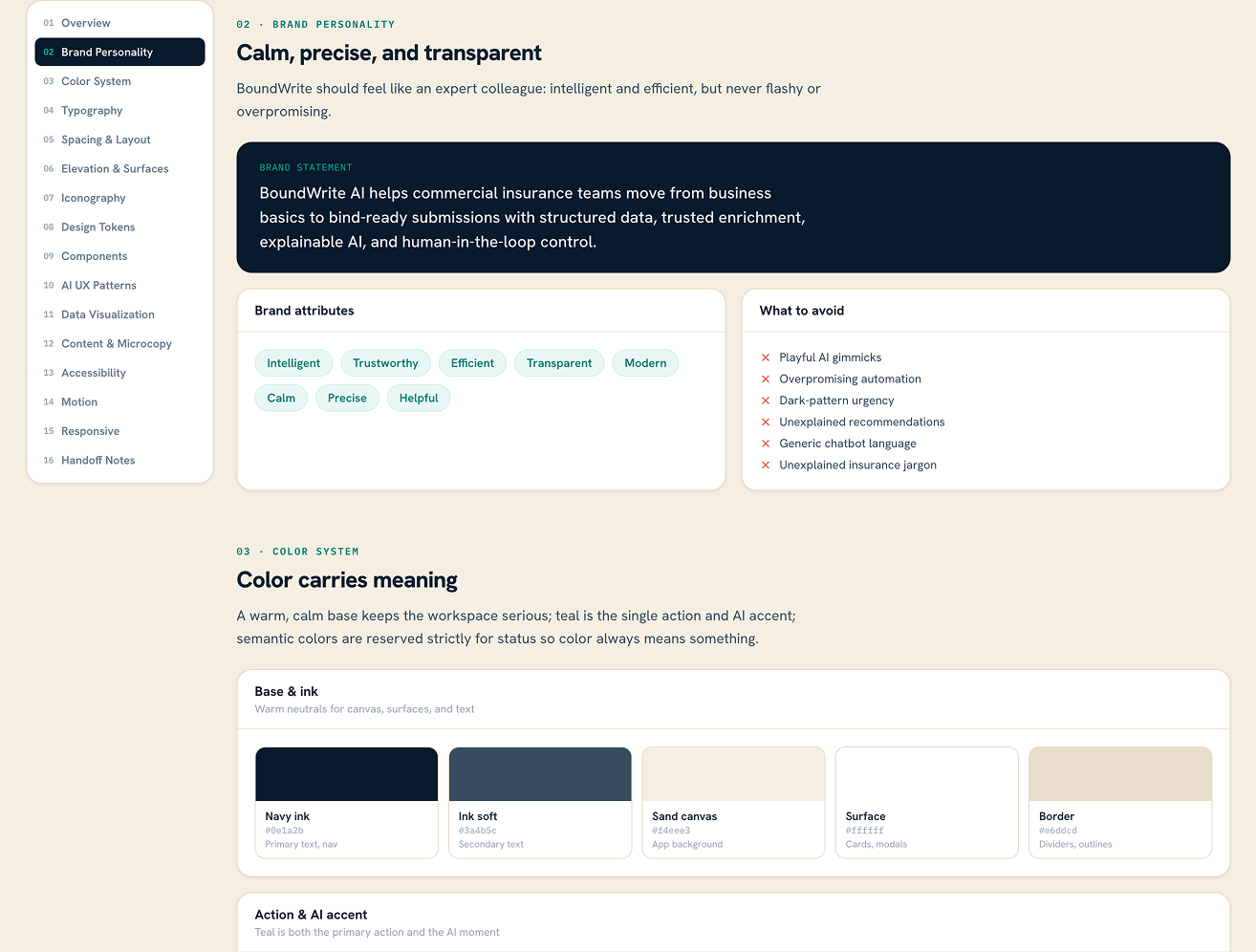
The final section should show how BoundWrite AI was designed as a scalable product system rather than a collection of disconnected screens. The design system can include foundational components, layout rules, form patterns, AI disclosure patterns, confidence states, alert styles, data tables, review cards, navigation structures, and accessibility considerations. This section demonstrates the product maturity behind the interface and shows how consistent UX patterns can support faster delivery, better usability, and long-term maintainability. It is also a strong way to close the case study because it reinforces your principal-level design strengths: systems thinking, product architecture, and the ability to create reusable patterns for complex enterprise software.
Interactive Prototype
Launch the interactive prototype to explore the AI-enhanced Quote & Bind Flow, Intelligence Dashboards, Risk Arcade, Carrier & AI Settings and the Project Blueprint including the Design System Library. View from a tablet or larger for the best experience.